










Global ISO Certification Consultant Services – Qualitcert

QualitCert Get a Quote

ISO Certifications

Mutt

rah

Consulting &

ISO Certifications

-ISO Certification-

SOC II Certification Services in Muttrah

QUALIT

CERT

CONSULTING AND ISO CERTIFICATIONS

Qualitcert is a trusted provider of SOC II (Service Organization Control II) certification services in Muttrah, helping organizations in the technology and service sectors establish robust controls for managing data security, availability, processing integrity, confidentiality, and privacy. SOC II is a widely recognized standard designed to ensure that service providers securely manage data to protect the interests and privacy of their clients. Qualitcert’s experienced consultants guide organizations through the entire certification process, from conducting readiness assessments and identifying control gaps to implementing effective measures and preparing for the final audit. Their services include developing comprehensive documentation and providing staff training to ensure compliance with SOC II requirements. By achieving SOC II certification with Qualitcert’s support, companies in Muttrah can demonstrate their commitment to maintaining high standards of data protection, building customer trust, and gaining a competitive advantage in the market. With a focus on tailored solutions and industry best practices, Qualitcert empowers businesses to strengthen their security posture and ensure continuous compliance with SOC II standards in an evolving digital landscape.

Please Reach Us Today

Test
Consultants Consultants
afd9a249 perf wp theme group 8796 Consultants Consultants

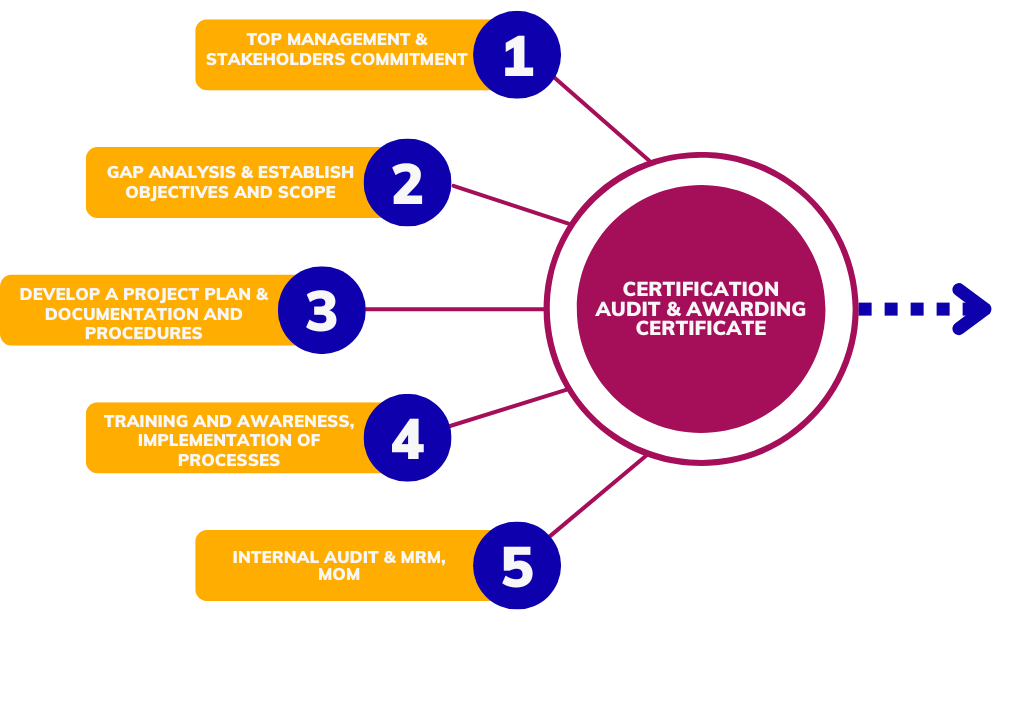
Approach and Methodology used to implement Management System Standard

Colorful Minimalist Linear Steps Circular Diagram 1 e1712599893569 Consultants Consultants

Implementing an ISO standards involves a structured methodology to ensure that the organization effectively meets the requirements of the chosen standard and achieves certification. Sometimes defined methodology may vary depending on factors such as the size of the organization, its industry, and the complexity of the ISO standard being implemented, the following steps provide a basic framework

Ellipse 6 copy Consultants Consultants

OUR

Process

1, Determine the ISO Standard

2. Understand the Requirements

3. Training and Awareness

4. Implement the System

5. Internal Audit

6. Certification

partner_img Consultants Consultants

Benefits of having ISO Certification

Enhanced Credibility and Reputation

Legal and Regulatory Compliance

Enhanced Customer Satisfaction

Access to Global Markets

Environmental Sustainability

Information Security

Our Achievements and Success

Professional Experts
0 +
Years Experience
0 +
Projects
0 +
Satisfied Customers
0 %

Our Clients

WhatsApp Image 2023 05 12 at 8.24.31 PM e1684164170667
WhatsApp Image 2023 05 12 at 8.16.53 PM e1684163940587
WhatsApp Image 2023 05 12 at 8.22.55 PM
WhatsApp Image 2023 05 12 at 8.04.13 PM 3 e1684163886384
WhatsApp Image 2023-05-12 at 8.15.32 PM

OUR

SERVICES

ISO 9001 Certification
ISO 45001 Certification
ISO 14001 Certification
ISO 22000 Certification
ISO 13485 Certification
ISO 27001 Certification
ISO 20000-1 Certification
ISO 29001 Certification
SOC 2 in Muttrah

SOC 2 Readiness in Muttrah for Trust-Centred Trust Services Criteria and service assurance

SOC 2 readiness in Muttrah works best when the organisation defines its system and customer commitments before writing a control matrix. Evidence becomes inefficient when Trust Services categories are chosen without purpose, subservice organisations are omitted and controls are worded more strongly than operations can support.

Define the service system before building assurance controls

SOC 2 readiness in Muttrah works best when the organisation defines its system and customer commitments before writing a control matrix; for SOC 2 in Muttrah, this point is applied to the current operating model.

SOC 2 is an independent attestation report focused on controls relevant to applicable Trust Services Criteria. The operating design needs to connect system description, Trust Services Criteria and risk assessment with identity and change control, vendor and incident governance and period evidence; otherwise individual controls can appear complete while the overall outcome remains weak.

Evidence becomes inefficient when Trust Services categories are chosen without purpose, subservice organisations are omitted and controls are worded more strongly than operations can support; for SOC 2 in Muttrah, this point is applied to the current operating model.

Qualitcert can support the organisation in turning Trust Services Criteria and service assurance into responsibilities, evidence, internal review and improvement actions that fit actual Muttrah operations.

Operating Context in Muttrah

Trust assurance depends on a stable service boundary

The controls need to fit real handoffs, suppliers, technology and operating conditions rather than an abstract model; for SOC 2 in Muttrah, this point is applied to the current operating model.

Ownership of system description should remain visible whenever work crosses teams, systems or external providers; unclear handoffs can weaken an otherwise well-designed control.

Risk assessment needs an explicit trigger for reassessment when risk, technology, suppliers, workload or stakeholder needs change.

Results from period evidence should lead to a decision, correction or improvement instead of being recorded without changing how the process is managed.

Practical Value of SOC 2

What focused SOC 2 readiness changes before examination

The business value comes from stronger Trust Services Criteria and service assurance and clearer decisions, not from increasing document volume.

The service boundary becomes understandable

Applications, infrastructure, people and providers are described around the system customers rely on.

Criteria selection remains purposeful

Trust Services categories are included because commitments and risk justify them.

Evidence routines become repeatable

Teams know which records must exist throughout the examination period.

Provider dependencies become visible

Subservice organisations are reflected in the system description and control approach.

Applications Across Muttrah

Muttrah digital services with different Trust Services priorities

Different sectors need different examples, evidence and control depth even when they use the same framework; for SOC 2 in Muttrah, this point is applied to the current operating model.

01

SaaS providers — Trust Services Criteria and service assurance application

In Muttrah, saas providers can use SOC 2 to demonstrate security and other applicable trust controls; the controls should follow the real workflow and the consequence of failure in that environment.

02

Managed IT providers — Trust Services Criteria and service assurance application

In Muttrah, managed it providers can use SOC 2 to show governance over access, incidents and suppliers; the controls should follow the real workflow and the consequence of failure in that environment.

03

Cloud application businesses — Trust Services Criteria and service assurance application

In Muttrah, cloud application businesses can use SOC 2 to provide assurance around change, logging and resilience; the controls should follow the real workflow and the consequence of failure in that environment.

04

Fintech services — Trust Services Criteria and service assurance application

In Muttrah, fintech services can use SOC 2 to address security, availability and processing commitments; the controls should follow the real workflow and the consequence of failure in that environment.

05

Healthcare technology — Trust Services Criteria and service assurance application

In Muttrah, healthcare technology can use SOC 2 to demonstrate controls over sensitive services; the controls should follow the real workflow and the consequence of failure in that environment.

06

Outsourced business services — Trust Services Criteria and service assurance application

In Muttrah, outsourced business services can use SOC 2 to provide independent evidence over the service control environment; the controls should follow the real workflow and the consequence of failure in that environment.

How SOC 2 Works in Practice

Move from service commitments to stable examination-period evidence

This sequence follows the specific control logic of SOC 2 rather than a generic readiness routine.

01

Clarify the boundary for system description

Name the accountable owner, intended result and decision authority for system description.

02

Observe how Trust Services Criteria works today

Use current records and interviews to understand how Trust Services Criteria behaves in real work.

03

Prioritise criteria for risk assessment

Make choices around risk assessment repeatable by defining criteria and escalation.

04

Control identity and change control through normal responsibilities

Embed identity and change control in everyday roles instead of a separate audit-only routine.

05

Test evidence around vendor and incident governance

Monitor vendor and incident governance, retain exceptions and verify that follow-up happens.

06

Improve the system using period evidence

Use period evidence to decide whether correction, resources or a broader change is required.

Evidence That Matters

Records that make Trust Services Criteria and service assurance understandable without reconstruction

Evidence should be current, attributable and tied to an actual decision, activity or exception; for SOC 2 in Muttrah, this point is applied to the current operating model.

Operating evidence for SOC 2 in Muttrah

  • SOC 2 system description, showing the approved boundary and current owner
  • TSC mapping, with responsibilities and review status visible
  • Control matrix, linked to actual operating decisions
  • Risk assessment, showing how changes are approved
  • Access evidence, supported by implementation evidence
  • Change records, with current monitoring or evaluation results
  • Logging and incident evidence, showing relevant approvals and exceptions
  • Vendor assessments, retained for traceability and follow-up
  • Availability evidence, connected to corrective or improvement actions
  • Readiness testing tracker, used as an input to leadership review
For SOC 2, process owners should be able to explain why each record exists and which decision or control it supports.

Weak points that deserve attention before formal review — focused on Trust Services Criteria and service assurance — applied to the current operating model

For SOC 2, these patterns can make documented expectations look stronger than everyday practice.

  • The system description excludes material suppliers. The issue may remain hidden until a real exception occurs.
  • Control wording uses unsupported absolutes. That often creates inconsistent evidence between people or shifts.
  • Evidence is created only when requested. Management then has less reliable information for decisions.
  • TSC categories are added without a rationale. The control may exist without a clear measure of effectiveness.
  • Subservice responsibilities are unclear. The same weakness can return because the underlying cause remains.
Closing these SOC 2 weaknesses early improves the operating system and reduces last-minute evidence repair.
Related Management Areas

Where the same process also depends on broader management controls, consider for SOC 2 ISO/IEC 27001 in Muttrah.

A second discipline that can strengthen connected responsibilities is VAPT in Muttrah.

For another governance or assurance perspective, review PCI DSS in Muttrah.

SOC 2 Questions

Questions process owners should answer with real SOC 2 evidence

These questions test whether SOC 2 is understood, operated and reviewed during normal work.

What should a Muttrah service provider define before choosing SOC 2 controls?

Define the customer-facing system, applications, infrastructure, people, data, suppliers and service commitments.

Is SOC 2 a certification?

No. It is an independent attestation report.

Why is Security the foundation of SOC 2?

The common criteria provide the baseline for protecting the service system and information.

When should Availability be included?

When uptime, resilience or recovery commitments are material to the service customers rely on.

How should a SOC 2 control be written?

State what is done, who performs it, how often and what evidence demonstrates operation.

Why can absolute wording create exceptions?

Words such as 'always' create conditions that may not match approved variations or real practice.

How should subservice organisations be represented?

Describe material providers, the approach to their controls and the responsibilities retained internally.

How do Type 1 and Type 2 reports differ?

Type 1 addresses design at a point in time; Type 2 also addresses operating effectiveness over a period.

What should readiness testing achieve?

It should reveal design, evidence and consistency gaps before the formal examination period.

How can Qualitcert support SOC 2 readiness in Muttrah in the SOC 2 operating context for Muttrah?

Qualitcert can support system scoping, criteria mapping, control design, evidence sampling and readiness before independent attestation.

Next Step with SOC 2

Take one customer trust commitment and prove the control can operate for months

Choose one material area—identity and change control—and follow it from ownership through criteria, evidence, exceptions and improvement decisions.

View SOC 2 Services in Muttrah — SOC 2 Muttrah →
Scroll to Top