Global ISO Certification Consultant Services – Qualitcert

QualitCert Get a Quote

ISO Certifications

zarqa

Consulting &

ISO Certifications

-ISO Certification-

SOC I Certification Services in Zarqa

QUALIT

CERT

CONSULTING AND ISO CERTIFICATIONS

Qualitcert’s SOC I(System and Organization Controls I) certification services in Zarqa are intended to assist companies in proving to stakeholders, auditors, and clients that they have internal controls over financial reporting. In order to ensure that businesses adhere to compliance rules and reduce financial risks, SOC I reports concentrate on evaluating the efficacy of controls pertaining to financial processes. From the first assessment and gap analysis to the control implementation and final audit, Qualitcert offers professional advice throughout the whole certification process. With the help of a group of skilled auditors, they make sure Zarqa businesses fulfill the strict requirements needed to obtain SOC I accreditation, which raises their reputation and dependability in the financial services industry. Organizations that provide outsourced services, particularly those that handle sensitive financial data, must have this accreditation.

Please Reach Us Today

Test
afd9a249 perf wp theme group 8796

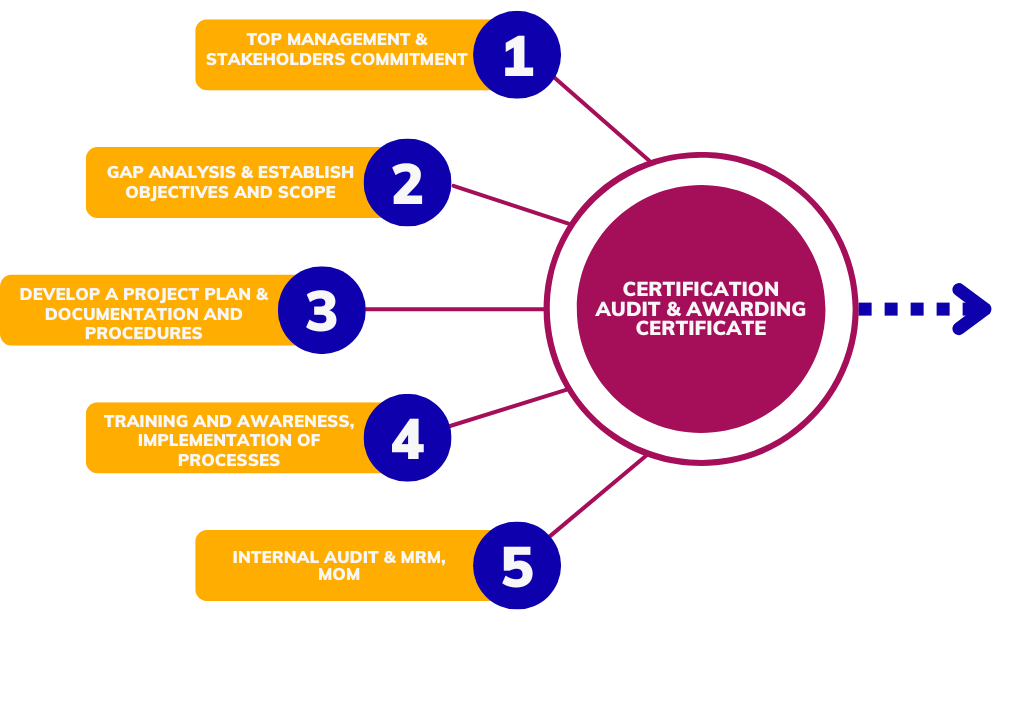
Approach and Methodology used to implement Management System Standard

Colorful Minimalist Linear Steps Circular Diagram 1 e1712599893569

Implementing an ISO  standards involves a structured methodology to ensure that the organization effectively meets the requirements of the chosen standard and achieves certification. Sometimes defined methodology may vary depending on factors such as the size of the organization, its industry, and the complexity of the ISO standard being implemented, the following steps provide a basic framework

Ellipse 6 copy

OUR

Process

1, Determine the ISO Standard

2. Understand the Requirements

3. Training and Awareness

4. Implement the System

5. Internal Audit

6. Certification

partner_img

Benefits of having ISO Certification

Enhanced Credibility and Reputation

Legal and Regulatory Compliance

Enhanced Customer Satisfaction

Access to Global Markets

Environmental Sustainability

Information Security

Our Achievements and Success

Professional Experts
0 +
Years Experience
0 +
Projects
0 +
Satisfied Customers
0 %

Our Clients

WhatsApp Image 2023 05 12 at 8.24.31 PM e1684164170667
WhatsApp Image 2023 05 12 at 8.16.53 PM e1684163940587
WhatsApp Image 2023 05 12 at 8.22.55 PM
WhatsApp Image 2023 05 12 at 8.04.13 PM 3 e1684163886384
WhatsApp Image 2023-05-12 at 8.15.32 PM

OUR

SERVICES

ISO 9001 Certification
ISO 45001 Certification
ISO 14001 Certification
ISO 22000 Certification
ISO 13485 Certification
ISO 27001 Certification
ISO 20000-1 Certification
ISO 29001 Certification
Financial Reporting Controls for Zarqa Service Providers

SOC 1 Certification Services in Zarqa for Internal Controls over Financial Reporting and Client Assurance

SOC 1 readiness helps Zarqa service organizations demonstrate that controls affecting clients’ financial reporting are suitably designed, documented and operating effectively.

Assurance over financial reporting controls

SOC 1 certification services in Zarqa are relevant for service organizations whose work can affect a client’s financial statements or internal controls over financial reporting. The focus is not general quality, cybersecurity or broad compliance; it is control assurance related to financial reporting.

Examples include payroll processing, billing support, claims processing, transaction processing, accounting support, fund administration, warehouse inventory services with financial relevance, outsourced finance operations and technology platforms that process financial transactions.

A SOC 1 engagement requires a clear description of the system, control objectives, control activities, responsibilities, user entity considerations, evidence of operation and management assertion. The organization must show that controls are not only documented but also performed consistently.

Qualitcert supports SOC 1 readiness by helping define system boundaries, map services to financial reporting risks, document control objectives, prepare control matrices, organize evidence, identify gaps, support remediation and prepare teams for independent assessment.

For Zarqa service providers working with clients that rely on outsourced processing, SOC 1 readiness can reduce repeated customer questionnaires and provide structured assurance to auditors, finance teams and governance stakeholders.

Client Assurance Context

Why SOC 1 Matters for Zarqa Outsourcing and Service Operations

When clients outsource a process that feeds their accounting, billing, inventory or transaction records, they need assurance that relevant controls are reliable.

A service provider may not prepare the client’s financial statements, but its work can still influence them. Incorrect payroll, inaccurate billing files, unauthorized transaction changes, inventory reconciliation failures or weak system access can create financial reporting risks.

SOC 1 readiness begins by defining the system. This includes services provided, locations, technology, people, procedures, data flows, subservice organizations and control boundaries.

Control objectives must be relevant. They may cover authorization, completeness, accuracy, timeliness, access control, change management, processing integrity, reconciliation, exception handling and segregation of duties.

Evidence is critical. Control owners should be able to show approvals, review logs, reconciliations, exception reports, access reviews, change records, incident records and supervisor sign-offs for the period under review.

The journey often uncovers process improvements. Clearer responsibilities, better exception tracking and more consistent review evidence can reduce operational errors as well as improve client assurance.

Implementation should start by identifying the points where the service provider’s work enters the client’s financial reporting process. A control that does not affect authorization, completeness, accuracy, timeliness or reporting may not belong in SOC 1 scope.

Policies and procedures should describe transaction processing, approvals, reconciliations, access rights, change control, exception handling, report generation and record retention. Control evidence should be retained consistently throughout the reporting period.

Risk management should focus on errors or unauthorized actions that could affect client financial information. This includes incorrect data entry, missed transactions, unapproved changes, duplicate processing, reconciliation failures and access misuse.

Internal readiness review should test whether control evidence matches the control description and frequency. Management should review gaps before the examination period so control owners have time to correct weak practices.

A comprehensive SOC 1 readiness file should include user entity control considerations. Some control objectives rely on clients performing approvals, providing accurate input data, reviewing reports or restricting their own user access.

Control owners should understand evidence expectations before the examination period begins. If a review is weekly, monthly or per transaction, the record should show performance, reviewer, date, exceptions and follow-up.

Continual improvement in SOC 1 comes from exception trends, customer feedback, internal testing, access issues, late reconciliations and processing errors. These inputs help refine controls before client auditors raise concerns.

Required documentation should also define service commitments, system boundaries and any subservice organizations. If a third party supports hosting, processing or workflow tools, management should understand how that affects control assurance.

Best practice is to create a control evidence calendar before the reporting period. This helps control owners know what must be retained daily, weekly, monthly, quarterly or for each transaction.

Management review should evaluate control exceptions, client questions, internal testing outcomes, system changes and remediation status. This prevents readiness work from becoming a one-time report preparation exercise.

Assurance Value

SOC 1 Benefits for Zarqa Service Organizations

SOC 1 can strengthen client trust when financial reporting controls are central to the outsourced service.

Client auditor support

A SOC 1 report can help client auditors understand and evaluate controls at the service organization.

Reduced repeated questionnaires

Documented control objectives and evidence can reduce the need to answer the same control questions for every client.

Improved control discipline

Control owners gain clearer responsibilities for approvals, reconciliations, access reviews and exception handling.

Stronger outsourcing credibility

Service providers can demonstrate that financially relevant services are governed by a structured control environment.

Service Applications

Where SOC 1 Applies in Zarqa

SOC 1 is appropriate when the service provided may affect client financial reporting or related control processes.

01

Payroll and HR processing

Control employee data, payroll calculations, approvals, changes, payments, exceptions and confidentiality of payroll records.

02

Billing and collections support

Manage pricing files, invoice generation, adjustments, approval workflows, reconciliations and exception handling.

03

Inventory and warehouse services

Support controls over stock movement, cycle counts, inventory reports, customer-owned goods and reconciliations.

04

Accounting support services

Control journal support, data entry, reconciliations, document retention, approval and segregation of duties.

05

Transaction processing platforms

Document access, change management, processing accuracy, completeness, exception reporting and system monitoring.

06

Claims or benefit administration

Control eligibility, claim entry, approvals, calculations, adjustments, customer reporting and record retention.

SOC 1 Readiness Journey

How SOC 1 Preparation Is Structured

The journey should begin with financial reporting risk and end with evidence that controls operate consistently.

01

Define the system

Clarify services, boundaries, locations, applications, data flows, personnel and subservice organizations.

02

Map ICFR risks

Identify where the service could affect client financial reporting, accuracy, completeness, authorization or reporting timelines.

03

Design control objectives

Develop relevant control objectives and control activities with owners, frequency and evidence requirements.

04

Collect evidence

Organize approvals, reconciliations, access reviews, exception reports, change records and review sign-offs.

05

Remediate gaps

Correct missing evidence, unclear ownership, weak frequency, access issues or undocumented exception handling.

06

Prepare for assessment

Review management description, control matrix, user considerations and readiness evidence before independent examination.

Control Evidence

Documents, Controls and Records Needed for SOC 1 Readiness

SOC 1 readiness depends on a clear control description and consistent evidence over the reporting period.

Typical Records

  • System description and service boundaries
  • Control objectives and control matrix
  • Risk and control mapping
  • Policies for access, change and operations
  • User access review records
  • Transaction processing review records
  • Reconciliation and exception reports
  • Approval and authorization evidence
  • Change management records
  • Incident and issue logs
  • Subservice organization records
  • Management assertion support file
SOC 1 evidence must match the control wording, frequency and period. A control performed monthly should have monthly evidence.

SOC 1 Mistakes to Avoid

SOC 1 gaps usually appear when organizations treat the report as a document project rather than a control operating project.

  • Including services that do not affect financial reporting while missing services that do.
  • Writing control objectives that are too broad to test meaningfully.
  • Keeping evidence in email threads without a consistent owner, date or review trail.
  • Ignoring user entity controls that clients must perform for the overall control objective.
  • Confusing SOC 1 with SOC 2 and focusing on general security instead of ICFR relevance.
Best practice is to test evidence early for a sample period before committing to a full reporting period.
Related Zarqa Services

Service organizations needing assurance over security, availability or confidentiality can compare SOC 1 scope with SOC 2 certification services in Zarqa.

Information security controls supporting systems and data can be structured through ISO 27001 certification services in Zarqa.

Organizations that want broader process discipline around service delivery can integrate control ownership with ISO 9001 certification services in Zarqa.

FAQs

SOC 1 Questions from Zarqa Service Organizations

These answers focus on internal controls over financial reporting, control objectives and readiness evidence.

What is SOC 1?

SOC 1 is an assurance report focused on controls at a service organization that may affect clients’ internal controls over financial reporting.

Who needs SOC 1 in Zarqa?

Payroll processors, billing service providers, accounting support firms, transaction processors, claims administrators and inventory service providers may need SOC 1 when clients rely on their controls for financial reporting.

How is SOC 1 different from SOC 2?

SOC 1 focuses on internal controls over financial reporting, while SOC 2 focuses on Trust Services Criteria such as security, availability, confidentiality, processing integrity and privacy.

What are control objectives?

Control objectives describe what the control environment is intended to achieve, such as accurate processing, authorized changes, complete transactions or timely reconciliations.

What evidence is needed for SOC 1?

Evidence may include approvals, reconciliations, access reviews, exception reports, change records, incident logs, processing reports and management review records.

What is a Type 1 SOC 1 report?

A Type 1 report evaluates whether controls are suitably designed at a point in time.

What is a Type 2 SOC 1 report?

A Type 2 report evaluates whether controls are suitably designed and operating effectively over a defined period.

Do user entities have responsibilities?

Yes. SOC 1 reports often include complementary user entity controls that clients must perform for the control objectives to be achieved.

Can ISO 27001 replace SOC 1?

No. ISO 27001 covers information security management, while SOC 1 addresses controls relevant to client financial reporting.

How does Qualitcert support SOC 1 readiness in Zarqa?

Qualitcert supports system scoping, ICFR risk mapping, control matrix development, evidence organization, gap remediation and readiness preparation.

Speak with Qualitcert

Prepare SOC 1 Readiness for Zarqa Service Operations

Share your outsourced service model, control activities and client assurance requirements. Qualitcert can help organize SOC 1 readiness around financial reporting risk and evidence.

Request a Consultation →
Scroll to Top