









Global ISO Certification Consultant Services – Qualitcert

QualitCert Get a Quote

ISO Certifications

Nige

ria

Consulting &

ISO Certifications

-ISO Certification-

ISO 9001 Certification Consulting Services in Nigeria

QUALIT

CERT

CONSULTING AND ISO CERTIFICATIONS

Qualitcert offers comprehensive ISO 9001 certification services in Nigeria, designed to help organizations implement effective Quality Management Systems (QMS) that meet international standards. Their expert consultants provide end-to-end support, starting with an initial assessment to identify gaps, followed by tailored guidance on system design, documentation, and implementation. They assist in internal audits and prepare organizations for the final certification audit, ensuring that all ISO 9001 requirements are met. By achieving ISO 9001 certification, Nigerian companies can enhance their operational efficiency, improve customer satisfaction, and gain a competitive edge in both local and international markets.

Please Reach Us Today

Test
afd9a249 perf wp theme group 8796

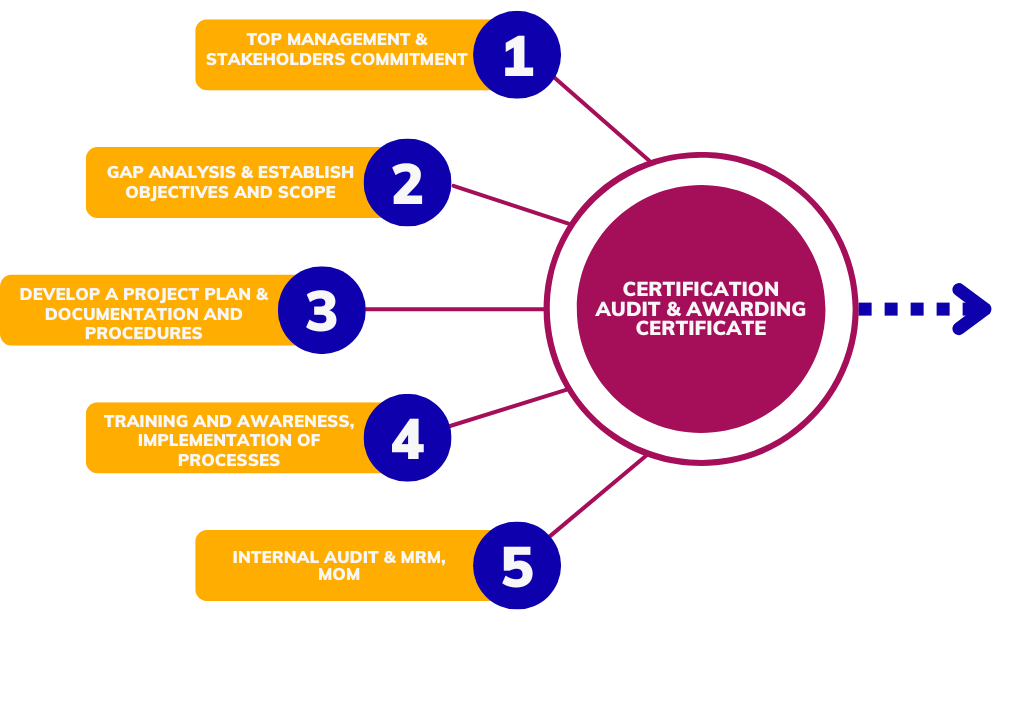
Approach and Methodology used to implement Management System Standard

Colorful Minimalist Linear Steps Circular Diagram 1 e1712599893569

Implementing an ISO  standards involves a structured methodology to ensure that the organization effectively meets the requirements of the chosen standard and achieves certification. Sometimes defined methodology may vary depending on factors such as the size of the organization, its industry, and the complexity of the ISO standard being implemented, the following steps provide a basic framework

Ellipse 6 copy

OUR

Process

1, Determine the ISO Standard

2. Understand the Requirements

3. Training and Awareness

4. Implement the System

5. Internal Audit

6. Certification

partner_img

Benefits of having ISO Certification

Enhanced Credibility and Reputation

Legal and Regulatory Compliance

Enhanced Customer Satisfaction

Access to Global Markets

Environmental Sustainability

Information Security

Our Achievements and Success

Professional Experts
0 +
Years Experience
0 +
Projects
0 +
Satisfied Customers
0 %

Our Clients

WhatsApp Image 2023 05 12 at 8.24.31 PM e1684164170667
WhatsApp Image 2023 05 12 at 8.16.53 PM e1684163940587
WhatsApp Image 2023 05 12 at 8.22.55 PM
WhatsApp Image 2023 05 12 at 8.04.13 PM 3 e1684163886384
WhatsApp Image 2023-05-12 at 8.15.32 PM

OUR

SERVICES

ISO 9001 Certification
ISO 45001 Certification
ISO 14001 Certification
ISO 22000 Certification
ISO 13485 Certification
ISO 27001 Certification
ISO 20000-1 Certification
ISO 29001 Certification
Quality Management for Nigerian Enterprises

ISO 9001 Certification Services in Nigeria for Consistent Delivery and Customer Confidence

Nigerian organisations use ISO 9001 to stabilise fast-growing operations, clarify process ownership and turn customer feedback into measurable improvement.

Create a quality system that works across people, sites and suppliers

ISO 9001 provides a management framework for controlling how products and services are planned, delivered, checked and improved. The standard asks an organisation to define its processes, understand customer and regulatory requirements, address risks and opportunities, and evaluate whether the quality management system is achieving intended results.

In Nigeria, quality problems often appear at the handover points between sales, procurement, operations, logistics and customer service. A quotation may promise one specification while production works from another; a branch may use an outdated form; or a complaint may be closed without identifying why the failure occurred. These are management-system issues rather than isolated employee mistakes.

A practical QMS connects contract review, supplier approval, competence, operational controls, inspection, release, complaint handling and corrective action. It also establishes indicators that management can use to compare performance across facilities, projects or service teams instead of relying only on anecdotal updates.

Qualitcert supports Nigeria-based organisations with gap analysis, process mapping, documented information, internal auditor development, management review preparation and certification readiness. The objective is a usable operating system that supports dependable delivery, not a collection of documents prepared only for an audit.

Nigeria Business Context

Where Nigerian businesses commonly lose quality control

Rapid expansion, imported inputs, distributed teams and demanding customer contracts can expose weaknesses in process discipline.

Manufacturers and food processors may need stronger controls over incoming materials, work instructions, inspection and product release. Logistics and construction businesses often need clearer subcontractor evaluation, change control and evidence that customer specifications were reviewed before work began.

Service organisations face different risks. Unclear service-level criteria, inconsistent case handling, incomplete customer records and informal escalation can create variation even when staff are experienced. ISO 9001 makes these expectations explicit and links them to competence, monitoring and corrective action.

For organisations operating through several branches or project locations, a common QMS provides controlled templates, comparable indicators and a structured route for learning from problems. Management can see whether an issue is local or systemic and assign improvement actions accordingly.

Business Outcomes

Where ISO 9001 creates measurable value

The strongest benefits appear when quality objectives are connected to customer, delivery and cost performance.

More dependable delivery

Defined inputs, checks and acceptance criteria reduce avoidable variation between teams, branches and shifts.

Stronger customer confidence

Complaint trends, contract review and satisfaction data are managed through an auditable process.

Better supplier control

Approval, monitoring and re-evaluation criteria make purchasing decisions more evidence-based.

Practical improvement

Root-cause analysis and management review turn recurring problems into controlled improvement actions.

Sector Applications

How ISO 9001 can be applied in Nigeria

A quality system should reflect the risks, customer promises and evidence expected in the organisation's own sector.

01

Industrial manufacturing

Control specifications, production instructions, inspection, rework, calibration and final release across factories and contract manufacturers.

02

Oil and gas services

Align tender commitments, mobilisation, equipment readiness, subcontractor control, field records and client close-out requirements.

03

Banking and professional services

Standardise client onboarding, approvals, service delivery, complaint handling and performance reporting.

04

Construction and engineering

Connect design review, material approval, site inspection, variation control, snag closure and handover documentation.

05

Agribusiness and exports

Manage supplier qualification, grading, traceability, packaging, customer specifications and export documentation.

06

Logistics and distribution

Define booking, warehouse handling, route planning, proof of delivery, claims and outsourced transport controls.

Certification Roadmap

A process-led route from gap analysis to certification

The sequence below keeps implementation focused on operating evidence, not unnecessary documentation.

01

Confirm scope and context

Define sites, products, services, interested parties and the boundaries of the quality management system.

02

Map core processes

Identify inputs, outputs, owners, risks, controls, measures and interactions across the customer journey.

03

Design QMS controls

Prepare policies, procedures, forms and records only where they support consistency or required evidence.

04

Operate and measure

Use the system, monitor objectives, evaluate suppliers, record issues and collect customer feedback.

05

Audit and review

Conduct internal audits, close findings and hold a management review using reliable performance information.

06

Prepare for certification

Complete readiness checks, organise objective evidence and support responses through the external audit stages.

QMS Documentation

Documents and records that support ISO 9001 readiness

The documented information should be proportionate to process complexity, competence needs, customer obligations and business risk.

Common QMS evidence

  • QMS scope statement
  • Quality policy and objectives
  • Process maps and responsibilities
  • Contract review records
  • Approved supplier evaluations
  • Operational work instructions
  • Inspection or service checklists
  • Nonconformity and CAPA records
  • Internal audit programme
  • Management review minutes
Forms and records should help staff make correct decisions, not duplicate information already controlled in a dependable system.

Quality system mistakes to avoid

Certification delays often result from a system that looks complete on paper but is not connected to daily management.

  • Writing procedures that do not match actual work practices.
  • Using generic objectives without owners, baselines or review dates.
  • Closing corrective actions without verifying whether the cause was removed.
  • Auditing clauses only instead of testing process effectiveness and interfaces.
  • Treating management review as a presentation rather than a decision-making meeting.
A useful readiness review tests both conformity and effectiveness: the process must exist, be followed and achieve its intended result.
Integrated Management Options

For a connected requirement, review ISO 14001 consulting services in Nigeria to coordinate shared governance, records and management responsibilities.

For a connected requirement, review ISO 45001 consulting services in Nigeria where common risks, suppliers or operational controls should be aligned.

For a connected requirement, review ISO/IEC 27001 consulting services in Nigeria to reduce duplicated work and build a more coherent assurance programme.

Quality Management FAQs

ISO 9001 questions from organisations in Nigeria

These answers address scope, documentation, auditing and practical implementation decisions.

What is the main purpose of ISO 9001 certification in Nigeria?

ISO 9001 provides a structured quality management system for consistently meeting customer and applicable requirements, monitoring process performance and improving results.

Can a small Nigerian business implement ISO 9001?

Yes. The standard is scalable. A small organisation can use concise process maps, responsibilities and records rather than adopting complex documentation designed for a large enterprise.

Does ISO 9001 require a quality manual?

A formal quality manual is not mandatory, but many organisations use one concise overview to explain scope, process interaction and references to controlled information.

How should quality objectives be selected?

Objectives should address relevant business and customer priorities, have measurable indicators, assigned responsibility, resources and planned review dates.

What is process-based internal auditing?

It follows how a process operates from inputs to outputs, tests interfaces with other processes and evaluates whether controls achieve the intended result.

How are outsourced activities controlled?

The organisation should define requirements, select capable providers, monitor performance and retain evidence proportionate to the risk of the outsourced activity.

What evidence is needed for corrective action?

Evidence normally includes the problem, containment, cause analysis, planned action, implementation, responsibility and verification that recurrence risk was reduced.

Can ISO 9001 be integrated with other ISO standards?

Yes. Its management-system structure aligns well with ISO 14001, ISO 45001, ISO 27001 and other standards, allowing shared audits, objectives and review processes.

How long should records be retained?

Retention should reflect customer contracts, legal obligations, product or service risk and the period needed to demonstrate effective control.

How does Qualitcert support ISO 9001 readiness in Nigeria?

Qualitcert helps with gap analysis, process mapping, documentation, staff awareness, internal audits, corrective action and preparation for certification assessment.

Strengthen Everyday Quality

Build an ISO 9001 System That Fits Your Nigerian Operations

Share your scope, sites, customer requirements and current process documents. Qualitcert can help convert them into a practical QMS and a clear certification-readiness plan.

Plan Your QMS Review →
Scroll to Top