
ISO Certifications
Nigeria
Consulting &
ISO Certifications

-ISO Certification-
QUALIT
CERT
CONSULTING AND ISO CERTIFICATIONS
Qualitcert provides comprehensive ISO 27001 certification consulting services in Nigeria, assisting organizations in implementing robust information security management systems (ISMS) that align with international standards. Their expert consultants offer end-to-end support, including initial gap analysis, risk assessment, development of policies and procedures, and implementation of security controls. They focus on ensuring that organizations can effectively identify, manage, and reduce information security risks. Qualitcert also provides training for employees to foster a culture of security awareness and conducts internal audits to ensure the ISMS is effectively established and maintained. By partnering with Qualitcert, organizations in Nigeria can enhance their data protection capabilities, ensure compliance with legal and regulatory requirements, and build trust with clients and stakeholders, ultimately securing their information assets against cyber threats and breaches.
Please Reach Us Today


Approach and Methodology used to implement Management System Standard
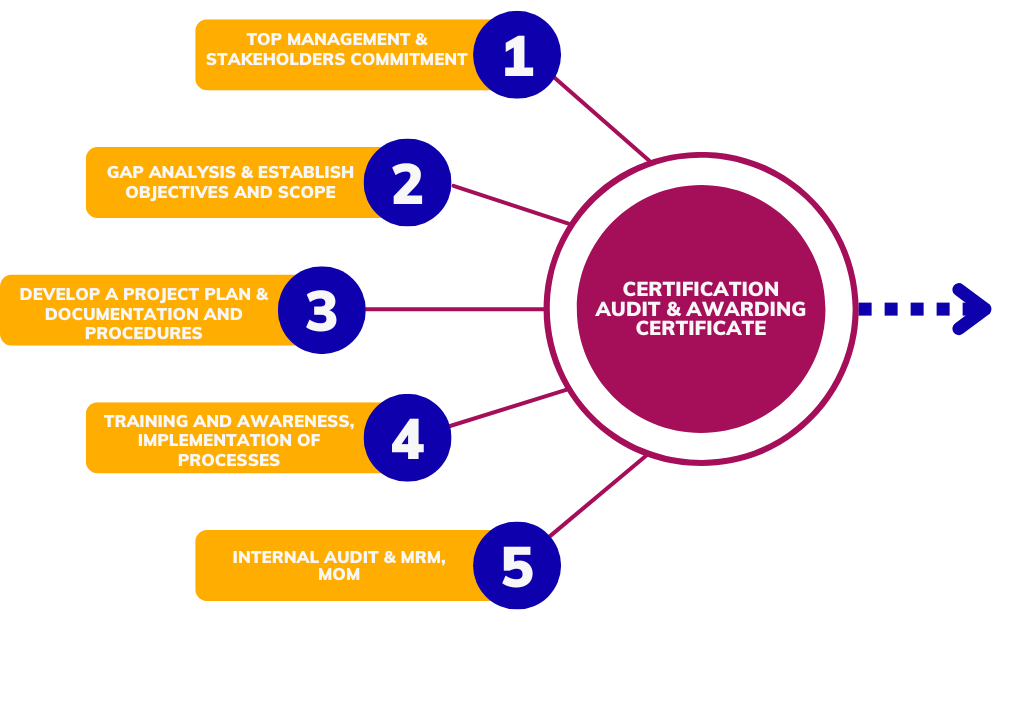
Implementing an ISO standards involves a structured methodology to ensure that the organization effectively meets the requirements of the chosen standard and achieves certification. Sometimes defined methodology may vary depending on factors such as the size of the organization, its industry, and the complexity of the ISO standard being implemented, the following steps provide a basic framework

OUR
Process
1, Determine the ISO Standard
2. Understand the Requirements
3. Training and Awareness
4. Implement the System
5. Internal Audit
6. Certification

Benefits of having ISO Certification
Enhanced Credibility and Reputation
Legal and Regulatory Compliance
Enhanced Customer Satisfaction
Access to Global Markets
Environmental Sustainability
Information Security
Our Achievements and Success
Our Clients





OUR
SERVICES
ISO 27001 Certification Services in Nigeria for Risk-Based Information Security
ISO/IEC 27001 helps Nigerian organisations establish an ISMS that protects information through risk assessment, accountable governance and justified Annex A controls.
Manage information security as a business risk, not an IT checklist
ISO/IEC 27001 specifies requirements for an information security management system. It asks organisations to define scope, understand interested-party requirements, assess information-security risks, select treatment options and operate controls that protect confidentiality, integrity and availability.
Nigerian businesses increasingly depend on cloud platforms, mobile access, outsourced technology, payment channels and distributed service teams. Security gaps often occur where ownership is unclear: privileged access is not reviewed, suppliers are onboarded without due diligence, backups are not tested, or incident decisions are improvised.
The Statement of Applicability is central to the ISMS. It records which Annex A controls are applicable, why they were selected or excluded, and how implementation is evidenced. This prevents certification from becoming a generic control-copying exercise disconnected from actual risks.
Qualitcert supports ISMS scoping, asset and risk assessment, risk treatment, control design, policies, internal audit, management review and certification readiness. The result should help executives understand exposure and help operational teams maintain evidence.
Security assurance for Nigeria's digital and outsourced economy
Financial services, fintech, telecoms, healthcare, professional services and online platforms handle information that customers and partners expect to remain protected.
An organisation may process customer identity data, payment information, employee records, intellectual property or sensitive commercial instructions across several applications and vendors. ISO 27001 creates a common governance layer for these assets.
Supplier and cloud risk is especially important. Contracts, access rights, shared responsibilities, incident notification, service continuity and exit arrangements should be evaluated before critical information is entrusted to a third party.
A mature ISMS also prepares the business for disruption. Incident classification, escalation, evidence preservation, communication and recovery testing allow decisions to be made through a rehearsed process rather than under pressure.
How ISO 27001 supports trust and resilience
The value lies in making security decisions traceable, risk-based and repeatable across business and technical teams.
Better risk ownership
Business owners can see residual risk, treatment status and the decisions requiring acceptance or investment.
Stronger customer assurance
Controlled evidence supports due diligence, tenders and security reviews from clients and partners.
More coordinated incident response
Roles, escalation, evidence handling and lessons learned are planned before a security event occurs.
Improved supplier governance
Security expectations, assessments and monitoring are aligned with the information and services entrusted to third parties.
ISO 27001 applications in Nigeria's service economy
The scope and controls should reflect information flows, technology dependencies and contractual commitments.
Fintech and payment services
Govern customer data, secure development, privileged access, third-party dependencies and incident response.
Banks and insurers
Coordinate information classification, access review, cryptography, supplier assurance and continuity controls.
Telecommunications
Protect network operations, subscriber data, administrative access, monitoring and critical-service recovery.
Healthcare and health technology
Manage patient information, connected systems, vendor access, backups and confidentiality obligations.
Professional and legal services
Secure client files, collaboration tools, remote work, document exchange and retention arrangements.
Cloud and managed services
Demonstrate control design, tenant separation, change management, logging and customer assurance.
From scope and risk assessment to an auditable ISMS
ISO 27001 implementation works best when risk treatment and operational evidence are developed together.
Define the ISMS boundary
Confirm sites, services, systems, people, interfaces and exclusions that shape the certification scope.
Establish risk methodology
Set criteria for likelihood, impact, acceptance, ownership and consistent information-security risk evaluation.
Assess and treat risks
Identify assets, threats and vulnerabilities, then select avoidance, modification, sharing or acceptance options.
Implement Annex A controls
Prepare the Statement of Applicability and operate selected organisational, people, physical and technological controls.
Measure and challenge
Monitor objectives, incidents, supplier performance, vulnerabilities and control effectiveness through internal audit.
Review and certify
Complete management review, corrective actions and evidence preparation for the certification audit stages.
Policies, registers and records expected during ISO 27001 assessment
Documentation should explain the organisation's security logic and provide evidence that selected controls are operating.
Common ISMS records
- ISMS scope and policy
- Risk assessment methodology
- Information risk register
- Risk treatment plan
- Statement of Applicability
- Asset and access records
- Supplier security assessments
- Incident response records
- Internal audit programme
- Management review minutes
ISMS mistakes that weaken assurance
Certification problems often arise when technical controls exist but governance, risk reasoning or operating evidence is incomplete.
- Copying a generic risk register that does not reflect real services and information flows.
- Selecting all Annex A controls without documenting applicability and treatment rationale.
- Restricting the ISMS to IT while business owners and suppliers remain outside the process.
- Listing policies without retaining logs, reviews, approvals or test evidence.
- Accepting residual risk informally without defined authority or review dates.
Related ISO/IEC 27001 Services for Nigerian Organisations
For a connected requirement, review SOC 2 consulting services in Nigeria to coordinate shared governance, records and management responsibilities.
For a connected requirement, review VAPT consulting services in Nigeria where common risks, suppliers or operational controls should be aligned.
For a connected requirement, review ISO 9001 consulting services in Nigeria to reduce duplicated work and build a more coherent assurance programme.
ISO 27001 questions from Nigeria-based organisations
These answers focus on risk assessment, Annex A, scope, evidence and certification.
What is an Information Security Management System?
An ISMS is a coordinated set of policies, risk processes, responsibilities, controls and reviews used to protect information and improve security performance.
Does ISO 27001 require every Annex A control?
No. The organisation considers all Annex A controls, but selects those needed based on risk treatment and other requirements, documenting decisions in the Statement of Applicability.
What is the Statement of Applicability?
It records control applicability, justification, implementation status and references, providing a bridge between risk treatment and the Annex A control set.
Can a cloud-based company be certified to ISO 27001?
Yes. The organisation must define its scope and manage shared responsibilities, suppliers, access, configuration, monitoring, backup and incident obligations.
How detailed should the information risk register be?
It should be detailed enough to support consistent decisions, clear ownership, treatment tracking and residual risk acceptance without becoming unmanageable.
Is penetration testing mandatory for ISO 27001?
The standard does not prescribe one universal test schedule, but vulnerability and security testing may be necessary based on risk, contractual duties and selected controls.
How are suppliers included in an ISMS?
Suppliers are assessed according to the information, systems and services they affect, with security requirements, monitoring and exit arrangements defined as appropriate.
What is the difference between risk assessment and risk treatment?
Assessment identifies and evaluates risk. Treatment decides what to do about it, assigns actions, selects controls and documents residual risk.
Can ISO 27001 support client security questionnaires?
Yes. A controlled ISMS provides policies, risk records, audits, incident processes and control evidence that can make due diligence more consistent.
How does Qualitcert support ISO 27001 in Nigeria?
Qualitcert can help define scope, create the risk framework, prepare the Statement of Applicability, document controls, audit the ISMS and prepare for certification.
Define a Practical ISO 27001 Roadmap for Your Nigerian Organisation
Share your ISMS scope, key systems, suppliers and current security documents. Qualitcert can help structure risk treatment, Annex A control evidence and certification readiness.