
ISO Certifications
Nigeria
Consulting &
ISO Certifications

-ISO Certification-
QUALIT
CERT
CONSULTING AND ISO CERTIFICATIONS
Qualitcert offers comprehensive ISO 50001 certification services in Nigeria, aimed at helping organizations establish, implement, maintain, and improve their energy management systems. Their experienced consultants guide clients through the entire certification process, starting with an initial energy review to identify areas of significant energy use and opportunities for improvement. They assist in developing an energy management policy, setting objectives and targets, and creating action plans to achieve energy performance improvements. Qualitcert provides support in designing and implementing energy-efficient practices, conducting internal audits, and preparing for the certification audit. By obtaining ISO 50001 certification, organizations can systematically enhance their energy performance, reduce energy consumption and costs, and demonstrate their commitment to environmental sustainability. This certification also helps organizations comply with regulatory requirements, improve operational efficiencies, and boost their corporate image. With Qualitcert’s expertise, businesses in Nigeria can achieve measurable energy savings and contribute to global energy conservation efforts.
Please Reach Us Today


Approach and Methodology used to implement Management System Standard
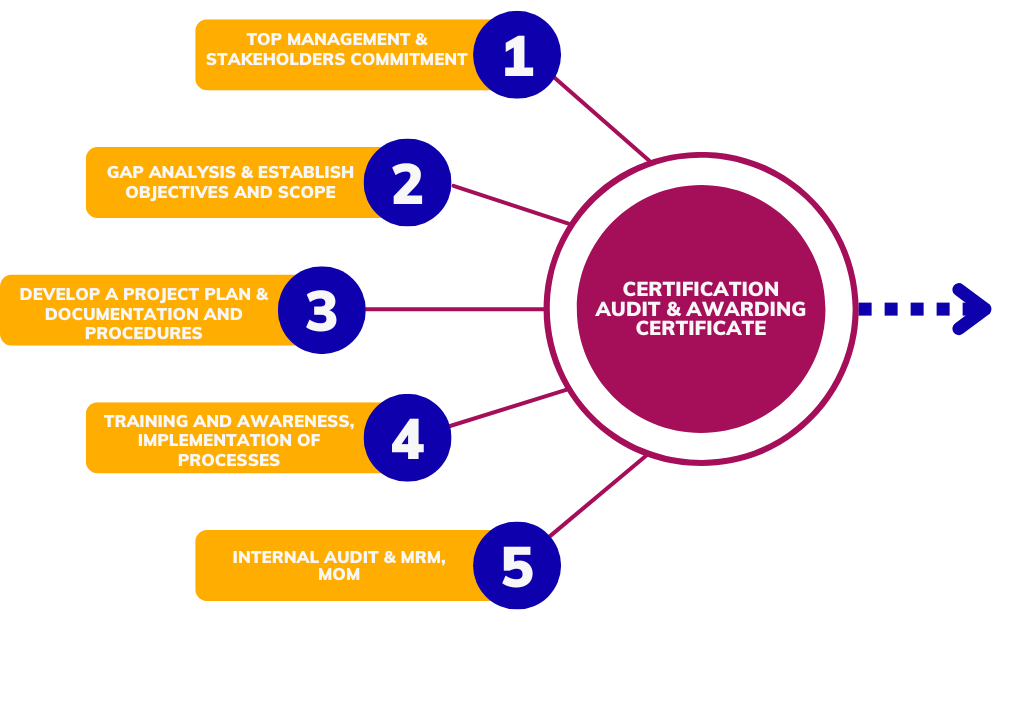
Implementing an ISO standards involves a structured methodology to ensure that the organization effectively meets the requirements of the chosen standard and achieves certification. Sometimes defined methodology may vary depending on factors such as the size of the organization, its industry, and the complexity of the ISO standard being implemented, the following steps provide a basic framework

OUR
Process
1, Determine the ISO Standard
2. Understand the Requirements
3. Training and Awareness
4. Implement the System
5. Internal Audit
6. Certification

Benefits of having ISO Certification
Enhanced Credibility and Reputation
Legal and Regulatory Compliance
Enhanced Customer Satisfaction
Access to Global Markets
Environmental Sustainability
Information Security
Our Achievements and Success
Our Clients




OUR
SERVICES
ISO 50001 Certification Services in Nigeria for Measurable Energy Improvement
ISO 50001 helps Nigerian organisations understand significant energy uses, establish reliable baselines and improve performance through operational and investment controls.
Turn energy data into operational decisions
ISO 50001 specifies requirements for an energy management system that supports continual improvement in energy performance. It requires an energy review, significant energy uses, energy performance indicators, baselines, objectives, action plans and controls for design and procurement.
In Nigeria, organisations may manage grid supply, generators, gas, diesel, solar systems, compressed air, refrigeration and process heat within the same facility. Total utility bills do not reveal which processes drive consumption or where avoidable losses occur.
An effective EnMS identifies relevant variables such as production volume, weather, occupancy or operating hours and uses them to interpret performance. Significant energy uses are assigned owners, operational criteria and monitoring that can detect drift.
Qualitcert supports energy reviews, data planning, EnPI and baseline development, operational controls, procurement criteria, internal audit, management review and certification readiness.
Energy resilience and cost control for Nigerian facilities
High energy costs and mixed supply arrangements make accurate measurement and disciplined operation valuable across industrial and commercial sites.
Generator loading, maintenance condition and fuel measurement can materially affect performance. Facilities also lose energy through compressed-air leaks, poor power-factor management, inefficient refrigeration, steam losses or equipment left operating outside production hours.
ISO 50001 helps separate technical projects from management controls. Capital upgrades are important, but scheduling, set points, maintenance, shutdown routines and operator response can deliver improvement with limited investment.
Procurement and design decisions also influence long-term consumption. Life-cycle energy performance can be considered when purchasing motors, chillers, vehicles, boilers, lighting or production equipment.
How ISO 50001 supports cost and performance control
The EnMS helps management prioritise actions using data rather than relying on isolated savings campaigns.
Better energy visibility
Meters, data ownership and analysis reveal where consumption and avoidable losses occur.
More credible savings
Baselines and EnPIs help verify whether projects and operational changes improved performance.
Improved equipment decisions
Energy performance becomes a criterion in design, procurement and lifecycle evaluation.
Stronger operating discipline
Set points, maintenance, shutdown and monitoring practices become controlled routines.
ISO 50001 applications in Nigeria
The system can be applied to sites, buildings, processes, fleets or combined organisational boundaries.
Manufacturing facilities
Analyse production energy, motors, compressed air, process heat, maintenance and shutdown practices.
Data centres and telecoms
Control cooling, backup power, power usage effectiveness, generator performance and capacity planning.
Hotels and commercial buildings
Manage HVAC, lighting, hot water, kitchens, occupancy patterns and preventive maintenance.
Food and cold-chain operations
Improve refrigeration, freezing, compressed air, steam, cleaning and temperature-control efficiency.
Cement and building materials
Track high-energy processes, fuel mix, equipment loading, maintenance and production-normalised indicators.
Transport fleets
Monitor fuel economy, route planning, driver behaviour, maintenance and vehicle procurement criteria.
From energy review to verified performance improvement
The sequence builds a reliable analytical baseline before objectives and projects are judged.
Define scope and data needs
Confirm facilities, energy types, boundaries, meters, data owners and relevant variables.
Conduct the energy review
Analyse past and present use, identify significant energy uses and estimate improvement opportunities.
Set EnPIs and baselines
Choose indicators and reference periods that fairly reflect operational conditions.
Plan controls and projects
Assign objectives, operating criteria, maintenance actions, procurement rules and project responsibilities.
Measure and verify
Monitor performance, investigate significant deviations and verify results using appropriate methods.
Audit, review and certify
Complete internal audits, management review, corrective actions and external certification readiness.
Records that support ISO 50001 certification
Evidence should connect raw energy data with significant energy uses, actions, results and management decisions.
Typical EnMS evidence
- Energy policy and scope
- Energy data inventory
- Energy review report
- Significant energy use register
- EnPIs and baseline methodology
- Objectives and action plans
- Operational control records
- Design and procurement evaluations
- Monitoring and verification results
- Audit and management review records
Energy management mistakes
An EnMS is weakened when utility reporting is mistaken for energy-performance management.
- Using total consumption without adjusting for relevant variables.
- Choosing EnPIs that staff cannot influence or explain.
- Listing energy projects without defined baselines and verification methods.
- Ignoring operating and maintenance practices while focusing only on capital projects.
- Claiming improvement from lower activity rather than improved energy performance.
Related ISO 50001 Services for Nigerian Organisations
For a connected requirement, review ISO 14001 consulting services in Nigeria to coordinate shared governance, records and management responsibilities.
For a connected requirement, review ISO 9001 consulting services in Nigeria where common risks, suppliers or operational controls should be aligned.
For a connected requirement, review ISO 45001 consulting services in Nigeria to reduce duplicated work and build a more coherent assurance programme.
ISO 50001 questions from organisations in Nigeria
These answers explain energy reviews, SEUs, EnPIs, baselines, normalisation and improvement evidence.
What is the purpose of ISO 50001?
It provides a management system for continually improving energy performance, including energy efficiency, energy use and energy consumption.
What is a significant energy use?
An SEU is an energy use that accounts for substantial consumption or offers considerable opportunity for performance improvement.
What is an energy performance indicator?
An EnPI is a measure selected to quantify energy performance, such as energy per unit of production or per occupied area.
Why is an energy baseline needed?
The baseline provides a reference for comparing energy performance while considering relevant variables and changes.
Does ISO 50001 require renewable energy?
No. Renewable energy may support organisational goals, but the standard focuses on systematic energy performance improvement.
How is energy performance normalised?
Relevant variables such as production, occupancy, weather or operating hours are incorporated so performance can be compared fairly.
Can ISO 50001 cover vehicle fuel?
Yes. Fleet fuel can be included when it falls within the EnMS scope and is managed as an energy use.
What evidence supports an energy-saving claim?
Evidence may include meter data, baseline calculations, operating conditions, project records and a defined measurement and verification method.
Can ISO 50001 integrate with ISO 14001?
Yes. Energy, emissions, objectives, audits and management review can be coordinated within an integrated system.
How does Qualitcert support ISO 50001 in Nigeria?
Qualitcert can support energy review, SEU analysis, EnPIs, baselines, documentation, audits and certification readiness.
Create an ISO 50001 Plan for Your Nigerian Energy Profile
Provide energy sources, major equipment, available consumption data and improvement priorities. Qualitcert can help establish baselines, EnPIs and a certification-ready EnMS.