










Global ISO Certification Consultant Services – Qualitcert

QualitCert Get a Quote

ISO Certifications

Mutt

rah

Consulting &

ISO Certifications

-ISO Certification-

ISO 31000 Certification Services in Muttrah

QUALIT

CERT

CONSULTING AND ISO CERTIFICATIONS

In order to assist enterprises in implementing an efficient risk management framework that improves organizational resilience and decision-making, Qualitcert provides specialized ISO 31000 Certification services in Muttrah. The globally acclaimed ISO 31000 standard offers best practices, guidelines, and principles for handling a range of hazards, including financial, strategic, and operational risks. A thorough evaluation of an organization’s risk management policies, practices, and strategies is part of Qualitcert’s certification process, which verifies that they comply with ISO 31000 standards. By using this procedure, Qualitcert guarantees a proactive approach to risk management by assisting businesses in identifying, analyzing, and mitigating risks that may affect their goals. A company’s dedication to upholding a methodical and structured risk management process is demonstrated by obtaining ISO 31000 certification with Qualitcert. This can boost stakeholder confidence, improve business performance, and

Please Reach Us Today

Test
Consultants Consultants
afd9a249 perf wp theme group 8796 Consultants Consultants

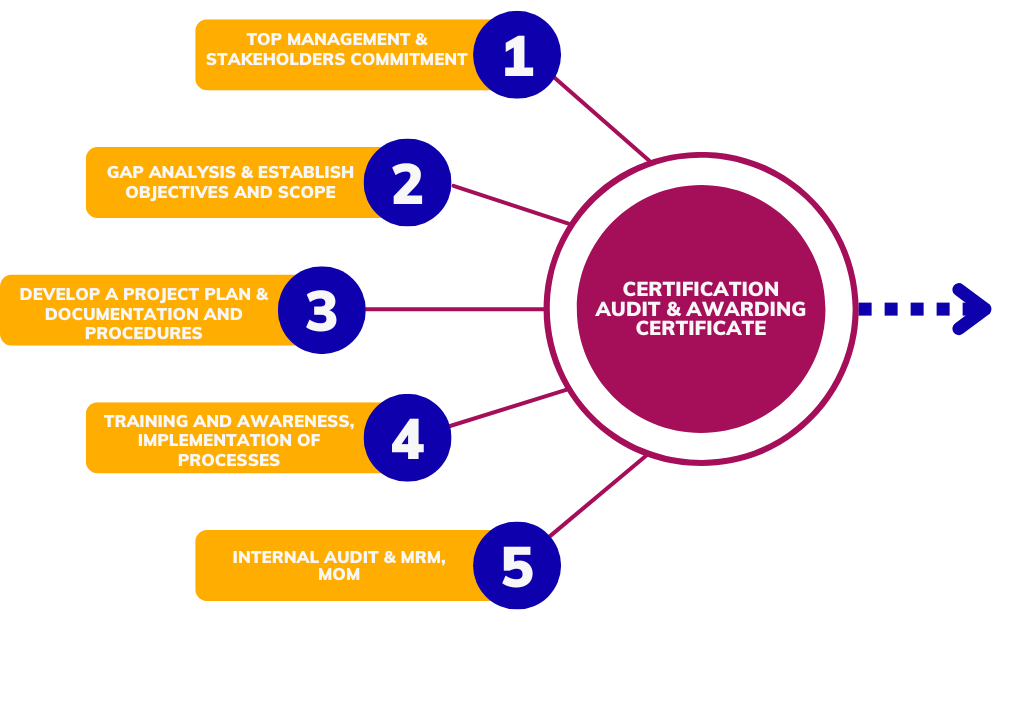
Approach and Methodology used to implement Management System Standard

Colorful Minimalist Linear Steps Circular Diagram 1 e1712599893569 Consultants Consultants

Implementing an ISO standards involves a structured methodology to ensure that the organization effectively meets the requirements of the chosen standard and achieves certification. Sometimes defined methodology may vary depending on factors such as the size of the organization, its industry, and the complexity of the ISO standard being implemented, the following steps provide a basic framework

Ellipse 6 copy Consultants Consultants

OUR

Process

1, Determine the ISO Standard

2. Understand the Requirements

3. Training and Awareness

4. Implement the System

5. Internal Audit

6. Certification

partner_img Consultants Consultants

Benefits of having ISO Certification

Enhanced Credibility and Reputation

Legal and Regulatory Compliance

Enhanced Customer Satisfaction

Access to Global Markets

Environmental Sustainability

Information Security

Our Achievements and Success

Professional Experts
0 +
Years Experience
0 +
Projects
0 +
Satisfied Customers
0 %

Our Clients

WhatsApp Image 2023 05 12 at 8.24.31 PM e1684164170667
WhatsApp Image 2023 05 12 at 8.16.53 PM e1684163940587
WhatsApp Image 2023 05 12 at 8.22.55 PM
WhatsApp Image 2023 05 12 at 8.04.13 PM 3 e1684163886384
WhatsApp Image 2023-05-12 at 8.15.32 PM

OUR

SERVICES

ISO 9001 Certification
ISO 45001 Certification
ISO 14001 Certification
ISO 22000 Certification
ISO 13485 Certification
ISO 27001 Certification
ISO 20000-1 Certification
ISO 29001 Certification
ISO 31000 in Muttrah

ISO 31000 Guidance in Muttrah for Better Decisions Through risk-informed decision making

ISO 31000 helps Muttrah leaders turn risk management from a static register into a practical input to investment, operations and strategic decisions. Risk systems add little value when teams use inconsistent scoring, owners lack authority and treatment actions close without reassessing residual exposure.

Take risk out of the register and into the decision

Risk systems add little value when teams use inconsistent scoring, owners lack authority and treatment actions close without reassessing residual exposure; for ISO 31000 in Muttrah, this point is applied to the current operating model.

Qualitcert can support the organisation in turning risk-informed decision making into responsibilities, evidence, internal review and improvement actions that fit actual Muttrah operations.

ISO 31000 helps Muttrah leaders turn risk management from a static register into a practical input to investment, operations and strategic decisions; for ISO 31000 in Muttrah, this point is applied to the current operating model.

ISO 31000 is risk-management guidance rather than a certifiable requirements standard, so value comes from better treatment and decision-making. The operating design needs to connect risk governance, risk criteria and risk ownership with risk analysis, risk treatment and monitoring; otherwise individual controls can appear complete while the overall outcome remains weak.

Operating Context in Muttrah

Different risks still need a common decision language

The controls need to fit real handoffs, suppliers, technology and operating conditions rather than an abstract model; for ISO 31000 in Muttrah, this point is applied to the current operating model.

Ownership of risk governance should remain visible whenever work crosses teams, systems or external providers; unclear handoffs can weaken an otherwise well-designed control.

Risk ownership needs an explicit trigger for reassessment when risk, technology, suppliers, workload or stakeholder needs change.

Results from monitoring should lead to a decision, correction or improvement instead of being recorded without changing how the process is managed.

Practical Value of ISO 31000

What better risk discipline changes for leadership

The business value comes from stronger risk-informed decision making and clearer decisions, not from increasing document volume.

Ownership of risk governance becomes clearer

Decision rights and review points make risk governance less dependent on informal knowledge.

Risk criteria becomes more consistent — focused on risk-informed decision making — applied to the current operating model

Current records and agreed criteria make risk criteria easier to compare over time.

Decisions around risk analysis become easier to defend

Risk, exceptions and changing conditions are considered before risk analysis is treated as routine.

Monitoring produces visible follow-through — focused on risk-informed decision making — applied to the current operating model

Results are converted into actions, learning or management decisions rather than passive records; for ISO 31000 in Muttrah, this point is applied to the current operating model.

Applications Across Muttrah

Muttrah operating environments where uncertainty appears differently

Different sectors need different examples, evidence and control depth even when they use the same framework; for ISO 31000 in Muttrah, this point is applied to the current operating model.

01

Hospitality — risk-informed decision making application

In Muttrah, hospitality can use ISO 31000 to evaluate supplier, reputation and service uncertainty; the controls should follow the real workflow and the consequence of failure in that environment.

02

Logistics — risk-informed decision making application

In Muttrah, logistics can use ISO 31000 to manage transport, inventory and system risks; the controls should follow the real workflow and the consequence of failure in that environment.

03

Healthcare — risk-informed decision making application

In Muttrah, healthcare can use ISO 31000 to consider service, workforce and technology exposure; the controls should follow the real workflow and the consequence of failure in that environment.

04

Retail — risk-informed decision making application

In Muttrah, retail can use ISO 31000 to assess demand, payment and supply-chain risks; the controls should follow the real workflow and the consequence of failure in that environment.

05

Professional services — risk-informed decision making application

In Muttrah, professional services can use ISO 31000 to manage client, contractual and reputation risk; the controls should follow the real workflow and the consequence of failure in that environment.

06

Asset-intensive organisations — risk-informed decision making application

In Muttrah, asset-intensive organisations can use ISO 31000 to connect failure risk with investment decisions; the controls should follow the real workflow and the consequence of failure in that environment.

How ISO 31000 Works in Practice

Move from objective and uncertainty to treatment and monitoring

This sequence follows the specific control logic of ISO 31000 rather than a generic readiness routine.

01

Clarify the boundary for risk governance

Name the accountable owner, intended result and decision authority for risk governance.

02

Observe how risk criteria works today

Use current records and interviews to understand how risk criteria behaves in real work.

03

Prioritise criteria for risk ownership

Make choices around risk ownership repeatable by defining criteria and escalation.

04

Control risk analysis through normal responsibilities

Embed risk analysis in everyday roles instead of a separate audit-only routine.

05

Test evidence around risk treatment

Monitor risk treatment, retain exceptions and verify that follow-up happens.

06

Improve the system using monitoring

Use monitoring to decide whether correction, resources or a broader change is required.

Evidence That Matters

Records that make risk-informed decision making understandable without reconstruction

Evidence should be current, attributable and tied to an actual decision, activity or exception; for ISO 31000 in Muttrah, this point is applied to the current operating model.

Operating evidence for ISO 31000 in Muttrah

  • Risk framework, showing the approved boundary and current owner
  • Risk criteria, with responsibilities and review status visible
  • Ownership matrix, linked to actual operating decisions
  • Risk register, showing how changes are approved; for ISO 31000 in Muttrah, this point is applied to the current operating model.
  • Assessment records, supported by implementation evidence
  • Treatment plans, with current monitoring or evaluation results
  • Risk indicators, showing relevant approvals and exceptions
  • Acceptance decisions, retained for traceability and follow-up
  • Escalation records, connected to corrective or improvement actions
  • Review evidence, used as an input to leadership review
For ISO 31000, process owners should be able to explain why each record exists and which decision or control it supports.

Weak points that deserve attention before formal review — focused on risk-informed decision making — applied to the current operating model

For ISO 31000, these patterns can make documented expectations look stronger than everyday practice.

  • Functions use incompatible scoring methods. The issue may remain hidden until a real exception occurs.
  • Risk owners cannot approve treatment. That often creates inconsistent evidence between people or shifts.
  • Actions close without residual-risk review. Management then has less reliable information for decisions.
  • Indicators do not trigger early reassessment. The control may exist without a clear measure of effectiveness.
  • Leadership receives lists instead of decision-focused information. The same weakness can return because the underlying cause remains.
Closing these ISO 31000 weaknesses early improves the operating system and reduces last-minute evidence repair.
Related Management Areas

Where the same process also depends on broader management controls, consider ISO 22301 in Muttrah.

A second discipline that can strengthen connected responsibilities is ISO 55001 in Muttrah.

For another governance or assurance perspective, review for ISO 31000 ISO 37001 in Muttrah.

ISO 31000 Questions

Questions process owners should answer with real ISO 31000 evidence

These questions test whether ISO 31000 is understood, operated and reviewed during normal work.

What should a Muttrah organisation define first for ISO 31000?

ISO 31000 is risk-management guidance rather than a certifiable requirements standard, so value comes from better treatment and decision-making. Define scope, intended outcomes, key stakeholders and the operating processes that influence risk-informed decision making; this creates a practical boundary for ownership and evidence.

Who should own risk governance in the ISO 31000 operating context for Muttrah?

Ownership should sit with someone able to influence the process, make or escalate decisions and keep evidence for risk governance current.

What evidence shows risk criteria is working?

Use recent approvals, monitoring results, exceptions and follow-up connected to risk criteria; the strongest evidence is produced during normal work.

When should risk ownership be reconsidered?

Review risk ownership when significant changes in risk, technology, suppliers, workforce, customer need or operating conditions could affect the original decision.

Why is risk analysis important to ISO 31000?

Risk analysis directly supports risk-informed decision making; the organisation should be able to explain the outcome it protects and how effectiveness is checked.

How can risk treatment be controlled without unnecessary paperwork?

Keep only the documented information needed to make risk treatment repeatable, reviewable and proportionate to risk; reuse effective operating records wherever possible.

What should internal review test about monitoring in the ISO 31000 operating context for Muttrah?

Sample monitoring in real operation, examine exceptions and verify that follow-up addresses causes rather than only closing tasks.

How should external providers be considered within ISO 31000 in the ISO 31000 operating context for Muttrah?

External providers should be controlled according to how strongly they can affect risk-informed decision making, with approval, monitoring and escalation matched to that exposure.

What should management decide after reviewing ISO 31000 performance in the ISO 31000 operating context for Muttrah?

Management should decide on unresolved risks, resources, changes and improvement priorities rather than simply acknowledge performance information; for ISO 31000 in Muttrah, this point is applied to the current operating model.

How can Qualitcert support ISO 31000 in Muttrah in the ISO 31000 operating context for Muttrah?

Qualitcert can support gap assessment, implementation planning, control design, internal audit, evidence review and readiness activities relevant to ISO 31000.

Next Step with ISO 31000

Take one material risk out of the register and into a decision

Choose one material area—risk governance—and follow it from ownership through criteria, evidence, exceptions and improvement decisions.

View ISO 31000 Services in Muttrah — ISO 31000 Muttrah →
Scroll to Top