
baghdad

ISO 22000 Certification Services in Baghdad
QUALIT
CERT
In Baghdad, Qualitcert delivers comprehensive ISO 22000 certification consulting services aimed at helping businesses in the food sector establish and maintain a robust Food Safety Management System (FSMS). ISO 22000 is an internationally recognized standard that integrates key principles of food safety management, enabling organizations to effectively control hazards throughout the food supply chain and ensure the delivery of safe, high-quality products. Qualitcert supports clients through every stage of the certification journey from initial assessments and system implementation to regular audits and continual improvement initiatives. By leveraging Qualitcert’s industry expertise, businesses can enhance operational efficiency, build stronger consumer trust, and meet global food safety regulations. Achieving ISO 22000 certification not only demonstrates compliance with legal and regulatory requirements but also strengthens a company’s competitive edge in the marketplace.
ISO Certification Process – Step by Step Guide
The ISO certification process helps organizations implement international standards to improve quality, safety, efficiency, and compliance. Below is a structured step-by-step ISO certification process followed by professional ISO consultants and certification bodies.
ISO Application
The organization submits an application for ISO certification and defines the scope of certification including departments, processes, and operations.
Gap Analysis
ISO consultants analyze the current management system and identify gaps between existing processes and ISO standard requirements.
ISO Documentation
Preparation of ISO manuals, procedures, policies, risk assessments, and records required to comply with ISO standards.
System Implementation
ISO processes are implemented across departments with employee training, process control, and compliance monitoring.
Internal Audit
Internal auditors review the management system to verify compliance and identify corrective actions before the certification audit.
Management Review
Top management evaluates the effectiveness of the ISO management system and ensures readiness for certification.
Certification Audit
An accredited certification body conducts an external audit to verify compliance with ISO standards.
ISO Certification
After successful audit completion, the organization receives the official ISO certificate demonstrating compliance with international standards.
Surveillance Audits
Annual surveillance audits ensure continuous compliance and improvement of the ISO management system.
Get In Touch


Approach and Methodology used to implement Management System Standard
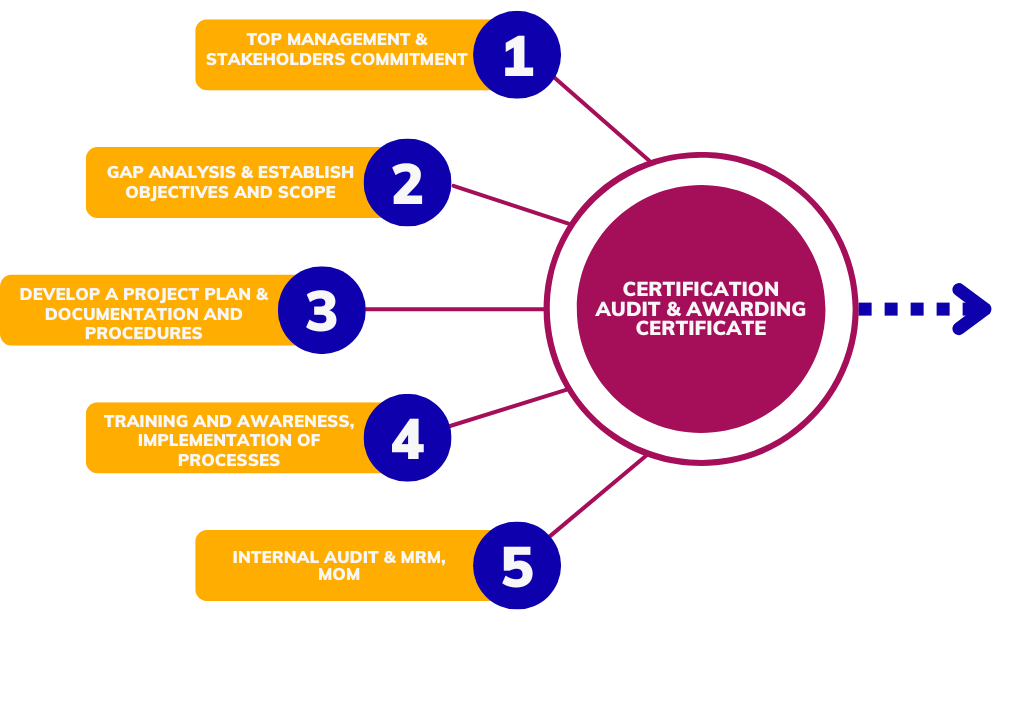
Implementing an ISO standards involves a structured methodology to ensure that the organization effectively meets the requirements of the chosen standard and achieves certification. Sometimes defined methodology may vary depending on factors such as the size of the organization, its industry, and the complexity of the ISO standard being implemented, the following steps provide a basic framework


Benefits of having ISO Certification
Enhanced Credibility and Reputation
Legal and Regulatory Compliance
Enhanced Customer Satisfaction
Access to Global Markets
Environmental Sustainability
Information Security
Our Achievements and Success
Our Clients





OUR
SERVICES
ISO 22000 Certification Services in Baghdad for Food Safety Management Systems
Baghdad food businesses need food safety controls that connect purchasing, receiving, storage, processing, hygiene, temperature control, traceability, and corrective action across the food chain.
A complete FSMS for food safety decision-making
ISO 22000 certification services in Baghdad help organisations build a Food Safety Management System that combines management system discipline with food safety hazard control.
The standard is designed for organisations across the food chain, including processors, caterers, warehouses, cold stores, restaurants, packaging suppliers, ingredient traders, and distribution companies.
A strong FSMS includes prerequisite programmes, hazard analysis, operational controls, traceability, withdrawal and recall readiness, communication, verification, validation, internal audit, and management review.
Qualitcert supports Baghdad food businesses with gap assessment, FSMS documentation, PRP review, hazard analysis support, internal audit preparation, and certification-readiness guidance aligned with ISO 22000 requirements.
Food safety needs in Baghdad supply and service operations
Food operations in Baghdad may manage mixed supply sources, transport conditions, storage constraints, high-volume service, seasonal demand, and customer-specific requirements.
ISO 22000 helps these organisations move beyond individual hygiene practices by creating a complete system for food safety planning, monitoring, verification, and communication.
The FSMS is especially valuable where teams handle temperature-sensitive products, ready-to-eat foods, dry goods, ingredients, packaging, catering, or distribution routes that require traceability.
When implemented well, ISO 22000 helps managers see whether controls are effective before customer complaints, inspection concerns, or product withdrawal situations occur.
ISO 22000 Benefits for Baghdad Food Businesses
The benefits come from linking hazard control with management responsibility and verifiable records.
Stronger hazard control
Hazards are assessed and controlled through PRPs, OPRPs, CCPs, monitoring, and verification.
Improved traceability
Batch, supplier, storage, and distribution records help locate affected product quickly.
Better customer confidence
Food buyers can see a structured FSMS rather than isolated hygiene documents.
Prepared recall response
Withdrawal and recall procedures help teams respond quickly when product risk is identified.
Practical ISO 22000 Applications in Baghdad
Food safety controls must fit the product type, process flow, storage conditions, and customer risk.
Food processing units
Control raw materials, process steps, hygiene, allergens, temperature, foreign matter, and batch traceability.
Catering and central kitchens
Manage receiving, preparation, cooking, holding, delivery, cleaning schedules, and staff hygiene.
Cold storage and distribution
Monitor temperature, loading, vehicle hygiene, stock rotation, delivery records, and emergency response.
Restaurants and hospitality groups
Standardise supplier checks, kitchen hygiene, pest control, cooking controls, and complaint review.
Ingredient and packaging suppliers
Control product specifications, supplier approval, storage conditions, and customer communication.
Food importers and traders
Organise supplier documents, product identity, shelf-life controls, storage evidence, and batch records.
How ISO 22000 Readiness Is Developed
Implementation follows the food safety logic from product understanding to control validation and verification.
Define FSMS scope
Confirm products, sites, processes, food-chain role, outsourced activities, and customer requirements.
Review PRPs
Assess hygiene, cleaning, pest control, waste, maintenance, storage, personnel practices, and supplier controls.
Map food processes
Document product descriptions, intended use, flow diagrams, and process confirmation at the site.
Conduct hazard analysis
Identify biological, chemical, physical, allergen, and process-related hazards and required controls.
Set monitoring and verification
Define control limits or criteria, monitoring methods, corrective actions, and verification records.
Prepare certification evidence
Organise internal audit, management review, traceability test, and FSMS implementation records.
Documents Commonly Prepared for ISO 22000
Documents should show how food safety hazards are controlled from supplier approval to final delivery.
Typical ISO 22000 Records
- FSMS scope
- Food safety policy
- PRP checklist
- Product descriptions
- Process flow diagrams
- Hazard analysis worksheet
- OPRP and CCP plan
- Traceability test report
- Withdrawal and recall procedure
- Internal audit report
Weak Points to Avoid
These problems can reduce FSMS credibility during readiness review.
- Confusing HACCP plans with a complete FSMS.
- Not validating critical food safety controls.
- Keeping traceability records that cannot be tested.
- Ignoring outsourced transport or storage risks.
- Completing monitoring forms without corrective action rules.
Food Safety Services That Support ISO 22000
Businesses focusing specifically on hazard analysis and control points can review HACCP certification services in Baghdad.
Food companies seeking a broader food safety scheme may also consider FSSC 22000 certification services in Baghdad.
Organisations that want process consistency alongside food safety can align the FSMS with ISO 9001 certification services in Baghdad.
ISO 22000 Questions from Baghdad Food Businesses
These answers focus on Food Safety Management Systems, food-chain controls, and certification preparation.
What is ISO 22000 certification in Baghdad?
It is certification of a Food Safety Management System that controls food safety hazards through PRPs, hazard analysis, monitoring, verification, traceability, and continual improvement.
How is ISO 22000 different from HACCP?
HACCP focuses on hazard analysis and critical control points, while ISO 22000 includes HACCP principles within a complete management system framework.
Who can use ISO 22000?
Processors, caterers, restaurants, warehouses, cold stores, packaging suppliers, ingredient suppliers, traders, and distributors can apply ISO 22000.
What are prerequisite programmes?
PRPs are basic food safety conditions such as hygiene, cleaning, pest control, maintenance, waste handling, personnel practices, and storage controls.
Does ISO 22000 require traceability testing?
Traceability must be maintained and should be tested to verify that affected product can be traced forward and backward.
What is an OPRP?
An Operational Prerequisite Programme is a control measure identified by hazard analysis as essential to control a significant food safety hazard.
What records are important for ISO 22000?
Important records include PRP checks, supplier approval, flow diagrams, hazard analysis, monitoring logs, corrective actions, verification, traceability tests, and audits.
Can small food businesses implement ISO 22000?
Yes. The FSMS should be scaled to the size, product risk, process complexity, and customer requirements of the business.
What happens when unsafe food is suspected?
The organisation should follow documented withdrawal, recall, evaluation, communication, and corrective action procedures.
How does Qualitcert support ISO 22000 readiness?
Qualitcert helps with gap review, PRP assessment, FSMS documents, hazard analysis support, implementation guidance, internal audit, and certification-readiness planning.
Prepare ISO 22000 FSMS Readiness in Baghdad
Share your product categories, process flow, current hygiene controls, and traceability records. Qualitcert can help build ISO 22000 readiness for your Baghdad food operation.