
baghdad

HACCP Certification Services in Baghdad
QUALIT
CERT
Qualitcert offers comprehensive HACCP (Hazard Analysis and Critical Control Points) certification services in Baghdad to help businesses comply with stringent food safety regulations and protect public health. HACCP is a globally recognized, preventive food safety system designed to identify, assess, and control hazards across all stages of food production and handling. Qualitcert’s expert team supports organizations through every phase of the certification process—from hazard analysis to establishing and maintaining critical control points—ensuring a streamlined, effective certification experience.
Our services are tailored for diverse sectors, including food manufacturing, processing, packaging, and distribution, and align with international food safety standards. By obtaining HACCP certification in Baghdad, businesses demonstrate their commitment to food safety, strengthen customer trust, and meet both local and global regulatory requirements. With Qualitcert’s in-depth expertise and dedicated guidance, companies not only achieve certification but also foster a proactive culture of food safety and continuous improvement, benefiting both their brand reputation and community well-being.
ISO Certification Process – Step by Step Guide
The ISO certification process helps organizations implement international standards to improve quality, safety, efficiency, and compliance. Below is a structured step-by-step ISO certification process followed by professional ISO consultants and certification bodies.
ISO Application
The organization submits an application for ISO certification and defines the scope of certification including departments, processes, and operations.
Gap Analysis
ISO consultants analyze the current management system and identify gaps between existing processes and ISO standard requirements.
ISO Documentation
Preparation of ISO manuals, procedures, policies, risk assessments, and records required to comply with ISO standards.
System Implementation
ISO processes are implemented across departments with employee training, process control, and compliance monitoring.
Internal Audit
Internal auditors review the management system to verify compliance and identify corrective actions before the certification audit.
Management Review
Top management evaluates the effectiveness of the ISO management system and ensures readiness for certification.
Certification Audit
An accredited certification body conducts an external audit to verify compliance with ISO standards.
ISO Certification
After successful audit completion, the organization receives the official ISO certificate demonstrating compliance with international standards.
Surveillance Audits
Annual surveillance audits ensure continuous compliance and improvement of the ISO management system.
Get In Touch


Approach and Methodology used to implement Management System Standard
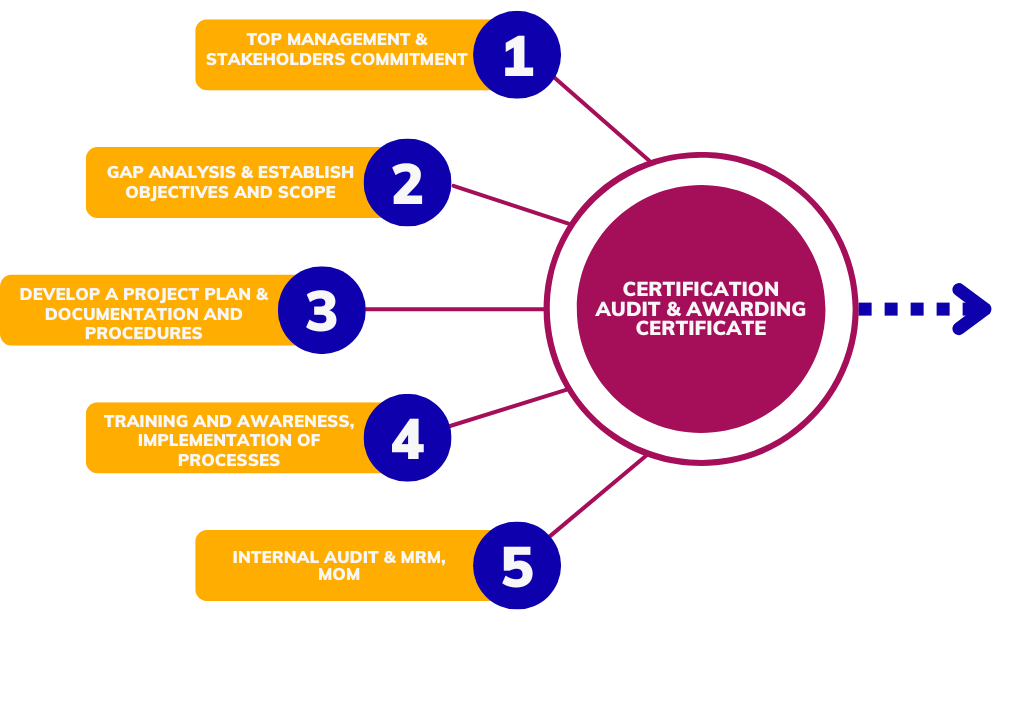
Implementing an ISO standards involves a structured methodology to ensure that the organization effectively meets the requirements of the chosen standard and achieves certification. Sometimes defined methodology may vary depending on factors such as the size of the organization, its industry, and the complexity of the ISO standard being implemented, the following steps provide a basic framework


Benefits of having ISO Certification
Enhanced Credibility and Reputation
Legal and Regulatory Compliance
Enhanced Customer Satisfaction
Access to Global Markets
Environmental Sustainability
Information Security
Our Achievements and Success
Our Clients





OUR
SERVICES
HACCP Certification Services in Baghdad for Seven-Principle Hazard Control
Baghdad food businesses that prepare, process, store, transport, or serve food need a practical HACCP plan that identifies hazards and controls them at the right points in the process.
A focused method for controlling food safety hazards
HACCP certification services in Baghdad focus on the Seven HACCP Principles: conduct hazard analysis, determine critical control points, establish critical limits, set monitoring procedures, define corrective actions, verify the system, and maintain records.
Unlike a broad management system, HACCP is centred on product flow and hazard control. It asks what can go wrong at each step, which hazards are significant, where control is essential, and what evidence proves the control is working.
For kitchens, food processors, bakeries, cold stores, catering units, packaging operations, and ingredient handling businesses, a well-built HACCP plan helps teams move from general hygiene awareness to specific monitoring and corrective action.
Qualitcert supports Baghdad food organisations with process-flow review, hazard analysis support, CCP identification, monitoring formats, verification planning, record control, and HACCP audit-readiness guidance.
Why HACCP planning is important in Baghdad food operations
Food businesses in Baghdad often manage fast-moving ingredients, variable supplier records, manual preparation steps, temperature-sensitive products, and service deadlines.
These conditions make informal control risky. A chef, production supervisor, storekeeper, driver, and quality checker may all influence food safety, but each person needs to understand the exact control point relevant to the product.
HACCP planning helps identify whether a hazard is controlled by a prerequisite programme, an operational control, or a critical control point. This prevents teams from treating every step as critical while missing the few steps that truly determine safety.
The plan also supports training. Staff can learn what must be checked, how often it must be checked, what limit applies, and what action is required when a result is outside the acceptable range.
HACCP Benefits for Baghdad Food Businesses
The value comes from clear decisions at process steps where food safety can be lost or protected.
Sharper hazard visibility
Biological, chemical, physical, allergen, and process hazards are reviewed step by step.
Defined critical limits
Temperature, time, pH, metal detection, or other limits can be set where control is essential.
Faster corrective action
Staff know what to do when monitoring shows a loss of control.
Better verification discipline
Records, reviews, tests, and observations confirm whether the HACCP plan remains effective.
Practical HACCP Applications in Baghdad
HACCP should be designed around the product, process flow, intended consumer, and actual control measures.
Central kitchens and catering
Control receiving, cooking, cooling, hot holding, chilled transport, reheating, and service steps.
Bakeries and sweet production
Manage ingredient control, allergen handling, baking parameters, cooling, packaging, and storage.
Meat and poultry handling
Evaluate cross-contamination, chilled storage, preparation, cooking, cleaning, and waste controls.
Cold stores and distributors
Monitor temperature, loading, stock rotation, vehicle hygiene, and delivery conditions.
Juice and beverage operations
Control water quality, washing, blending, filling, cleaning, and shelf-life-related hazards.
Restaurants and hotel kitchens
Define CCPs or key controls for high-risk menu items, preparation zones, and holding conditions.
How HACCP Readiness Is Developed
The route follows HACCP logic from product understanding to control monitoring and verification.
Assemble product information
Confirm ingredients, intended use, consumer group, packaging, shelf life, and storage needs.
Map process flow
Create and verify the flow diagram from receiving through final service or dispatch.
Conduct hazard analysis
Assess biological, chemical, physical, allergen, and process hazards at each step.
Determine CCPs and limits
Select critical control points and define measurable limits where loss of control is unacceptable.
Set monitoring and corrective action
Document who checks, how often, what is recorded, and what happens when limits fail.
Verify and maintain records
Review monitoring logs, calibration, testing, observations, corrective actions, and plan updates.
Documents Commonly Prepared for HACCP
Records should show how each HACCP principle has been applied to the actual product and process.
Typical HACCP Records
- Product description
- Intended-use statement
- Process flow diagram
- Hazard analysis table
- CCP decision record
- Critical limit sheet
- Monitoring log
- Corrective action record
- Verification schedule
- HACCP review minutes
Weak Points to Avoid
These issues can make a HACCP plan ineffective even when forms exist.
- Copying a HACCP plan from another product.
- Declaring too many CCPs without decision logic.
- Setting limits that staff cannot measure.
- Recording monitoring results after the activity ends.
- Failing to update the plan after menu, ingredient, or process changes.
Food Safety Standards Related to HACCP
Food organisations that need a full management system can review ISO 22000 certification services in Baghdad.
Businesses targeting wider scheme recognition may also consider FSSC 22000 certification services in Baghdad.
Food brands with additional market requirements can compare HACCP controls with Halal, GMP and Organic certification services in Baghdad.
HACCP Questions from Baghdad Food Businesses
These answers focus on the Seven HACCP Principles, hazard control, and practical implementation.
What is HACCP certification in Baghdad?
It is certification or verification support for a hazard-control system based on the Seven HACCP Principles applied to a food process.
What are the Seven HACCP Principles?
They are hazard analysis, CCP determination, critical limits, monitoring, corrective actions, verification, and record keeping.
How is HACCP different from ISO 22000?
HACCP focuses on hazard analysis and control points, while ISO 22000 uses HACCP principles within a broader Food Safety Management System.
What is a critical control point?
A CCP is a step where control is essential to prevent, eliminate, or reduce a significant food safety hazard to an acceptable level.
Can every food business use HACCP?
Yes. The depth of the HACCP plan depends on product risk, process complexity, customer expectations, and regulatory or buyer requirements.
What records are needed for HACCP?
Typical records include flow diagrams, hazard analysis, CCP decisions, monitoring logs, corrective actions, verification records, and plan reviews.
What is a critical limit?
A critical limit is a measurable boundary that separates acceptable from unacceptable control at a CCP.
Who should monitor HACCP controls?
Trained staff assigned to the process should monitor controls and record results at the frequency defined in the plan.
When should a HACCP plan be reviewed?
It should be reviewed after product changes, process changes, supplier changes, equipment changes, incidents, audit findings, or verification failures.
How does Qualitcert support HACCP readiness?
Qualitcert helps with product-flow review, hazard analysis, CCP planning, monitoring formats, corrective action rules, verification plans, and audit-readiness support.
Build a Practical HACCP Plan in Baghdad
Share your product list, process flow, and existing food safety records. Qualitcert can help structure HACCP readiness around your actual Baghdad food operation.