

ISO Certifications
Nige
ria
Consulting &
ISO Certifications

-ISO Certification-
QUALIT
CERT
CONSULTING AND ISO CERTIFICATIONS
Qualitcert provides specialized ISO 22000 certification consulting services in Nigeria, aimed at assisting organizations in establishing effective Food Safety Management Systems (FSMS). Their expert consultants guide clients through the entire certification process, starting with a thorough assessment of current food safety practices to identify areas for improvement. They help develop comprehensive documentation, implement necessary procedures, and train staff to ensure compliance with ISO 22000 standards. Qualitcert also performs internal audits to prepare the organization for the final certification audit. With Qualitcert’s support, Nigerian food businesses can achieve ISO 22000 certification, ensuring their products meet international safety standards, enhancing customer trust, and opening up new market opportunities.
Please Reach Us Today


Approach and Methodology used to implement Management System Standard
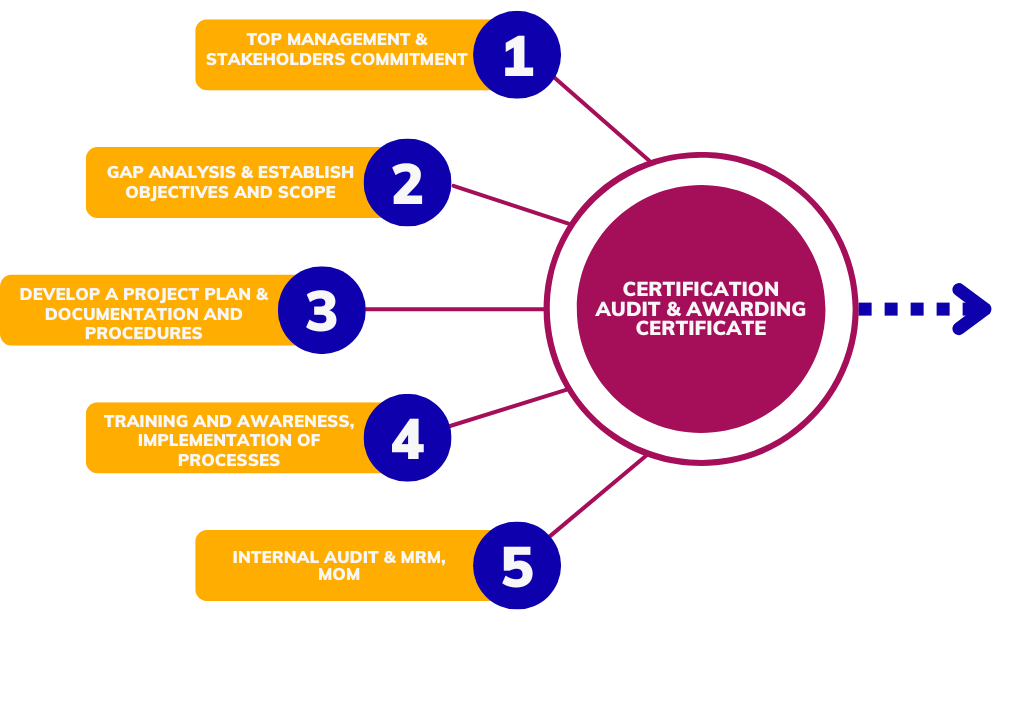
Implementing an ISO standards involves a structured methodology to ensure that the organization effectively meets the requirements of the chosen standard and achieves certification. Sometimes defined methodology may vary depending on factors such as the size of the organization, its industry, and the complexity of the ISO standard being implemented, the following steps provide a basic framework

OUR
Process
1, Determine the ISO Standard
2. Understand the Requirements
3. Training and Awareness
4. Implement the System
5. Internal Audit
6. Certification

Benefits of having ISO Certification
Enhanced Credibility and Reputation
Legal and Regulatory Compliance
Enhanced Customer Satisfaction
Access to Global Markets
Environmental Sustainability
Information Security
Our Achievements and Success
Our Clients





OUR
SERVICES
ISO 22000 Certification Services in Nigeria for Controlled Food Safety Systems
ISO 22000 integrates food-safety hazards, prerequisite programmes, operational controls and management-system discipline across Nigeria's food chain.
Connect hazard control with leadership, communication and traceability
ISO 22000 specifies requirements for a food safety management system applicable to organisations at any stage of the food chain. It combines management-system requirements with prerequisite programmes, hazard analysis, operational prerequisite programmes and critical control points.
Nigerian food businesses often manage complex raw-material supply, variable storage conditions, imported ingredients, contract transport and seasonal demand. Product safety can be affected by supplier changes, temperature excursions, allergen cross-contact, sanitation failures or incomplete traceability.
A functioning FSMS starts by describing products and intended use, mapping process steps, confirming the flow diagram and identifying biological, chemical and physical hazards. The control-measure categorisation process then determines whether hazards are managed through PRPs, OPRPs or CCPs.
Qualitcert supports food-safety team development, hazard analysis, PRP evaluation, traceability, recall testing, verification planning, internal audit and certification readiness. Documentation is built around the actual process and product risk.
Food-chain control from farm inputs to consumer delivery
Nigeria's processors, cold stores, caterers, packers and distributors need food-safety controls that remain effective across long and sometimes fragmented supply chains.
Supplier approval is essential where raw materials vary by source or season. Specifications, certificates, inspection criteria and acceptance decisions should show how incoming hazards are controlled before material enters production.
Temperature-controlled products require more than thermometer readings. Calibration, loading practices, alarm response, route duration, equipment maintenance and corrective action must work together to protect the cold chain.
ISO 22000 also strengthens emergency and recall readiness. Lot identification, distribution records, contact lists and simulation results allow the organisation to test whether affected product can be located and controlled promptly.
Business benefits of a structured FSMS
Food safety performance improves when preventive controls and management-system discipline reinforce each other.
More reliable hazard control
Hazard analysis and validated control measures reduce dependence on end-product testing alone.
Faster traceability decisions
Lot coding, material links and distribution records support efficient withdrawal and investigation.
Stronger customer confidence
Certification evidence helps answer retailer, hospitality, export and contract-manufacturing requirements.
Better cross-functional control
Procurement, production, maintenance, quality, warehousing and logistics work through one food safety framework.
Where ISO 22000 supports Nigerian food businesses
The FSMS scope can cover manufacturing, packaging, storage, transport, catering and supporting food-chain services.
Food and beverage manufacturing
Integrate PRPs, hazard analysis, CCP/OPRP monitoring, allergen control and product release.
Cold storage and distribution
Control receiving temperatures, storage zones, equipment alarms, loading and transport conditions.
Commercial catering
Manage menu hazards, supplier controls, preparation, hot/cold holding, hygiene and service records.
Agricultural packhouses
Address field inputs, washing, sorting, contamination prevention, traceability and dispatch.
Ingredient and packaging suppliers
Control specifications, contamination risks, supplier changes, storage and customer communication.
Retail food operations
Strengthen receiving, display temperatures, expiry control, cleaning, withdrawal and complaint response.
A food safety journey from PRPs to certification
The sequence builds technical control first, then verifies that the wider management system sustains it.
Define scope and food chain
Identify products, processes, sites, customers, external providers and applicable food safety requirements.
Strengthen prerequisite programmes
Review hygiene, sanitation, pest control, utilities, maintenance, personnel practices and storage controls.
Conduct hazard analysis
Confirm product descriptions and flow diagrams, identify hazards and assess their significance.
Classify and validate controls
Determine OPRPs and CCPs, establish action criteria or critical limits and validate control effectiveness.
Operate, verify and test
Monitor controls, manage deviations, conduct verification, test traceability and evaluate emergency arrangements.
Audit and prepare for certification
Complete internal audits, management review, corrective action and evidence readiness for external assessment.
Food safety plans, procedures and records
The evidence set should connect food safety policy and objectives with practical controls at each process step.
Typical ISO 22000 records
- FSMS scope and policy
- Food safety team records
- Product descriptions and flow diagrams
- PRP procedures and inspections
- Hazard analysis worksheets
- OPRP and CCP control plans
- Monitoring and deviation records
- Supplier approval records
- Traceability and withdrawal tests
- Verification and management review records
Food safety system errors to avoid
An FSMS can appear detailed while still failing to explain how hazards, controls and verification decisions were reached.
- Treating all controls as CCPs without using a consistent classification approach.
- Relying on finished-product testing instead of validating preventive measures.
- Using flow diagrams that do not match actual rework, storage or transfer steps.
- Running mock recalls without testing quantity reconciliation and decision speed.
- Failing to reassess hazards after ingredient, supplier, process or packaging changes.
Related ISO 22000 Services for Nigerian Organisations
For a connected requirement, review HACCP consulting services in Nigeria to coordinate shared governance, records and management responsibilities.
For a connected requirement, review ISO 9001 consulting services in Nigeria where common risks, suppliers or operational controls should be aligned.
For a connected requirement, review ISO 14001 consulting services in Nigeria to reduce duplicated work and build a more coherent assurance programme.
ISO 22000 questions from food organisations in Nigeria
The following answers distinguish FSMS requirements, PRPs, OPRPs, CCPs and traceability.
What is the purpose of ISO 22000?
ISO 22000 provides a Food Safety Management System framework that combines management controls, prerequisite programmes, hazard analysis and operational food safety control.
Who can use ISO 22000?
Food manufacturers, processors, caterers, storage and transport providers, packaging suppliers and other organisations in the food chain can use it.
What is the difference between a PRP and an OPRP?
PRPs maintain the general hygienic environment, while OPRPs are hazard-specific controls identified through hazard analysis and managed with defined action criteria.
How is a CCP managed under ISO 22000?
A CCP has a validated control measure, measurable critical limits, monitoring, planned corrections and corrective action, plus verification records.
Does ISO 22000 replace HACCP?
It incorporates HACCP-based hazard-control principles within a broader management system that also covers leadership, communication, objectives, audits and review.
Why are flow diagrams important?
They provide the basis for hazard analysis and must accurately represent process steps, rework, storage, transfers and outsourced activities.
What is a traceability test?
It is a planned exercise that checks whether materials, processing records and distribution information can identify affected product accurately and promptly.
Are laboratory tests enough to prove food safety?
No. Testing samples only part of production. Preventive controls, monitoring, verification and process discipline are necessary to manage food safety consistently.
How often should hazard analysis be reviewed?
It should be reviewed after significant changes and at planned intervals to confirm that products, processes, suppliers and scientific assumptions remain valid.
How does Qualitcert support ISO 22000 certification in Nigeria?
Qualitcert can assist with PRP review, hazard analysis, control plans, documentation, training, traceability exercises, internal audits and certification preparation.
Build an ISO 22000 FSMS Around Your Nigerian Food Operations
Provide your product range, process flow, PRPs and current hazard analysis. Qualitcert can help establish a risk-based FSMS and a clear route to certification.