

Ir
aq

QUALIT
CERT
Qualitcert provides expert ISO 22000 Certification Consulting Services in Iraq, helping food businesses achieve global standards in food safety management. ISO 22000 is an internationally recognized standard designed to ensure the safety of food at every step of the supply chain. In a growing market like Iraq spanning cities such as Baghdad, Basra, Erbil, and Mosul implementing ISO 22000 is essential for businesses that want to meet both regulatory and customer demands. Qualitcert works with food manufacturers, processors, suppliers, and distributors to establish a robust Food Safety Management System (FSMS). Our consulting process covers hazard analysis, prerequisite programs, traceability, and emergency preparedness. We help Iraqi companies align with Codex HACCP principles and ISO documentation requirements. Our consultants conduct training, internal audits, and gap assessments to prepare your team for certification. Whether you’re targeting local markets or exports, ISO 22000 enhances credibility, food safety performance, and customer trust. Qualitcert ensures a smooth and cost-effective certification process tailored to the Iraqi food industry. We offer end-to-end support from initial analysis to final certification. Our local expertise combined with international experience makes us a preferred choice for ISO 22000 in Iraq. Partner with Qualitcert to strengthen your food safety system and stay competitive in Iraq’s food sector.
ISO Certification Process – Step by Step Guide
The ISO certification process helps organizations implement international standards to improve quality, safety, efficiency, and compliance. Below is a structured step-by-step ISO certification process followed by professional ISO consultants and certification bodies.
ISO Application
The organization submits an application for ISO certification and defines the scope of certification including departments, processes, and operations.
Gap Analysis
ISO consultants analyze the current management system and identify gaps between existing processes and ISO standard requirements.
ISO Documentation
Preparation of ISO manuals, procedures, policies, risk assessments, and records required to comply with ISO standards.
System Implementation
ISO processes are implemented across departments with employee training, process control, and compliance monitoring.
Internal Audit
Internal auditors review the management system to verify compliance and identify corrective actions before the certification audit.
Management Review
Top management evaluates the effectiveness of the ISO management system and ensures readiness for certification.
Certification Audit
An accredited certification body conducts an external audit to verify compliance with ISO standards.
ISO Certification
After successful audit completion, the organization receives the official ISO certificate demonstrating compliance with international standards.
Surveillance Audits
Annual surveillance audits ensure continuous compliance and improvement of the ISO management system.
Please Reach Us Today


Approach and Methodology used to implement Management System Standard
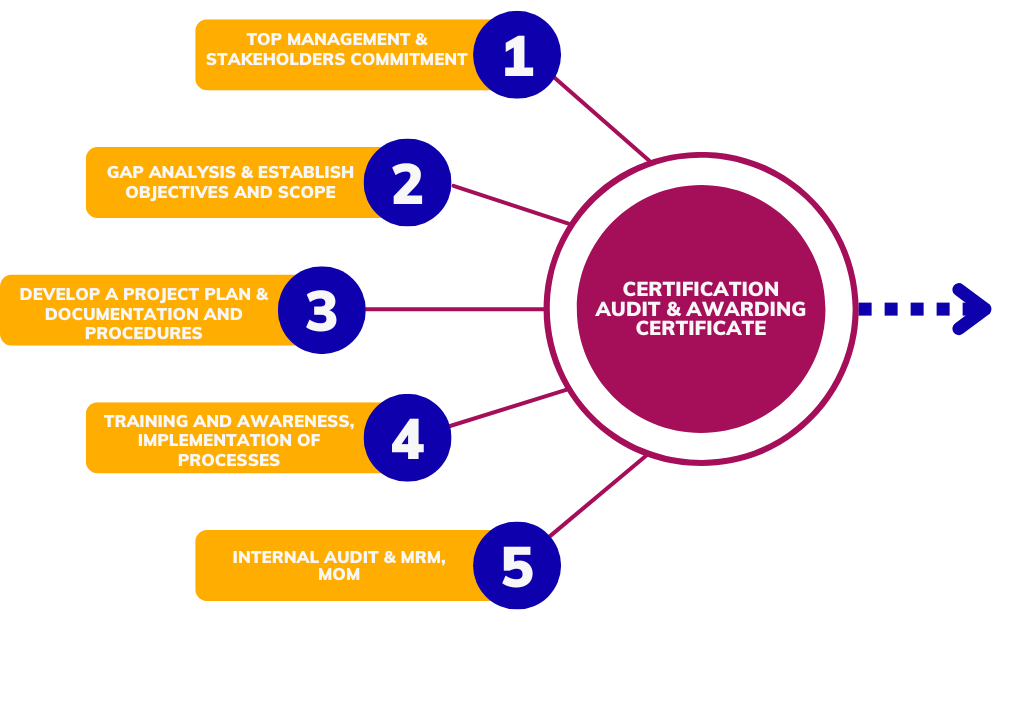
Implementing an ISO standards involves a structured methodology to ensure that the organization effectively meets the requirements of the chosen standard and achieves certification. Sometimes defined methodology may vary depending on factors such as the size of the organization, its industry, and the complexity of the ISO standard being implemented, the following steps provide a basic framework


Benefits of having ISO Certification
Enhanced Credibility and Reputation
Legal and Regulatory Compliance
Enhanced Customer Satisfaction
Access to Global Markets
Environmental Sustainability
Information Security
Our Achievements and Success
Our Clients





OUR
SERVICES
ISO 22000 Certification Consulting Services in Iraq for Food Safety Systems
ISO 22000 helps food businesses in Iraq manage food safety hazards through a complete Food Safety Management System covering PRPs, HACCP principles, communication and verification.
A food safety system from supplier intake to customer delivery
ISO 22000 certification consulting services in Iraq focus on the full food chain. The system covers procurement, storage, processing, handling, packaging, transport, cleaning, pest control, personal hygiene, traceability, withdrawal and verification.
Unlike a simple hygiene checklist, ISO 22000 requires a Food Safety Management System that combines prerequisite programmes, hazard analysis, operational PRPs, critical control points, documented communication and continual improvement.
Food processors, catering operations, warehouses, restaurants, packaging suppliers and distribution companies can use ISO 22000 to organise controls for biological, chemical, physical and allergen hazards. The system also supports customer audits and buyer confidence where food safety evidence is requested.
Qualitcert helps build food safety documentation, hazard analysis, process flow diagrams, monitoring records, corrective action routes, validation evidence and internal audit readiness for businesses preparing for certification.
ISO 22000 priorities for Iraq food businesses
Food safety expectations are important for local supply, hospitality, catering, retail and institutional buyers.
Food businesses often manage multiple risk points: raw material quality, temperature control, cross-contamination, cleaning effectiveness, pest control, packaging integrity and transport conditions.
ISO 22000 connects these controls into one management system. It requires defined responsibilities, food safety objectives, communication with suppliers and customers, emergency preparedness, verification planning and management review.
The standard can be integrated with ISO 9001 for process control or HACCP programmes for hazard analysis. However, ISO 22000 remains broader because it includes management system requirements and verification across the food safety chain.
ISO 22000 Benefits for Iraq Organisations
The main value is consistent control of food safety risk backed by records and verification.
Stronger hazard control
Biological, chemical, physical and allergen hazards are assessed and controlled systematically.
Improved traceability
Batch, supplier and delivery records support faster investigation and withdrawal decisions.
Better buyer confidence
Customers can review structured food safety records and certification readiness evidence.
More reliable operations
PRPs, monitoring and corrective action reduce inconsistent food handling practices.
Where ISO 22000 Applies in Iraq
The FSMS should match the type of food product, process flow and customer requirements.
Food manufacturing
Raw material checks, processing controls, CCP monitoring and packaging hygiene can be managed.
Catering and hospitality
Menu preparation, allergen control, temperature logs and cleaning schedules can be documented.
Cold storage
Temperature control, stock rotation and dispatch records support food safety evidence.
Retail food supply
Supplier approval, receiving checks and display controls can be standardised.
Bakeries and confectionery
Ingredient control, foreign body prevention and sanitation records can be monitored.
Food packaging suppliers
Material hygiene, storage, contamination control and customer requirements can be included.
ISO 22000 Implementation Approach
Implementation should follow the product flow and verify that controls are effective.
Define food safety scope
Identify products, sites, processes, suppliers and food chain responsibilities.
Map process flow
Prepare and verify process flow diagrams for each product or product family.
Build PRPs
Document hygiene, cleaning, pest control, maintenance, waste and personnel practices.
Conduct hazard analysis
Identify hazards and determine CCPs, OPRPs and monitoring requirements.
Verify implementation
Check monitoring records, corrective actions, traceability and validation evidence.
Review and improve
Use internal audits, test results, complaints and management review to improve the FSMS.
ISO 22000 Documents and Food Safety Evidence
Food safety evidence must prove that controls are implemented at the right process points.
Typical Records
- Food safety policy
- Product description
- Process flow diagram
- PRP procedures
- Hazard analysis worksheet
- CCP monitoring log
- OPRP monitoring log
- Cleaning schedule
- Traceability record
- Withdrawal test report
Food Safety Gaps to Avoid
These problems can weaken the FSMS and create audit concerns.
- Using generic hazard analysis not linked to actual products.
- Not verifying process flow diagrams on site.
- Monitoring CCPs without defined corrective action.
- Confusing PRPs with CCPs without clear justification.
- Keeping traceability records that cannot support a mock recall.
Internal Links for Iraq Pages
For a connected requirement, review HACCP certification consulting services in Iraq and align shared records where the same departments, suppliers or controls are involved.
For a connected requirement, review ISO 9001 certification consulting services in Iraq and align shared records where the same departments, suppliers or controls are involved.
For a connected requirement, review ISO 14001 certification consulting services in Iraq and align shared records where the same departments, suppliers or controls are involved.
ISO 22000 Questions from Iraq Food Businesses
These answers focus on Food Safety Management Systems and certification readiness.
What is ISO 22000 certification in Iraq?
It is certification of a Food Safety Management System that controls food safety hazards across the food chain.
How is ISO 22000 different from HACCP?
ISO 22000 includes HACCP principles but also adds management system requirements such as policy, objectives, communication, audits and management review.
What are PRPs in ISO 22000?
Prerequisite programmes are basic hygiene and operational conditions such as cleaning, pest control, personnel hygiene and maintenance.
What is an OPRP?
An operational prerequisite programme is a control measure that manages significant food safety hazards but is not handled as a CCP.
What documents are needed for ISO 22000?
Documents include food safety policy, PRPs, flow diagrams, hazard analysis, monitoring logs, traceability records and withdrawal procedures.
Does ISO 22000 require traceability?
Yes. Traceability supports product identification, supplier tracking, batch control and withdrawal decisions.
Who can apply ISO 22000?
Food manufacturers, caterers, warehouses, distributors, packaging suppliers and food service businesses can apply ISO 22000.
What is food safety verification?
Verification checks whether controls are implemented and effective through review, testing, audits and record evaluation.
Can ISO 22000 integrate with ISO 9001?
Yes. Process control, document control, audits and management review can be integrated while food safety controls remain specific.
How does Qualitcert support ISO 22000 in Iraq?
Qualitcert helps prepare FSMS documentation, hazard analysis, monitoring records, internal audit and certification readiness.
Prepare ISO 22000 Certification in Iraq
Share your food products, process flow and current hygiene controls. Qualitcert can help build an FSMS that supports safer food operations and audit readiness.