

Ir
aq

QUALIT
CERT
Qualitcert provides expert HACCP certification consulting services across Iraq to support food businesses in establishing effective food safety systems. HACCP (Hazard Analysis and Critical Control Points) is an internationally accepted method for managing food safety risks. Qualitcert guides organizations in Iraq through the identification of biological, chemical, and physical hazards in food production processes. Their services include customized HACCP plan development, gap analysis, risk assessment, and critical control point identification. By implementing HACCP, companies in Iraq ensure safer food handling, improved product quality, and compliance with local and global standards. The certification is essential for food manufacturers, catering services, restaurants, and distribution chains. Qualitcert’s experienced team offers end-to-end assistance, including documentation support, staff training, internal audits, and pre-certification readiness checks. With a structured and practical approach, businesses can prevent contamination, reduce foodborne illnesses, and avoid costly product recalls. HACCP also improves operational control and boosts customer trust. Whether you’re in Baghdad, Basra, Erbil, or any other major city, Qualitcert’s HACCP services are accessible across Iraq. Their focus on continuous improvement ensures your food safety system remains effective over time. Trust Qualitcert to achieve HACCP certification efficiently and reliably in Iraq.
ISO Certification Process – Step by Step Guide
The ISO certification process helps organizations implement international standards to improve quality, safety, efficiency, and compliance. Below is a structured step-by-step ISO certification process followed by professional ISO consultants and certification bodies.
ISO Application
The organization submits an application for ISO certification and defines the scope of certification including departments, processes, and operations.
Gap Analysis
ISO consultants analyze the current management system and identify gaps between existing processes and ISO standard requirements.
ISO Documentation
Preparation of ISO manuals, procedures, policies, risk assessments, and records required to comply with ISO standards.
System Implementation
ISO processes are implemented across departments with employee training, process control, and compliance monitoring.
Internal Audit
Internal auditors review the management system to verify compliance and identify corrective actions before the certification audit.
Management Review
Top management evaluates the effectiveness of the ISO management system and ensures readiness for certification.
Certification Audit
An accredited certification body conducts an external audit to verify compliance with ISO standards.
ISO Certification
After successful audit completion, the organization receives the official ISO certificate demonstrating compliance with international standards.
Surveillance Audits
Annual surveillance audits ensure continuous compliance and improvement of the ISO management system.
Please Reach Us Today


Approach and Methodology used to implement Management System Standard
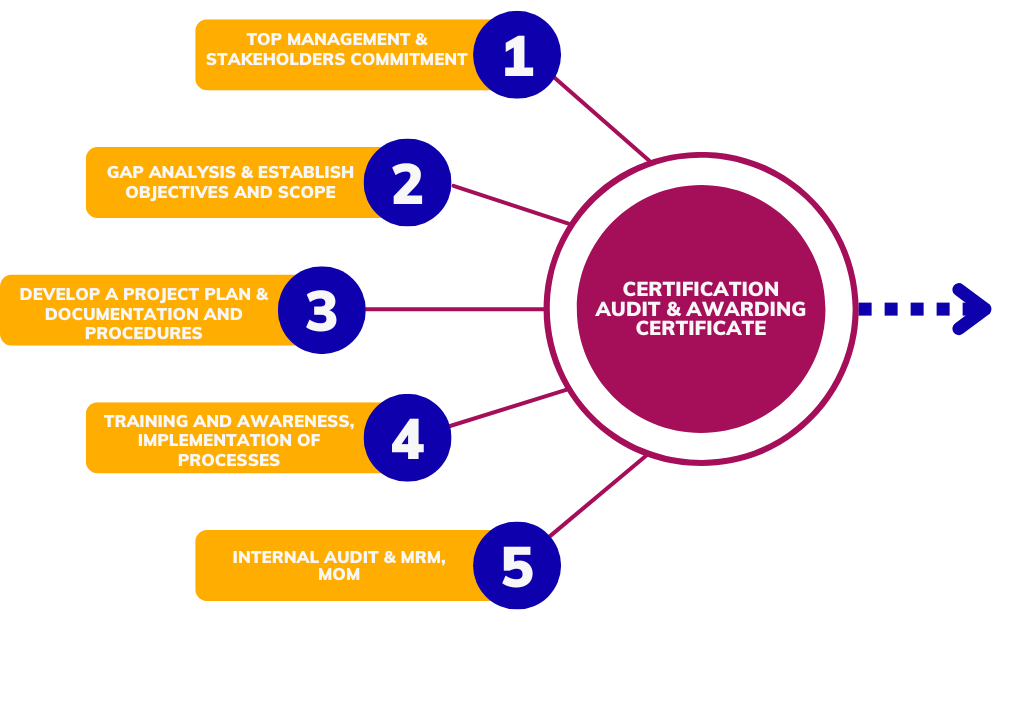
Implementing an HACCP standards involves a structured methodology to ensure that the organization effectively meets the requirements of the chosen standard and achieves certification. Sometimes defined methodology may vary depending on factors such as the size of the organization, its industry, and the complexity of the HACCP standard being implemented, the following steps provide a basic framework


Benefits of having ISO Certification
Enhanced Credibility and Reputation
Legal and Regulatory Compliance
Enhanced Customer Satisfaction
Access to Global Markets
Environmental Sustainability
Information Security
Our Achievements and Success
Our Clients





OUR
SERVICES
HACCP Certification Consulting Services in Iraq Based on the Seven HACCP Principles
HACCP helps food businesses in Iraq identify hazards, determine critical control points and monitor the controls that prevent unsafe food from reaching customers.
Hazard analysis before food safety problems happen
HACCP certification consulting services in Iraq focus on the Seven HACCP Principles: conduct hazard analysis, identify critical control points, establish critical limits, monitor CCPs, define corrective actions, verify the system and maintain records.
The approach is product and process specific. A HACCP plan for cooked meals will differ from a plan for chilled distribution, bakery production, beverage processing or dry goods packaging because the hazards, controls and monitoring points differ.
For food handlers, caterers, processors, retailers, warehouses and hospitality operators, HACCP gives a clear route to control biological, chemical, physical and allergen hazards at the points where control is essential.
Qualitcert supports product description, flow diagram development, hazard analysis, CCP decision logic, monitoring formats, corrective action records, verification planning and staff awareness so the HACCP plan is usable on the floor.
HACCP priorities for Iraq food businesses
Food operations need clear controls at the exact points where hazards can be prevented, eliminated or reduced to acceptable levels.
Many food businesses have cleaning schedules and temperature logs, but HACCP requires a disciplined analysis of hazards throughout the process flow. This includes receiving, storage, preparation, processing, cooling, packing and transport.
The HACCP team must decide which steps are critical, how limits are monitored, what happens if a limit is not met and how records prove control. This prevents the plan from becoming a generic food safety document.
HACCP can support ISO 22000 readiness, but it is narrower in purpose. It concentrates on hazard control and CCP management, while ISO 22000 adds a broader management system around food safety.
HACCP Benefits for Iraq Food Operations
The greatest benefit is control at the points that matter most for food safety.
Focused hazard prevention
Teams identify hazards before relying on end-product inspection.
Clear CCP monitoring
Critical limits and monitoring responsibilities reduce uncertainty during production.
Faster corrective action
Deviations can be handled using defined actions and disposition rules.
Better buyer assurance
Customers can review a structured HACCP plan and supporting records.
HACCP Use Cases in Iraq
Each HACCP plan should be built around the product, process and intended consumer.
Catering kitchens
Cooking, cooling, reheating and holding temperatures can be managed as critical controls.
Meat and poultry handling
Cross-contamination, chilling and sanitation hazards can be analysed.
Bakery production
Ingredient control, foreign body prevention and baking controls can be documented.
Beverage processing
Water quality, filtration, cleaning and packaging controls can be monitored.
Cold chain distribution
Temperature limits, dispatch checks and vehicle hygiene can be controlled.
Retail food preparation
Ready-to-eat handling, allergen separation and display temperatures can be reviewed.
How HACCP Certification Readiness Is Structured
The route follows the product flow and applies the Seven HACCP Principles.
Describe products
Define ingredients, process, packaging, storage, shelf life and intended use.
Verify flow diagrams
Confirm each process step through site review and team input.
Conduct hazard analysis
Identify biological, chemical, physical and allergen hazards at each step.
Determine CCPs
Use decision logic to decide where critical control is needed.
Set monitoring and actions
Define critical limits, monitoring records and corrective action routes.
Verify and maintain records
Review records, validate controls and update the plan when processes change.
Documents Commonly Needed for HACCP
HACCP records should prove that hazards are assessed and critical controls are monitored.
Typical Records
- Product description
- Process flow diagram
- HACCP team record
- Hazard analysis table
- CCP decision record
- Critical limit sheet
- CCP monitoring log
- Corrective action form
- Verification checklist
- HACCP plan review record
HACCP Mistakes to Avoid
These weaknesses can make the HACCP plan unreliable.
- Copying CCPs from another process without hazard analysis.
- Setting critical limits without scientific or operational justification.
- Monitoring temperatures without calibrated equipment.
- Recording deviations without product disposition decisions.
- Not reviewing the HACCP plan after ingredient, equipment or process changes.
Internal Links for Iraq Pages
For a connected requirement, review ISO 22000 certification consulting services in Iraq and align shared records where the same departments, suppliers or controls are involved.
For a connected requirement, review ISO 9001 certification consulting services in Iraq and align shared records where the same departments, suppliers or controls are involved.
For a connected requirement, review ISO 14001 certification consulting services in Iraq and align shared records where the same departments, suppliers or controls are involved.
HACCP Questions from Iraq Food Businesses
These answers focus on hazard analysis, CCPs and practical monitoring.
What is HACCP certification in Iraq?
HACCP certification confirms that a food business has a hazard analysis and critical control point system for food safety control.
What are the Seven HACCP Principles?
They are hazard analysis, CCP identification, critical limits, monitoring, corrective action, verification and record keeping.
How is HACCP different from ISO 22000?
HACCP focuses on hazard control and CCPs, while ISO 22000 includes HACCP within a broader Food Safety Management System.
What is a critical control point?
A CCP is a process step where control is essential to prevent, eliminate or reduce a food safety hazard.
What are critical limits?
Critical limits are measurable boundaries such as temperature, time, pH or detection sensitivity that separate control from loss of control.
Who needs HACCP?
Food processors, caterers, restaurants, cold stores, distributors, bakeries and food retailers can use HACCP.
What records are needed for HACCP?
Records include flow diagrams, hazard analysis, CCP monitoring logs, corrective actions, verification records and plan reviews.
Why is verification important?
Verification confirms that the HACCP system works and that monitoring records are complete and reliable.
Can HACCP support customer audits?
Yes. A clear HACCP plan and records help answer buyer questions about food safety controls.
How does Qualitcert support HACCP in Iraq?
Qualitcert helps prepare HACCP plans, hazard analysis, monitoring formats, corrective actions and audit readiness.
Develop a HACCP Plan for Iraq Operations
Share your products, process flow and current food safety records. Qualitcert can help prepare a HACCP system based on the Seven HACCP Principles.