

ISO Certifications
Nige
ria
Consulting &
ISO Certifications

-ISO Certification-
QUALIT
CERT
CONSULTING AND ISO CERTIFICATIONS
Qualitcert offers comprehensive ISO 17025 certification services in Nigeria, aimed at helping laboratories achieve and maintain accreditation for their competence in testing and calibration. Their experienced consultants guide laboratories through the entire certification process, starting with an initial gap analysis to identify areas needing improvement. They assist in developing and implementing a quality management system that meets the stringent requirements of ISO 17025. This includes the creation of detailed documentation, procedures, and quality manuals. Qualitcert also provides training for laboratory staff to ensure they understand and can effectively implement the standard’s requirements. Throughout the process, Qualitcert offers continuous support and advice, preparing laboratories for the final audit and ensuring a smooth path to achieving ISO 17025 certification. This certification helps laboratories enhance their credibility, improve operational efficiency, and assure clients of their technical competence and reliable results.
Please Reach Us Today


Approach and Methodology used to implement Management System Standard
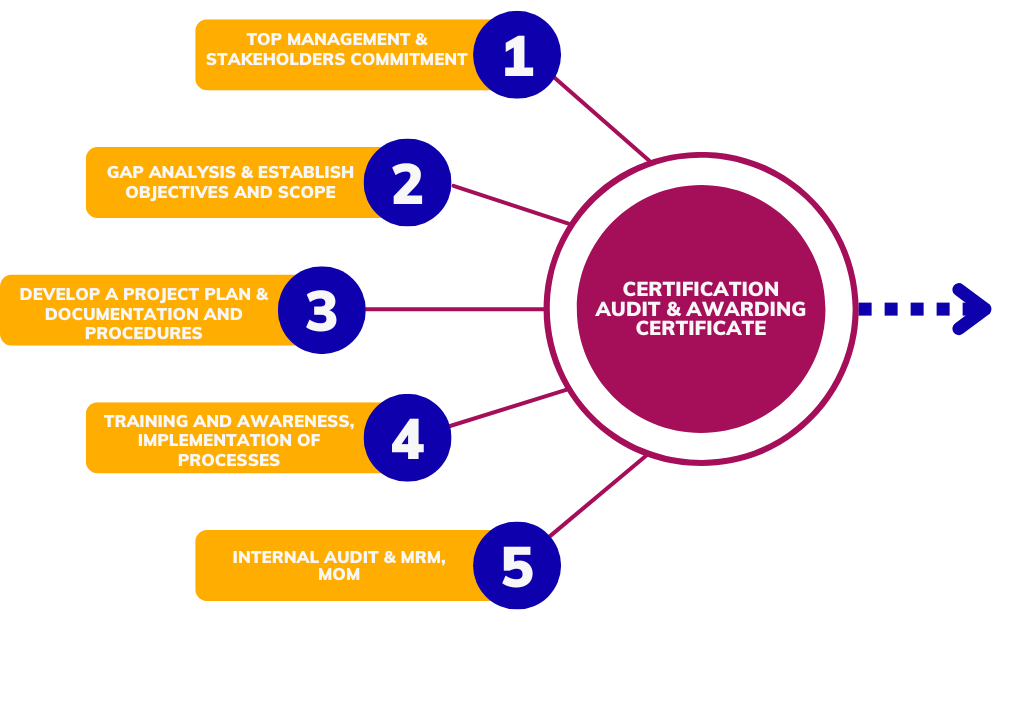
Implementing an ISO standards involves a structured methodology to ensure that the organization effectively meets the requirements of the chosen standard and achieves certification. Sometimes defined methodology may vary depending on factors such as the size of the organization, its industry, and the complexity of the ISO standard being implemented, the following steps provide a basic framework

OUR
Process
1, Determine the ISO Standard
2. Understand the Requirements
3. Training and Awareness
4. Implement the System
5. Internal Audit
6. Certification

Benefits of having ISO Certification
Enhanced Credibility and Reputation
Legal and Regulatory Compliance
Enhanced Customer Satisfaction
Access to Global Markets
Environmental Sustainability
Information Security
Our Achievements and Success
Our Clients





OUR
SERVICES
ISO 17025 Certification Services in Nigeria for Valid and Defensible Laboratory Results
ISO/IEC 17025 helps Nigerian testing and calibration laboratories demonstrate technical competence, impartiality and consistent production of valid results.
Prove competence through methods, people, equipment and data
ISO/IEC 17025 sets competence requirements for testing and calibration laboratories. It covers impartiality, confidentiality, organisational structure, personnel competence, facilities, equipment, metrological traceability, method validation, sampling, result reporting and management-system controls.
A laboratory can have experienced analysts and still produce unreliable results if methods are not verified, equipment status is unclear, reference materials are unsuitable or calculation files are uncontrolled. Accreditation readiness depends on technical evidence, not only procedures.
Nigerian laboratories supporting food, petroleum, construction, environmental, healthcare and industrial sectors must define a precise scope. For each test or calibration, the laboratory should show authorised methods, competent personnel, suitable conditions, controlled equipment and assurance of result validity.
Qualitcert supports gap assessment, scope development, method verification or validation, uncertainty evaluation, equipment and reference-material systems, internal audit, management review and readiness for accreditation assessment.
Confidence in results used for trade, safety and compliance
Laboratory reports influence product release, environmental decisions, engineering acceptance and regulatory action, making result validity a business-critical issue.
Sample identity and condition must be protected from receipt through disposal. Acceptance criteria, chain of custody, storage, preparation and deviations should be recorded so results can be interpreted correctly.
Metrological traceability requires more than calibration certificates. The laboratory must evaluate calibration scope, uncertainty, status, intermediate checks and the effect of any equipment found outside tolerance.
Proficiency testing, quality-control samples, replicate testing and trend review help detect performance changes. The laboratory should define how results are evaluated and what happens when acceptance criteria are not met.
How ISO 17025 strengthens technical confidence
The standard helps laboratories reduce avoidable variation and make competence visible to customers and assessors.
More defensible results
Method, equipment, environmental and quality-control records support technical validity.
Clearer competence authorisation
Training, observation and performance evidence define which personnel may perform and approve work.
Improved measurement confidence
Traceability and uncertainty evaluation clarify the quality and limitations of reported results.
Stronger customer acceptance
A structured competence system supports tenders, supply-chain approval and accreditation readiness.
ISO 17025 use cases across Nigeria
Each laboratory should define a precise scope that matches methods, matrices, ranges, equipment and capability.
Petroleum testing laboratories
Control sampling, fuel methods, reference materials, equipment, calculations and report authorisation.
Food and water laboratories
Demonstrate microbiological and chemical method competence, media control, traceability and quality checks.
Construction materials testing
Manage field sampling, curing, dimensional equipment, compression testing and result validity.
Environmental laboratories
Control sampling plans, preservation, detection limits, blanks, standards and data review.
Medical device and pharmaceutical labs
Strengthen method validation, equipment qualification, reference standards and controlled reporting.
Calibration laboratories
Establish measurement capability, uncertainty budgets, traceability, environmental conditions and certificates.
From technical scope to ISO 17025 assessment
The route must develop technical evidence for every activity included in the proposed laboratory scope.
Define scope and impartiality
List tests or calibrations, methods, ranges, locations and risks to impartiality.
Evaluate personnel competence
Set competence criteria, train, observe, authorise and monitor each technical role.
Control methods and equipment
Verify methods, maintain equipment, manage standards and monitor environmental conditions.
Establish result validity
Plan quality control, proficiency testing, interlaboratory comparison and trend review.
Audit technical processes
Sample jobs from receipt through calculation, review, reporting and record retention.
Prepare for assessment
Complete management review, corrective action and an evidence index for the accreditation body.
Technical and management records for ISO 17025
Records must support reconstruction of work and demonstrate that competence and result-validity controls were applied.
Typical laboratory evidence
- Defined accreditation scope
- Impartiality risk assessment
- Personnel competence records
- Method verification or validation
- Equipment and calibration records
- Measurement uncertainty budgets
- Reference material records
- Proficiency testing results
- Sample and test worksheets
- Audit and management review records
Laboratory readiness mistakes
Assessment findings often arise when management procedures exist but method-level technical evidence is incomplete.
- Listing methods in scope without current verification or validation evidence.
- Authorising analysts based only on training attendance.
- Using calibration certificates without checking traceability and suitability.
- Calculating uncertainty once and not reviewing changes in contributors.
- Participating in proficiency testing without analysing unsatisfactory or questionable results.
Related ISO/IEC 17025 Services for Nigerian Organisations
For a connected requirement, review ISO 9001 consulting services in Nigeria to coordinate shared governance, records and management responsibilities.
For a connected requirement, review ISO 13485 consulting services in Nigeria where common risks, suppliers or operational controls should be aligned.
For a connected requirement, review ISO 14001 consulting services in Nigeria to reduce duplicated work and build a more coherent assurance programme.
ISO 17025 questions from laboratories in Nigeria
These answers cover scope, methods, uncertainty, traceability, competence and result validity.
Is ISO 17025 certification or accreditation?
Laboratories are generally accredited to ISO/IEC 17025 by an accreditation body for a defined technical scope.
Can a small laboratory implement ISO 17025?
Yes. The system can be proportionate, but the laboratory must still demonstrate competence, valid methods, traceability and quality assurance for its scope.
What is method verification?
Verification confirms that a laboratory can achieve acceptable performance when implementing an established standard method.
When is method validation needed?
Validation is commonly required for non-standard, laboratory-developed, modified or out-of-scope methods.
Why is measurement uncertainty important?
It describes the dispersion associated with a measurement result and supports interpretation, comparability and conformity decisions.
What is metrological traceability?
It is the property of a result linked to a reference through a documented unbroken chain of calibrations, each contributing to uncertainty.
How is personnel competence demonstrated?
Through defined criteria, training, observation, practical evaluation, quality-control performance and formal authorisation.
Is proficiency testing always required?
The laboratory should use proficiency testing or suitable interlaboratory comparison where available and appropriate within a planned result-validity strategy.
What is a decision rule?
It explains how measurement uncertainty is considered when a laboratory reports conformity with a specification.
How does Qualitcert support ISO 17025 readiness in Nigeria?
Qualitcert can support scope design, method and equipment controls, uncertainty, competence, audits, management review and assessment readiness.
Prepare Your Nigerian Laboratory for ISO 17025 Assessment
Share your proposed scope, methods, equipment list and current quality controls. Qualitcert can help identify technical gaps and organise accreditation-readiness evidence.