Global ISO Certification Consultant Services – Qualitcert

QualitCert Get a Quote

ISO Certifications

zarqa

Consulting &

ISO Certifications

-ISO Certification-

HACCP Certification Services in Zarqa

QUALIT

CERT

CONSULTING AND ISO CERTIFICATIONS

HACCP (Hazard Analysis and Critical Control Points) Certification Services are provided by Qualitcert in Zarqa to assist companies in putting in place strong food safety management systems. With a focus on risk management and proactive hazard control throughout the production and handling processes, this certification guarantees that food products adhere to international safety requirements. From detecting possible hazards to putting in place efficient control measures, Qualitcert’s staff helps businesses at every stage. In the end, they help firms avoid contamination, cut down on waste, and boost client confidence. Businesses in Zarqa may show a strong commitment to food safety, comply with legal regulations, and obtain a competitive edge in both domestic and foreign markets by obtaining Qualitcert’s HACCP certification.

Please Reach Us Today

Test
Consultants Consultants
afd9a249 perf wp theme group 8796 Consultants Consultants

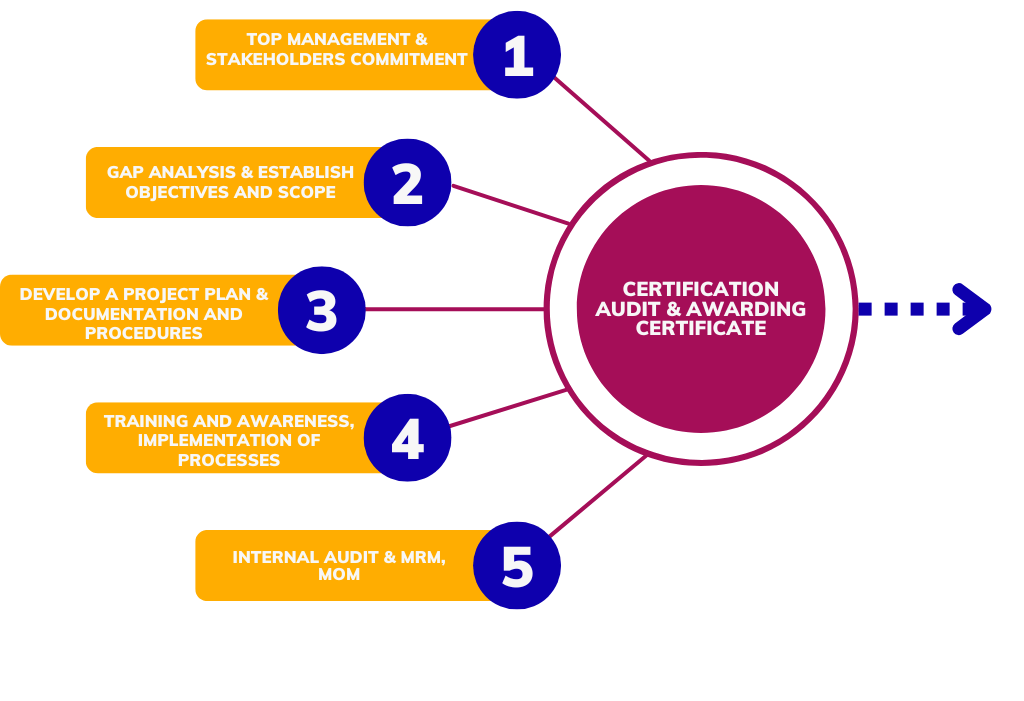
Approach and Methodology used to implement Management System Standard

Colorful Minimalist Linear Steps Circular Diagram 1 e1712599893569 Consultants Consultants

Implementing an ISO  standards involves a structured methodology to ensure that the organization effectively meets the requirements of the chosen standard and achieves certification. Sometimes defined methodology may vary depending on factors such as the size of the organization, its industry, and the complexity of the ISO standard being implemented, the following steps provide a basic framework

Ellipse 6 copy Consultants Consultants

OUR

Process

1, Determine the ISO Standard

2. Understand the Requirements

3. Training and Awareness

4. Implement the System

5. Internal Audit

6. Certification

partner_img Consultants Consultants

Benefits of having ISO Certification

Enhanced Credibility and Reputation

Legal and Regulatory Compliance

Enhanced Customer Satisfaction

Access to Global Markets

Environmental Sustainability

Information Security

Our Achievements and Success

Professional Experts
0 +
Years Experience
0 +
Projects
0 +
Satisfied Customers
0 %

Our Clients

WhatsApp Image 2023 05 12 at 8.24.31 PM e1684164170667
WhatsApp Image 2023 05 12 at 8.16.53 PM e1684163940587
WhatsApp Image 2023 05 12 at 8.22.55 PM
WhatsApp Image 2023 05 12 at 8.04.13 PM 3 e1684163886384
WhatsApp Image 2023-05-12 at 8.15.32 PM

OUR

SERVICES

ISO 9001 Certification
ISO 45001 Certification
ISO 14001 Certification
ISO 22000 Certification
ISO 13485 Certification
ISO 27001 Certification
ISO 20000-1 Certification
ISO 29001 Certification
Hazard Control for Zarqa Food Operations

HACCP Certification Services in Zarqa for Seven Principles, Critical Control Points and Food Hazard Prevention

HACCP helps Zarqa food businesses identify significant food safety hazards, establish control measures and monitor critical points so unsafe products are prevented before release.

A focused hazard-control system based on the seven HACCP principles

HACCP certification services in Zarqa focus on hazard analysis and control. The system is built around seven principles: conduct hazard analysis, determine critical control points, establish critical limits, establish monitoring, establish corrective actions, establish verification and establish documentation and records.

The purpose is narrower and more operational than a full management system standard. HACCP asks whether the food operation understands its product flow, identifies biological, chemical, physical and allergen hazards, determines where control is essential and proves that those controls are monitored.

For bakeries, food processors, catering kitchens, cold stores, ingredient suppliers and distributors in Zarqa, HACCP is useful when buyers want clear evidence of hazard prevention. It is also a practical foundation before moving toward ISO 22000 or other food safety schemes.

A reliable HACCP plan must be based on the actual process. Receiving, storage, preparation, cooking, cooling, packaging, labeling, warehousing and delivery should be reviewed step by step. If the flow diagram misses rework, temporary storage or packaging changeovers, the hazard analysis will be weak.

Qualitcert supports HACCP implementation by reviewing product scope, verifying process flow, preparing hazard analysis worksheets, helping identify CCPs, defining monitoring records, building SOPs, training responsible staff and preparing audit evidence.

Food Hazard Context

Why HACCP Is Practical for Zarqa Food Businesses

Many food operations need a clear hazard-control plan before they can meet buyer, retailer, distributor or institutional customer expectations.

HACCP is especially useful when a food business handles high-risk process steps such as cooking, chilling, freezing, metal detection, allergen changeover, pasteurization, water treatment, ingredient dosing or temperature-controlled storage.

The system begins with product information and intended use. A chilled ready-to-eat product, a bakery item, a dry ingredient and a packed frozen item have different hazards, users, storage conditions and control expectations.

After the flow diagram is verified on site, the team evaluates hazards at each step and decides which hazards are significant. Control measures are then reviewed to determine whether a point is a CCP or managed through other prerequisite controls.

Monitoring is the heart of HACCP. A critical limit that is not checked, recorded and acted upon does not protect customers. Monitoring forms should state what is checked, who checks it, how often, what limit applies and what happens when the limit is not met.

Verification keeps the plan alive. Internal checks, calibration, record review, product testing, complaint review, traceability exercises and HACCP team meetings help confirm that the hazard-control system remains effective.

Implementation should be led by a competent HACCP team with knowledge of the product, process, equipment, hazards and customer requirements. A single quality officer working alone may miss operational details that affect the plan.

SOPs and prerequisite programs support the HACCP plan by controlling the environment in which food is produced or handled. Cleaning, pest control, hygiene, maintenance and supplier controls reduce hazards before CCPs are even considered.

Records should be designed around the monitoring decision. If a cook, chiller operator or warehouse supervisor must act immediately, the form should clearly show the limit, actual result, corrective action and product disposition.

Verification should include record review, direct observation, calibration, product testing where appropriate and HACCP plan review after changes. Management should review HACCP performance, deviations, complaints and recall-test results.

A comprehensive HACCP program should also define prerequisite controls clearly enough that the HACCP team knows what risks are already managed before CCP decisions are made. Weak PRPs can lead to unnecessary or unstable CCPs.

The business should define how operators are trained to recognize deviations. A monitoring form is not enough if the person completing it does not understand why the limit matters or how to protect affected product.

Continual improvement in HACCP comes from reviewing deviations, complaints, verification failures, equipment changes and new hazard information. The plan should be updated whenever evidence shows that controls are no longer adequate.

Audit readiness improves when the HACCP file contains both the plan and proof of use. Auditors will expect to see monitoring records, deviation actions, verification records and evidence that the HACCP team reviews the plan periodically.

Required forms should avoid unnecessary complexity. A strong HACCP monitoring form is usually clear, dated, signed, linked to a product or batch and designed so deviations are visible without searching through notes.

Best practice is to compare HACCP decisions with customer requirements and applicable food safety expectations. Some customers may ask for additional controls, supplier documents or verification evidence beyond the basic plan.


Hazard Prevention Value

HACCP Benefits for Zarqa Food Operations

HACCP improves control where food safety depends on specific process steps and timely decisions.

Clear control points

Teams know which process steps are critical and which limits must be monitored to prevent unsafe product.

Better deviation handling

Defined corrective actions help employees respond quickly when temperature, time, detection or other limits are not met.

Stronger buyer confidence

A documented HACCP plan gives customers evidence that food hazards are identified and controlled systematically.

Foundation for advanced systems

HACCP supports later integration with ISO 22000, FSSC 22000 or customer-specific food safety programs.

Food Sector Applications

Where HACCP Fits in Zarqa Food Businesses

The method applies wherever food hazards must be prevented, eliminated or reduced to acceptable levels.

01

Bakeries and sweet production

Control ingredient hazards, allergen handling, baking conditions, cooling, packaging, foreign-body risks and labeling.

02

Catering kitchens

Manage receiving, cooking temperatures, hot holding, chilling, reheating, cross-contamination and service time limits.

03

Cold stores

Monitor temperature control, stock rotation, loading delays, hygiene, packaging integrity and deviation response.

04

Food processing

Identify CCPs such as heat treatment, metal detection, pH, water activity, filtration or other process-specific controls.

05

Ingredient trading

Verify supplier safety documents, storage requirements, batch identity, shelf life and recall information.

06

Packaging and repacking

Control hygiene, foreign-body risk, label accuracy, allergen declarations and product mix-up risks.

Seven Principle Route

How HACCP Implementation Is Developed

The certification journey should follow the HACCP principles without skipping product information, flow verification or record control.

01

Describe product and flow

Define product scope, intended use, process flow diagrams, storage conditions and distribution routes.

02

Conduct hazard analysis

Identify biological, chemical, physical and allergen hazards at each process step and evaluate significance.

03

Determine CCPs

Use a logical decision approach to identify where control is critical to food safety.

04

Set limits and monitoring

Define critical limits, monitoring method, frequency, responsibility and record format for each CCP.

05

Plan corrective actions

Document how to handle deviations, affected product, root causes, records and release decisions.

06

Verify and maintain

Review records, calibrate equipment, test traceability, conduct internal reviews and update the HACCP plan after changes.

HACCP Records

Documents, SOPs and Forms Needed for HACCP Certification

HACCP documentation should prove that the seven principles are applied to the real food process.

Typical Records

  • HACCP team list and responsibilities
  • Product description and intended use
  • Verified process flow diagram
  • Hazard analysis worksheet
  • CCP determination record
  • Critical limit records
  • CCP monitoring forms
  • Corrective action records for deviations
  • Verification schedule and verification records
  • Calibration records for monitoring devices
  • Traceability and recall test records
  • HACCP plan review minutes
HACCP records should be simple enough for operators to complete accurately during production, storage or service.

HACCP Mistakes to Avoid

HACCP problems usually happen when the plan is copied, too broad or not maintained after process changes.

  • Using a HACCP plan that does not match actual equipment, recipes, routes or product categories.
  • Calling every control point a CCP, which makes the plan hard to manage and weakens focus.
  • Setting critical limits without scientific, regulatory or process-based justification.
  • Failing to define product disposition when a CCP deviation occurs.
  • Not reviewing the HACCP plan after supplier, ingredient, equipment, packaging or process changes.
Best practice is to train the HACCP team, verify the flow on site and review monitoring records routinely.
Related Zarqa Food Safety Services

Businesses that need a full food safety management system can build on HACCP through ISO 22000 certification services in Zarqa.

Food manufacturers with customer or international scheme requirements may also evaluate FSSC 22000 certification services in Zarqa.

Food businesses that want stronger process control, supplier management and corrective action discipline can integrate HACCP with ISO 9001 certification services in Zarqa.

FAQs

HACCP Questions from Zarqa Food Businesses

These answers focus on the seven HACCP principles, hazard control, CCPs and certification readiness.

What is HACCP certification?

HACCP certification verifies that a food business has implemented a hazard analysis and critical control point system based on the seven HACCP principles.

What are the seven HACCP principles?

The seven principles are hazard analysis, determining CCPs, establishing critical limits, establishing monitoring, establishing corrective actions, establishing verification and establishing documentation and records.

How is HACCP different from ISO 22000?

HACCP focuses on hazard analysis and control points, while ISO 22000 adds a broader food safety management system with leadership, objectives, communication, internal audit and management review.

What is a critical control point?

A critical control point is a process step where control is essential to prevent, eliminate or reduce a significant food safety hazard to an acceptable level.

Which Zarqa businesses can use HACCP?

Bakeries, catering kitchens, food processors, cold stores, ingredient suppliers, distributors and packaging or repacking operations can use HACCP.

What records are needed for HACCP?

Typical records include product descriptions, flow diagrams, hazard analysis, CCP decisions, critical limits, monitoring records, corrective actions, verification records and HACCP review minutes.

Does HACCP require monitoring?

Yes. Monitoring proves whether each CCP remains within its critical limit and whether corrective action is needed.

What happens when a critical limit is exceeded?

The organization should control affected product, take corrective action, identify the cause, record the deviation and verify that safety is restored.

Can HACCP support buyer approval?

Yes. Many buyers want evidence that the supplier has identified hazards, established CCPs and maintains monitoring and verification records.

How does Qualitcert support HACCP in Zarqa?

Qualitcert supports product and flow review, hazard analysis, CCP determination, HACCP plan documentation, SOPs, monitoring forms, training and audit readiness.

Speak with Qualitcert

Prepare a Practical HACCP Plan in Zarqa

Share your product list, process flow and current food safety controls. Qualitcert can help you build a HACCP system that focuses on real hazards and audit-ready monitoring records.

Request a Consultation →
Scroll to Top