

erbil

HACCP Certification Services in Erbil
QUALIT
CERT
In Erbil, Qualitcert provides comprehensive HACCP (Hazard Analysis and Critical Control Points) certification services to help businesses comply with stringent food safety standards essential for protecting public health. The HACCP system follows a preventive approach by identifying, evaluating, and controlling food safety hazards at every stage of the production and handling process, ensuring the highest levels of hygiene and safety. Qualitcert’s experienced team supports organizations throughout the certification journey from conducting hazard analysis to establishing critical control points and implementing corrective actions ensuring seamless compliance. Their HACCP services are tailored for various sectors including food manufacturing, processing, packaging, and distribution, enabling organizations to align with international food safety regulations. By achieving HACCP certification through Qualitcert, companies in Erbil demonstrate a strong commitment to food safety, earning customer trust and enhancing their market reputation. This certification not only ensures regulatory compliance but also cultivates a culture of continuous improvement in food safety practices.
ISO Certification Process – Step by Step Guide
The ISO certification process helps organizations implement international standards to improve quality, safety, efficiency, and compliance. Below is a structured step-by-step ISO certification process followed by professional ISO consultants and certification bodies.
ISO Application
The organization submits an application for ISO certification and defines the scope of certification including departments, processes, and operations.
Gap Analysis
ISO consultants analyze the current management system and identify gaps between existing processes and ISO standard requirements.
ISO Documentation
Preparation of ISO manuals, procedures, policies, risk assessments, and records required to comply with ISO standards.
System Implementation
ISO processes are implemented across departments with employee training, process control, and compliance monitoring.
Internal Audit
Internal auditors review the management system to verify compliance and identify corrective actions before the certification audit.
Management Review
Top management evaluates the effectiveness of the ISO management system and ensures readiness for certification.
Certification Audit
An accredited certification body conducts an external audit to verify compliance with ISO standards.
ISO Certification
After successful audit completion, the organization receives the official ISO certificate demonstrating compliance with international standards.
Surveillance Audits
Annual surveillance audits ensure continuous compliance and improvement of the ISO management system.
Get In Touch


Approach and Methodology used to implement Management System Standard
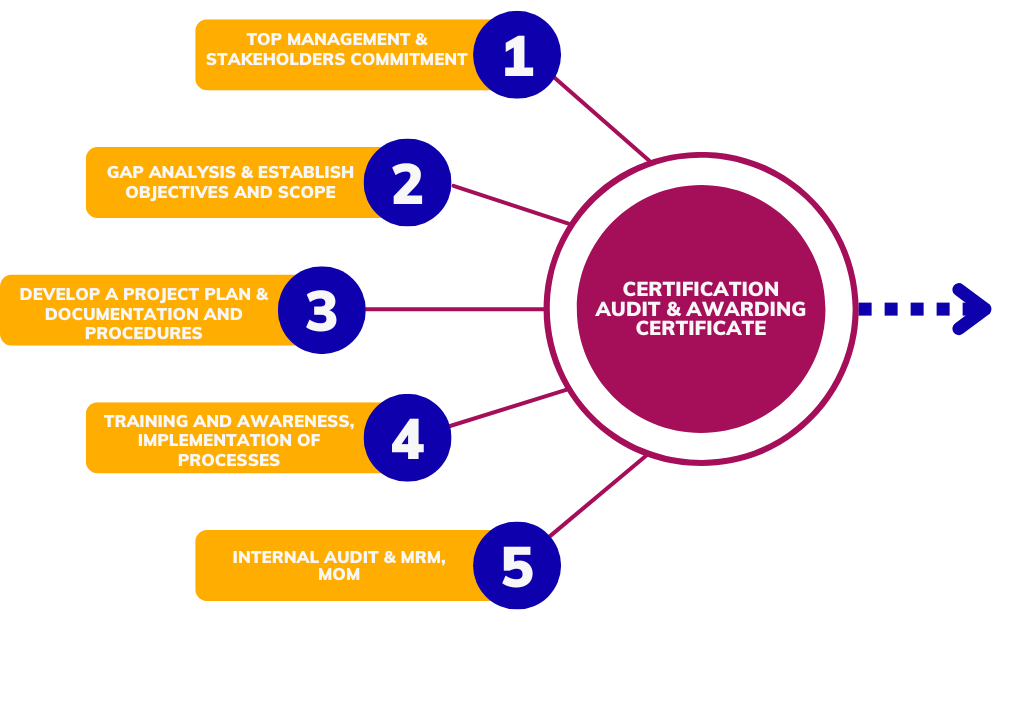
Implementing an ISO standards involves a structured methodology to ensure that the organization effectively meets the requirements of the chosen standard and achieves certification. Sometimes defined methodology may vary depending on factors such as the size of the organization, its industry, and the complexity of the ISO standard being implemented, the following steps provide a basic framework


Benefits of having ISO Certification
Enhanced Credibility and Reputation
Legal and Regulatory Compliance
Enhanced Customer Satisfaction
Access to Global Markets
Environmental Sustainability
Information Security
Our Achievements and Success
Our Clients





OUR
SERVICES
HACCP Certification Services in Erbil for Hazard Control and Food Safety Planning
HACCP helps Erbil food businesses identify food safety hazards, decide critical control points, set critical limits and monitor controls before unsafe food reaches customers.
Hazard control based on the food process
HACCP certification services in Erbil focus on the Seven HACCP Principles and the practical control of biological, chemical, physical and allergen hazards. Unlike broad management system programmes, HACCP starts with the food process and asks where hazards can occur and how they must be controlled.
A HACCP plan should be specific to the product, ingredient, process flow and customer use. Catering operations, restaurants, bakeries, processors, cold stores and food distributors can use HACCP to strengthen preventive control.
The Seven HACCP Principles cover hazard analysis, critical control point identification, critical limits, monitoring, corrective action, verification and record keeping. Each principle must be connected to real operating conditions.
Qualitcert helps Erbil food organisations develop HACCP plans, review prerequisite controls, train staff, prepare monitoring forms and build certification readiness.
Why HACCP matters for Erbil food handling
Food businesses need controls that work during busy service, large-volume production, delivery and storage.
Food safety failures can happen when monitoring is informal or when staff do not know what action to take after a temperature, time or contamination deviation. HACCP makes those decisions explicit.
In Erbil food operations, HACCP is useful for high-risk processes such as cooling, reheating, hot holding, cold storage, cooking, packing and transport. It also supports customer and buyer confidence where food safety evidence is requested.
A strong plan depends on accurate flow diagrams, realistic hazard assessment and practical monitoring forms that staff can actually use.
HACCP Benefits for Erbil Food Operations
HACCP improves preventive control by concentrating attention on the points that matter most for food safety.
Focused hazard control
The plan targets hazards that could make food unsafe.
Clear CCP monitoring
Critical limits and monitoring responsibilities are defined for staff.
Faster corrective action
Teams know what to do when a deviation occurs.
Stronger audit evidence
Records show that food safety controls are being checked and verified.
HACCP Applications in Erbil
Each food process needs its own hazard logic, not a copied generic plan.
Catering kitchens
Control bulk cooking, cooling, transport, hot holding and serving time.
Restaurants
Manage cooking temperatures, cross-contamination, allergen handling and cold storage.
Bakeries
Control ingredients, baking, cooling, foreign body risk and packaging.
Meat and poultry handling
Manage receiving temperature, cooking, segregation and cleaning controls.
Cold-chain distribution
Monitor storage, transport temperature and loading practices.
Food packing units
Control foreign body risk, labelling, sanitation and batch traceability.
The HACCP Certification Journey
Implementation follows the Seven HACCP Principles and converts each principle into working records.
Describe product
Define ingredients, intended use, shelf life, storage and customer group.
Map process flow
Confirm each process step on site before hazard analysis.
Analyse hazards
Identify biological, chemical, physical and allergen hazards at each step.
Set CCP controls
Determine CCPs, critical limits, monitoring and corrective actions.
Verify the plan
Use checks, calibration, review, sampling or supervisor verification.
Maintain records
Keep monitoring, deviation, verification and review evidence current.
HACCP Documents and Records
The final record set depends on scope, process complexity, customer requirements and certification route.
Typical Records
- Product description
- Process flow diagram
- Hazard analysis worksheet
- CCP decision tree
- Critical limit record
- Monitoring form
- Corrective action form
- Verification checklist
- Calibration record
- HACCP review minutes
HACCP Mistakes to Avoid
HACCP plans become ineffective when they identify controls but do not prove monitoring or response.
- Calling every step a CCP without proper decision logic.
- Critical limits that are not measurable.
- Monitoring records completed without actual checks.
- No corrective action when a limit is exceeded.
- Flow diagrams not verified against the real operation.
Internal Links for Erbil Pages
HACCP works closely with ISO 22000 for broader FSMS implementation and with quality management where supplier control and corrective action are shared.
For connected management system planning, review ISO 22000 certification services in Erbil so shared records, audits and corrective actions can be aligned.
Where another requirement affects the same teams, ISO 9001 certification services in Erbil can help reduce duplicate documentation and improve certification readiness.
For a wider compliance roadmap, consider ISO 13485 certification services in Erbil when the scope, customers or risks make it relevant.
HACCP Questions from Erbil Food Businesses
These answers focus on the Seven HACCP Principles, CCPs and food hazard control.
What is HACCP certification?
It is certification of a hazard control system that identifies food safety hazards and manages them through defined control points and records.
What are the Seven HACCP Principles?
They are hazard analysis, CCP identification, critical limits, monitoring, corrective action, verification and record keeping.
What is a CCP?
A Critical Control Point is a process step where control is essential to prevent, eliminate or reduce a food safety hazard.
How is HACCP different from ISO 22000?
HACCP is focused on hazard control. ISO 22000 includes HACCP within a wider Food Safety Management System.
Who needs HACCP in Erbil?
Restaurants, caterers, bakeries, processors, food handlers and cold-chain businesses can benefit from HACCP.
What records are needed?
Monitoring records, corrective action forms, verification records, calibration evidence and HACCP review notes are common.
Can HACCP apply to small kitchens?
Yes. The plan should be proportionate to the menu, process flow and food safety risk.
What happens when a critical limit is exceeded?
The team must take corrective action, control affected product and record what happened.
How often should HACCP be reviewed?
It should be reviewed when products, processes, equipment or hazards change and during planned verification.
How can Qualitcert help?
Qualitcert supports HACCP plan development, documentation, staff orientation, monitoring forms and certification readiness.
Create a Practical HACCP Plan in Erbil
Share your menu, process flow or product list. Qualitcert can help develop HACCP hazard controls and monitoring records for Erbil food operations.