
erbil

ISO 22000 Certification Services in Erbil
QUALIT
CERT
In Erbil, Qualitcert offers comprehensive ISO 22000 certification services aimed at helping businesses in the food industry establish and maintain a robust Food Safety Management System (FSMS). ISO 22000 is an internationally recognized standard that integrates food safety principles across all stages of the supply chain, ensuring the production and distribution of safe food products. Qualitcert’s expert team supports organizations through each phase of the certification journey—from initial assessment and system implementation to regular audits and continual improvement strategies. By leveraging Qualitcert’s deep industry knowledge, companies can enhance operational effectiveness, comply with global food safety regulations, and build consumer trust. Achieving ISO 22000 certification not only demonstrates a strong commitment to food safety but also positions businesses in Erbil to compete confidently in both local and international markets.
ISO Certification Process – Step by Step Guide
The ISO certification process helps organizations implement international standards to improve quality, safety, efficiency, and compliance. Below is a structured step-by-step ISO certification process followed by professional ISO consultants and certification bodies.
ISO Application
The organization submits an application for ISO certification and defines the scope of certification including departments, processes, and operations.
Gap Analysis
ISO consultants analyze the current management system and identify gaps between existing processes and ISO standard requirements.
ISO Documentation
Preparation of ISO manuals, procedures, policies, risk assessments, and records required to comply with ISO standards.
System Implementation
ISO processes are implemented across departments with employee training, process control, and compliance monitoring.
Internal Audit
Internal auditors review the management system to verify compliance and identify corrective actions before the certification audit.
Management Review
Top management evaluates the effectiveness of the ISO management system and ensures readiness for certification.
Certification Audit
An accredited certification body conducts an external audit to verify compliance with ISO standards.
ISO Certification
After successful audit completion, the organization receives the official ISO certificate demonstrating compliance with international standards.
Surveillance Audits
Annual surveillance audits ensure continuous compliance and improvement of the ISO management system.
Get In Touch


Approach and Methodology used to implement Management System Standard
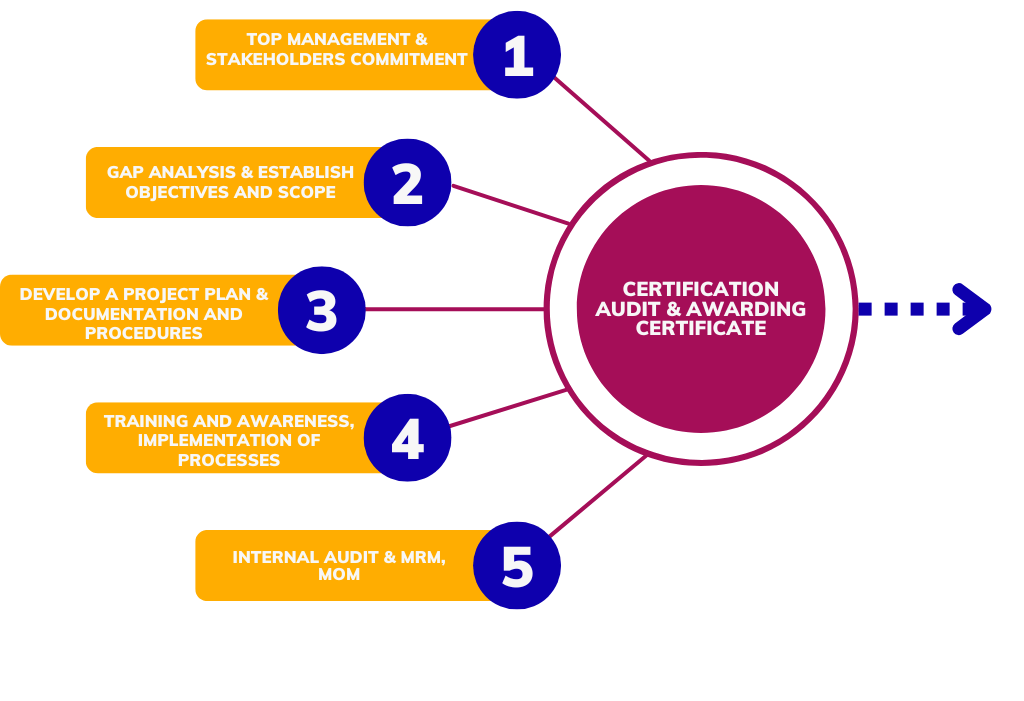
Implementing an ISO standards involves a structured methodology to ensure that the organization effectively meets the requirements of the chosen standard and achieves certification. Sometimes defined methodology may vary depending on factors such as the size of the organization, its industry, and the complexity of the ISO standard being implemented, the following steps provide a basic framework


Benefits of having ISO Certification
Enhanced Credibility and Reputation
Legal and Regulatory Compliance
Enhanced Customer Satisfaction
Access to Global Markets
Environmental Sustainability
Information Security
Our Achievements and Success
Our Clients





OUR
SERVICES
ISO 22000 Certification Services in Erbil for Food Safety Management Systems
ISO 22000 helps Erbil food businesses manage food safety hazards through PRPs, hazard analysis, operational controls, traceability and continual improvement.
A food safety system from receiving to serving or dispatch
ISO 22000 certification services in Erbil support food businesses that need a structured Food Safety Management System. The standard combines management system discipline with food safety control so hazards are identified, controlled, monitored and reviewed.
Restaurants, catering companies, bakeries, food processors, cold stores, hotels, supermarkets and food distributors need reliable controls for receiving, storage, preparation, processing, packaging, transport, cleaning, pest control and traceability.
ISO 22000 requires prerequisite programmes, hazard analysis, control measures, emergency preparedness, product withdrawal planning, verification, internal audit and management review. It is broader than a single checklist because it connects food safety decisions with management accountability.
Qualitcert helps Erbil food organisations develop FSMS documentation, implement controls, train teams and prepare for certification audit.
Food safety expectations in Erbil
Food service and food supply businesses need systems that can handle customer expectations, hygiene requirements and supplier variation.
Food safety problems often begin with small gaps: unclear receiving checks, weak cold-chain control, cleaning records completed after the fact or suppliers approved without verification. ISO 22000 brings these elements into one managed system.
The standard is useful where food operations serve hotels, events, institutions, retail customers or supply chains that expect stronger assurance. Documentation and records help prove that controls are being followed.
Implementation should be based on the process flow. Hazards, PRPs and operational controls should be specific to the food categories handled.
ISO 22000 Benefits for Erbil Food Businesses
The FSMS supports safer food handling, better supplier control and stronger buyer confidence.
Improved hazard control
Biological, chemical, physical and allergen hazards are assessed and managed.
Stronger hygiene discipline
Cleaning, pest control, personal hygiene and maintenance are tracked.
Better traceability
Batch, supplier and dispatch records support faster investigation and withdrawal.
Customer assurance
Certification readiness supports hotels, institutions, retailers and food-service contracts.
ISO 22000 Applications in Erbil
Food safety controls should match product risk, process complexity and distribution method.
Restaurants and cafes
Control receiving, storage temperatures, preparation hygiene and allergen communication.
Catering companies
Manage bulk preparation, transport, serving time and event-specific hygiene risks.
Bakeries and processors
Control ingredients, foreign bodies, cleaning, packaging and batch identification.
Cold stores
Monitor temperature, loading, product segregation and maintenance records.
Hotels
Integrate kitchen hygiene, buffet controls, supplier approval and guest safety expectations.
Food distributors
Maintain supplier records, vehicle hygiene, traceability and complaint response.
FSMS Certification Roadmap
ISO 22000 implementation follows the product flow and builds food safety evidence around it.
Define food scope
Confirm product categories, sites, processes, distribution and customer groups.
Map process flow
Document receiving, storage, preparation, processing, packaging and dispatch.
Establish PRPs
Implement hygiene, cleaning, pest control, maintenance and supplier programmes.
Analyse hazards
Identify food safety hazards and choose appropriate control measures.
Verify controls
Use monitoring, validation, traceability tests and internal audit.
Review FSMS
Management evaluates incidents, objectives, audit results and improvement actions.
FSMS Documents and Records
The final record set depends on scope, process complexity, customer requirements and certification route.
Typical Records
- Food safety policy
- Product description
- Process flow diagram
- PRP checklist
- Hazard analysis
- Supplier approval record
- Temperature log
- Cleaning schedule
- Traceability record
- Withdrawal procedure
Food Safety System Mistakes
FSMS implementation becomes weak when records are generic and not tied to actual food hazards.
- Using one hazard analysis for different product categories.
- Temperature records without defined limits or action rules.
- Supplier approval without food safety evidence.
- Cleaning schedules not verified by supervisors.
- Traceability records that cannot support a mock recall.
Internal Links for Erbil Pages
Food safety management can align with HACCP, quality management and environmental controls where hygiene, supplier approval and corrective actions overlap.
For connected management system planning, review HACCP certification services in Erbil so shared records, audits and corrective actions can be aligned.
Where another requirement affects the same teams, ISO 9001 certification services in Erbil can help reduce duplicate documentation and improve certification readiness.
For a wider compliance roadmap, consider ISO 14001 certification services in Erbil when the scope, customers or risks make it relevant.
ISO 22000 Questions from Erbil Food Businesses
These FAQs focus on Food Safety Management System implementation and certification readiness.
What is ISO 22000 certification?
It is certification of a Food Safety Management System that controls food safety hazards from receiving through production, service or distribution.
How is ISO 22000 different from HACCP?
HACCP focuses on hazard analysis and critical control. ISO 22000 includes HACCP principles within a broader management system framework.
Who can use ISO 22000 in Erbil?
Restaurants, caterers, food processors, bakeries, hotels, cold stores and distributors can use it.
What are PRPs?
Prerequisite programmes are basic hygiene and operating conditions such as cleaning, pest control, maintenance and personnel hygiene.
Does ISO 22000 require traceability?
Yes. Traceability is important for investigation, product withdrawal and customer confidence.
What records are important?
Temperature logs, cleaning records, supplier approvals, hazard analysis, PRP checks, corrective actions and internal audits are important.
Can ISO 22000 help with customer audits?
Yes. It provides structured evidence of food safety controls and management review.
What is a food safety objective?
It is a measurable target linked to food safety performance, such as reducing temperature deviations or improving supplier compliance.
How does internal audit support FSMS?
Internal audit checks whether food safety controls are followed and whether corrective action is needed.
How does Qualitcert support ISO 22000?
Qualitcert helps with FSMS gap analysis, documentation, hazard control planning, implementation and audit readiness.
Strengthen Food Safety Management in Erbil
Share your food categories, process flow and current hygiene records. Qualitcert can help prepare an ISO 22000 FSMS for Erbil operations.