
ISO Certifications
Namibia
Consulting &
ISO Certifications

-ISO Certification-
VAPT Certification Company in Namibia
QUALIT
CERT
CONSULTING AND ISO CERTIFICATIONS
A well-known VAPT (Vulnerability Assessment and Penetration Testing) certification provider in Namibia, Qualitcert is committed to strengthening businesses’ cybersecurity posture. Businesses may proactively address any risks before they can be exploited by using VAPT services to uncover security flaws in systems, networks, and applications. To examine the efficacy of current security measures, Qualitcert provides extensive evaluations that involve simulated assaults and in-depth vulnerability analysis. Their knowledgeable staff helps businesses build strong cybersecurity frameworks by offering specialized solutions, training, and certifications. Businesses in Namibia can guarantee adherence to industry standards, protect confidential data, and cultivate a security-conscious culture by collaborating with Qualitcert for VAPT certification. This will ultimately safeguard their assets and uphold stakeholder trust in an increasingly digital environment.
Get In Touch


Approach and Methodology used to implement Management System Standard
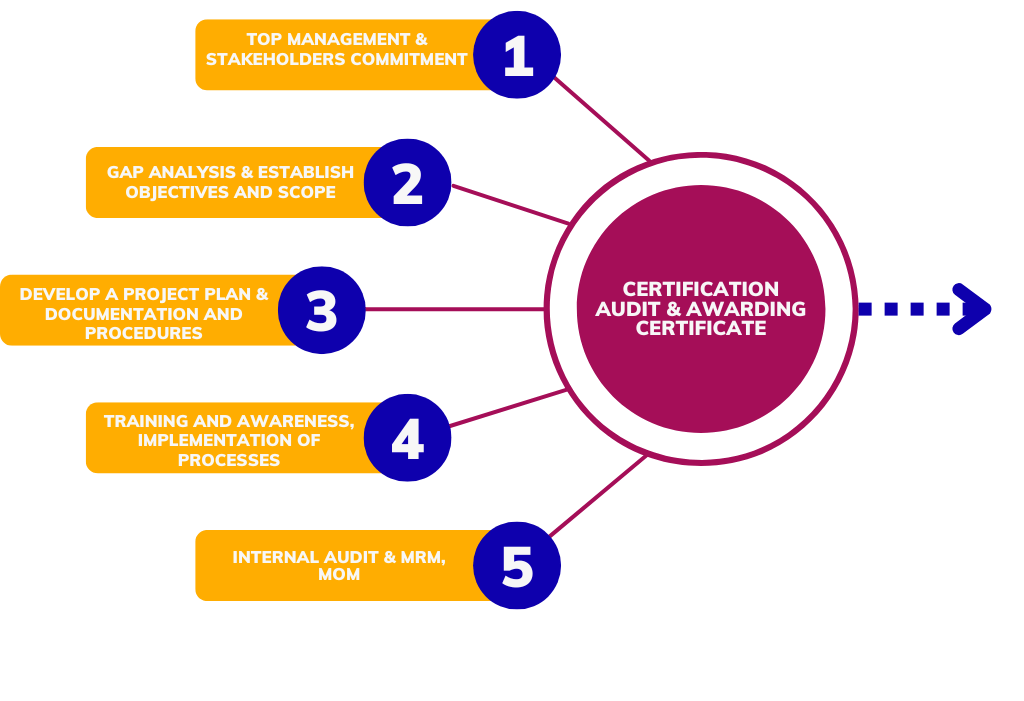
Implementing an ISO standards involves a structured methodology to ensure that the organization effectively meets the requirements of the chosen standard and achieves certification. Sometimes defined methodology may vary depending on factors such as the size of the organization, its industry, and the complexity of the ISO standard being implemented, the following steps provide a basic framework

OUR
Process
1, Determine the ISO Standard
2. Understand the Requirements
3. Training and Awareness
4. Implement the System
5. Internal Audit
6. Certification

Benefits of having ISO Certification
Enhanced Credibility and Reputation
Legal and Regulatory Compliance
Enhanced Customer Satisfaction
Access to Global Markets
Environmental Sustainability
Information Security
Our Achievements and Success
Our Clients





OUR
SERVICES
VAPT Services in Namibia for Verified Vulnerabilities and Attack Paths
VAPT combines systematic vulnerability assessment with controlled penetration testing to reveal exploitable weaknesses and prioritise remediation.
Move from automated findings to validated attack paths
Vulnerability assessment identifies weaknesses across defined assets, while penetration testing safely attempts exploitation to confirm attack paths and business impact.
Organisations in Namibia expose websites, APIs, mobile applications, remote-access gateways, cloud services and internal systems to different threat scenarios.
A controlled engagement defines scope, test windows, permitted techniques, excluded systems, data-handling rules, contacts and stopping conditions.
Qualitcert supports external, internal, web, API, mobile and cloud testing followed by risk-ranked reporting, remediation guidance and retesting.
Testing attack paths across Namibia's connected services
Online transactions, public portals, third-party integrations and remote administration can create exposures that configuration reviews do not reveal.
Authentication and authorisation require attention because weak sessions, password recovery and excessive privileges can expose sensitive information.
APIs and mobile back ends should be assessed for token handling, rate limits, input validation, data exposure and transaction logic.
Findings should identify affected assets, reproduction steps, likely impact, root conditions and recommended fixes, followed by retesting.
What disciplined VAPT provides
The value comes from validated findings and clear remediation priorities rather than raw vulnerability counts.
Verified technical risk
Manual testing separates exploitable issues from false positives and low-value scanner noise.
Prioritised remediation
Severity, exposure, exploitability and business impact guide practical action sequencing.
Stronger customer assurance
Reports and retest evidence support due diligence, compliance and contractual security expectations.
Improved engineering feedback
Root causes and attack paths help development and infrastructure teams prevent recurrence.
VAPT applications for organisations in Namibiaa
The testing method should match the asset type, threat model, authentication level and operational sensitivity.
Banks and payment services
Test customer applications, payment APIs, portals and internal attack paths.
Telecommunications
Assess subscriber platforms, exposed services, remote access and infrastructure.
Government services
Evaluate citizen portals, public applications and high-value systems.
Mining and logistics
Test remote access, supplier connections, corporate systems and exposed services.
Healthcare organisations
Assess patient systems, remote access and sensitive applications.
Cloud and software providers
Test applications, infrastructure, identity, APIs and deployment controls.
A controlled route from scope to retest
The engagement protects operational stability while producing reproducible and decision-ready evidence.
Authorise and scope
Define assets, dates, methods, credentials, exclusions, contacts, data handling and stop conditions.
Discover the attack surface
Identify reachable hosts, services, applications, APIs, versions and exposed functionality.
Assess vulnerabilities
Use appropriate tools and manual analysis to identify configuration, code and control weaknesses.
Validate exploitation safely
Confirm material findings and attack paths without exceeding agreed operational limits.
Report and remediate
Document evidence, impact, severity, root cause and prioritised corrective recommendations.
Retest closed findings
Verify remediation, identify residual exposure and issue updated status evidence.
Technical records expected from a professional engagement
Deliverables should be suitable for executives, risk owners and technical teams without exposing unnecessary sensitive detail.
Typical VAPT documentation
- Signed rules of engagement
- Authorised asset list
- Testing methodology
- Credential and access plan
- Finding evidence
- Risk and severity rationale
- Executive summary
- Technical remediation guidance
- Finding owner tracker
- Retest confirmation report
Security testing mistakes
Poorly planned testing can produce misleading results or unnecessary operational risk.
- Running scans without written authorisation and scope boundaries.
- Calling automated scanning a full penetration test.
- Testing only IP addresses while ignoring applications and APIs.
- Ranking findings by scanner score without business context.
- Closing findings from screenshots without a controlled retest.
Related VAPT Services for Namibian Organisations
For a connected requirement, review ISO/IEC 27001 certification services in Namibia to coordinate shared governance, documentation and management responsibilities.
For a connected requirement, review SOC 2 certification services in Namibia where common risks, suppliers or operational controls should be aligned.
For a connected requirement, review ISO 9001 certification services in Namibia to reduce duplicated work and build a coherent assurance programme.
VAPT questions from organisations in Namibiaa
These answers explain scope, scanning, penetration testing, reporting and remediation.
What is the difference between vulnerability assessment and penetration testing?
Vulnerability assessment identifies potential weaknesses, while penetration testing manually validates exploitability and attack impact within authorised limits.
Is an automated scan enough for VAPT?
No. Automated tools are useful, but professional testing includes manual verification, logic testing, attack-path analysis and false-positive review.
What systems can be included in VAPT?
Scope may include external or internal networks, web applications, APIs, mobile apps, cloud environments and wireless systems.
Is VAPT safe for production systems?
It can be performed safely with agreed methods, timing, stop conditions and exclusions, but residual operational risk must be assessed before testing.
What is authenticated vulnerability testing?
It uses approved credentials to inspect patching, configurations and privileges that cannot be assessed accurately from an unauthenticated position.
How are vulnerabilities prioritised?
Priority should consider technical severity, exposure, exploitability, affected data or service, compensating controls and business impact.
What should a penetration-test report contain?
It should include scope, methodology, executive findings, technical evidence, risk rationale, remediation guidance and limitations.
Why is retesting important?
Retesting confirms that the specific weakness and related attack path were removed rather than relying only on implementation statements.
How often should VAPT be performed?
Frequency should reflect risk, system change, contractual obligations and threat exposure. Major changes can trigger testing outside the routine cycle.
How does Qualitcert support VAPT in Namibiaa?
Qualitcert can help define scope, coordinate testing, present prioritised findings, support remediation tracking and verify closure through retesting.
Define a Controlled VAPT Scope for Your Namibia Systems
Share your asset list, architecture and testing constraints. Qualitcert can help plan testing, prioritise findings and verify remediation.