

ISO Certifications
ken
ya
Consulting &
ISO Certifications

-ISO Certification-
SOC I Certification Services in Kenya
QUALIT
CERT
CONSULTING AND ISO CERTIFICATIONS
Qualitcert offers professional SOC I certification services in Kenya, that assist businesses in proving their dedication to financial reporting compliance and management. In order to guarantee that their systems and procedures satisfy the highest requirements of security and accuracy, service firms that have an impact on their clients’ financial reporting must obtain SOC I accreditation. The SOC I audit process is handled by Qualitcert, which guarantees a comprehensive assessment of internal controls pertaining to the management of financial data. Our team of skilled professionals customizes our services to fit the unique requirements of your company, assisting you in lowering risks and preserving stakeholder and client trust. You may be sure that Qualitcert will help you achieve SOC I compliance quickly, boosting the reputation of your company and protecting your operations in Kenya’s cutthroat market.
Please Reach Us Today


Approach and Methodology used to implement Management System Standard
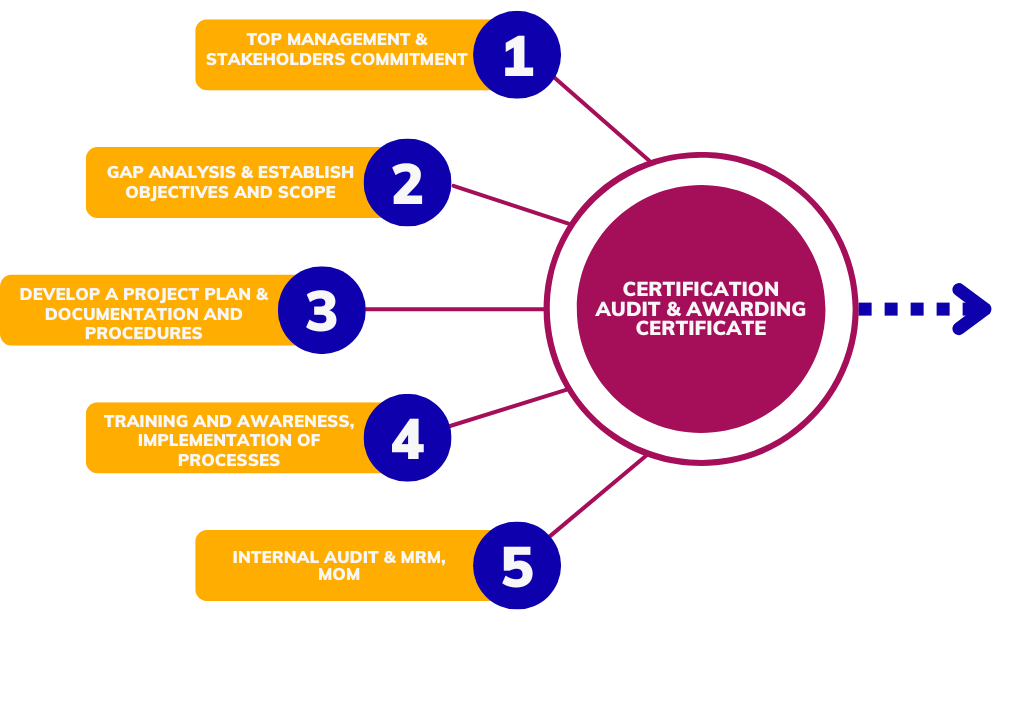
Implementing an SOC I standards involves a structured methodology to ensure that the organization effectively meets the requirements of the chosen standard and achieves certification. Sometimes defined methodology may vary depending on factors such as the size of the organization, its industry, and the complexity of the SOC I standard being implemented, the following steps provide a basic framework

OUR
Process
1, Determine the ISO Standard
2. Understand the Requirements
3. Training and Awareness
4. Implement the System
5. Internal Audit
6. Certification

Benefits of having ISO Certification
Enhanced Credibility and Reputation
Legal and Regulatory Compliance
Enhanced Customer Satisfaction
Access to Global Markets
Environmental Sustainability
Information Security
Our Achievements and Success
Our Clients





OUR
SERVICES
SOC 1 Services in Kenya for Controls Relevant to Financial Reporting
SOC 1 reports help service organisations demonstrate how outsourced processes and technology affect user entities' internal control over financial reporting.
Translate outsourced financial-process risk into testable controls
SOC 1 is an assurance reporting framework for controls at a service organisation that are relevant to user entities' internal control over financial reporting, commonly abbreviated as ICFR. It is particularly relevant where a provider processes transactions, calculations or records that feed a customer's financial statements.
The starting point is not a generic cybersecurity checklist. Management defines the services, system boundaries, control objectives and risks that could affect complete, accurate, authorised and timely financial information. Controls are then designed around those objectives.
A Type I report addresses the suitability of control design at a specified date. A Type II report also includes operating-effectiveness testing over a defined period. Both require a clear system description, management assertion and independent examination by an appropriately qualified assurance practitioner.
Qualitcert helps Kenya-based service organisations prepare for SOC 1 by defining scope, mapping financial-reporting risks, structuring control descriptions, identifying complementary user entity controls, organising evidence and resolving readiness gaps before the formal examination.
Assurance for providers handling transactions and financial data
Payroll processors, payment-support platforms, fund administrators, claims processors and finance BPO providers may influence customer ledgers and reporting.
Customers and their auditors need to understand which controls operate at the provider and which remain the customer's responsibility. A SOC 1 description clarifies that division through service commitments, subservice organisations and complementary user entity controls.
Controls may cover transaction authorisation, input completeness, processing accuracy, exception handling, access administration, change management, job monitoring, reconciliations and output distribution.
Readiness also requires evidence discipline. A control described as monthly must have complete monthly records, consistent review criteria, named reviewers and follow-up when exceptions are identified.
Why service organisations pursue SOC 1 readiness
The report can reduce repeated customer audit effort when the service genuinely affects financial-reporting controls.
Clearer customer assurance
A structured report explains relevant controls and testing to user entities and their auditors.
Better control accountability
Owners, frequencies, evidence and exception criteria are defined for financially relevant activities.
Reduced audit disruption
Reusable assurance evidence can replace multiple overlapping customer control reviews.
Stronger process discipline
Reconciliations, approvals, access and change controls become more consistent and reviewable.
Kenyan service scenarios where SOC 1 may be relevant
SOC 1 applies when the outsourced service can materially influence a customer's financial statements or ICFR.
Payroll processing
Control employee master data, pay calculations, approvals, deductions, payments and output files.
Payment and transaction support
Manage authorised input, transaction completeness, processing accuracy, settlement and exception handling.
Fund and investment administration
Control valuation inputs, investor records, fee calculations, reconciliations and financial reports.
Financial BPO services
Govern journal preparation, accounts payable, receivables, reconciliations and close-support activities.
Insurance administration
Control policy, premium, claim, reserve-support and financial data processing.
Hosted accounting platforms
Address system access, changes, batch processing, interfaces, backups and financially relevant availability.
From ICFR impact analysis to examination-ready evidence
The preparation route begins with the service's financial-reporting effect and ends with sustainable control operation.
Confirm report users and scope
Define services, systems, locations, subservice organisations and intended user entities.
Map ICFR-related risks
Identify how errors or unauthorised activity could affect transaction and reporting assertions.
Define objectives and controls
Document control purpose, owner, frequency, evidence, population and exception handling.
Prepare the system description
Describe services, infrastructure, people, procedures, data and control boundaries accurately.
Operate and test readiness
Collect evidence, sample controls, resolve gaps and confirm complementary user entity controls.
Support the examination
Coordinate management assertion, requests, exceptions and remediation with the assurance practitioner.
Records needed for financial-control assurance readiness
Evidence should be complete enough for an examiner to identify the control population, select samples and verify operation.
Typical SOC 1 readiness evidence
- Service and system scope
- ICFR risk and control matrix
- System description
- Control owner register
- Transaction processing logs
- Approval and reconciliation records
- Access review evidence
- Change management records
- Exception and incident records
- Management assertion support
SOC 1 readiness errors
Organisations lose time when the control description is broader than the available evidence or the report is used for the wrong assurance purpose.
- Treating SOC 1 as a general cybersecurity report.
- Including controls that do not affect user-entity financial reporting.
- Describing reviews without documenting criteria and follow-up.
- Ignoring complementary user entity and subservice-organisation controls.
- Starting a Type II period before controls operate consistently.
Related Kenya services for controls and trust
Providers needing assurance over security and availability can review SOC 2 services in Kenya.
Information-security governance can be strengthened through ISO 27001 certification services in Kenya.
Service-process consistency can align with ISO 9001 certification services in Kenya.
SOC 1 questions from service organisations in Kenya
These answers cover ICFR relevance, Type I and Type II reports, controls and user responsibilities.
What is a SOC 1 report used for?
It provides assurance over controls at a service organisation that are relevant to user entities' internal control over financial reporting.
Who typically requests SOC 1 assurance?
Customers whose financial reporting depends on the outsourced service, as well as their finance teams and external auditors, commonly request it.
What is the difference between SOC 1 Type I and Type II?
Type I addresses control design at a specified date, while Type II also tests operating effectiveness over a defined review period.
Is SOC 1 a certification?
SOC 1 is an independent assurance report rather than an ISO-style management-system certificate.
What are complementary user entity controls?
They are controls that customers must operate for the service organisation's controls and objectives to work as intended.
Can cybersecurity controls appear in SOC 1?
Yes, but only where they are relevant to financial-reporting risk, such as access or change controls over financially significant systems.
What should a system description include?
It should describe the service, infrastructure, software, people, procedures, data, boundaries, control objectives and relevant subservice organisations.
How long is a SOC 1 Type II review period?
The period is agreed for the engagement and should be long enough to provide meaningful operating-effectiveness evidence.
What happens when a control exception is found?
The examiner evaluates the nature and impact. Management should understand the cause, affected population, compensating controls and corrective action.
How can Qualitcert support SOC 1 readiness in Kenya?
Qualitcert can help with scope, risk-control mapping, system descriptions, evidence preparation, readiness testing and remediation planning.
Test your SOC 1 control design before the reporting period
Share your outsourced services, transaction flows, control matrix and customer assurance requests. Qualitcert can help your Kenya organisation structure a SOC 1 readiness programme.