










Global ISO Certification Consultant Services – Qualitcert

QualitCert Get a Quote

ISO Certifications

Bang

alore

Consulting &

ISO Certifications

-ISO Certification-

SOC I Certification & Consulting Service in Bangalore

QUALIT

CERT

CONSULTING AND ISO CERTIFICATIONS

Qualitcert, a renowned certification and consulting service provider in Bangalore, India, offers specialized support for SOC 1 (System and Organization Controls 1) certification. SOC 1 certification assures the effectiveness of internal controls over financial reporting within an organization. Qualitcert assists businesses in implementing robust frameworks aligned with SOC 1 standards, including thorough assessment of control objectives, risk mitigation strategies, and documentation of control activities. With expert guidance from Qualitcert consultants, organizations receive support in documentation, training, and system integration to achieve SOC 1 compliance efficiently. Qualitcert also facilitates preparation for SOC 1 audits, enabling organizations to demonstrate their commitment to financial integrity and regulatory compliance. Through their services, Qualitcert empowers businesses in Bangalore to enhance trust with stakeholders, streamline financial processes, and ensure the reliability of financial reporting practices.

Get In Touch

Test
afd9a249 perf wp theme group 8796

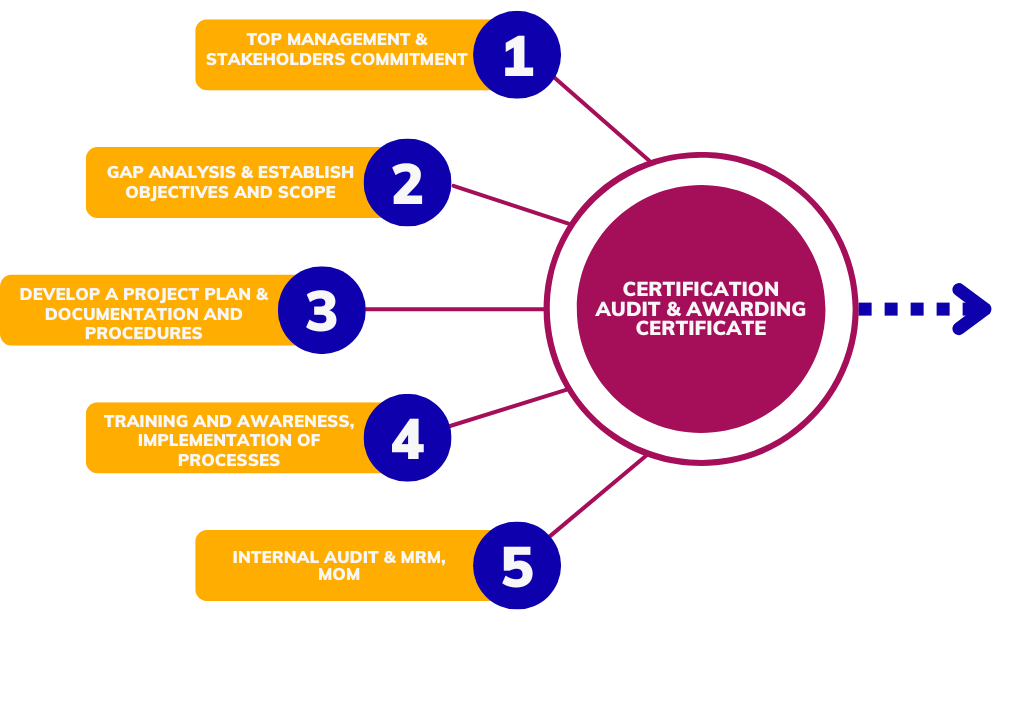
Approach and Methodology used to implement Management System Standard

Colorful Minimalist Linear Steps Circular Diagram 1 e1712599893569

Implementing an ISO  standards involves a structured methodology to ensure that the organization effectively meets the requirements of the chosen standard and achieves certification. Sometimes defined methodology may vary depending on factors such as the size of the organization, its industry, and the complexity of the ISO standard being implemented, the following steps provide a basic framework

Ellipse 6 copy

OUR

Process

1, Determine the ISO Standard

2. Understand the Requirements

3. Training and Awareness

4. Implement the System

5. Internal Audit

6. Certification

partner_img

Benefits of having ISO Certification

Enhanced Credibility and Reputation

Legal and Regulatory Compliance

Enhanced Customer Satisfaction

Access to Global Markets

Environmental Sustainability

Information Security

Our Achievements and Success

Professional Experts
0 +
Years Experience
0 +
Projects
0 +
Satisfied Customers
0 %

Our Clients

WhatsApp Image 2023 05 12 at 8.24.31 PM e1684164170667
WhatsApp Image 2023 05 12 at 8.16.53 PM e1684163940587
WhatsApp Image 2023 05 12 at 8.22.55 PM
WhatsApp Image 2023 05 12 at 8.04.13 PM 3 e1684163886384
WhatsApp Image 2023-05-12 at 8.15.32 PM

OUR

SERVICES

ISO 9001 Certification
ISO 45001 Certification
ISO 14001 Certification
ISO 22000 Certification
ISO 13485 Certification
ISO 27001 Certification
ISO 20000-1 Certification
ISO 29001 Certification
Assurance over financially relevant service controls

SOC 1 Readiness in Bangalore for Controls Affecting Financial Reporting

Prepare a clear control environment for service activities that could influence customers' internal control over financial reporting.

Connect service processes to financial-reporting risk

Bangalore service organisations may process transactions, payroll, claims, billing, reconciliations or financial data on behalf of customers. SOC 1 focuses on controls relevant to those customers' internal control over financial reporting.

Readiness begins by defining the system, services, boundaries, subservice organisations and control objectives that matter to user entities and their auditors.

We help map risks to controls, assign owners, clarify evidence and identify gaps in access, change, processing, reconciliation, exception handling and oversight.

The result is a more coherent system description and control framework that can support either a Type I or Type II examination.

Outsourced Finance in Bangalore

SOC 1 priorities for Bangalore's outsourced financial and transaction services

A focused readiness programme helps service organisations show how financially significant processes are authorised, processed, reviewed and evidenced.

Shared-service centres, payroll processors, fintech operations and business-process providers often support customers whose auditors require assurance over outsourced controls.

SOC 1 work should distinguish financially relevant controls from broader security controls, while documenting complementary user entity controls and subservice dependencies.

Qualitcert helps operational, finance, technology and compliance teams organise control narratives and evidence around the actual service delivered.

Financial Assurance Value

Why service organisations pursue SOC 1 readiness

The report can reduce repeated customer audit effort when the service genuinely affects financial-reporting controls.

Clearer customer assurance

A structured report explains relevant controls and testing to user entities and their auditors.

Better control accountability

Owners, frequencies, evidence and exception criteria are defined for financially relevant activities.

Reduced audit disruption

Reusable assurance evidence can replace multiple overlapping customer control reviews.

Stronger process discipline

Reconciliations, approvals, access and change controls become more consistent and reviewable.

SOC 1 Use Cases

Bangalore service scenarios where SOC 1 may be relevant

SOC 1 applies when the outsourced service can materially influence a customer's financial statements or ICFR.

01

Payroll Processing

Document input validation, processing, approvals, reconciliations, changes and exception handling.

02

Finance Shared Services

Control journal support, accounts processing, reconciliations and review evidence.

03

Transaction Platforms

Demonstrate completeness, accuracy, authorisation and controlled system changes.

04

Claims Administration

Map intake, assessment, approval, payment and exception controls.

05

Billing Services

Control rate tables, usage inputs, invoice generation, adjustments and review.

06

Fund and Account Support

Establish controls over data, calculations, approvals, reporting and access.

SOC 1 Readiness Journey

From ICFR impact analysis to examination-ready evidence

The preparation route begins with the service's financial-reporting effect and ends with sustainable control operation.

01

Confirm report users and scope

Define services, systems, locations, subservice organisations and intended user entities.

02

Map ICFR-related risks

Identify how errors or unauthorised activity could affect transaction and reporting assertions.

03

Define objectives and controls

Document control purpose, owner, frequency, evidence, population and exception handling.

04

Prepare the system description

Describe services, infrastructure, people, procedures, data and control boundaries accurately.

05

Operate and test readiness

Collect evidence, sample controls, resolve gaps and confirm complementary user entity controls.

06

Support the examination

Coordinate management assertion, requests, exceptions and remediation with the assurance practitioner.

SOC 1 Documentation

Records needed for financial-control assurance readiness

Evidence should be complete enough for an examiner to identify the control population, select samples and verify operation.

Typical SOC 1 readiness evidence

  • Service and system scope
  • ICFR risk and control matrix
  • System description
  • Control owner register
  • Transaction processing logs
  • Approval and reconciliation records
  • Access review evidence
  • Change management records
  • Exception and incident records
  • Management assertion support
Control evidence should show who performed the activity, when it occurred, what population was reviewed and how exceptions were resolved.

SOC 1 readiness errors

Organisations lose time when the control description is broader than the available evidence or the report is used for the wrong assurance purpose.

  • Treating SOC 1 as a general cybersecurity report.
  • Including controls that do not affect user-entity financial reporting.
  • Describing reviews without documenting criteria and follow-up.
  • Ignoring complementary user entity and subservice-organisation controls.
  • Starting a Type II period before controls operate consistently.
A readiness assessment should challenge both control design and the quality of evidence before the formal reporting period begins.
Service Organisation Assurance

For a connected requirement, review SOC 2 services in Bangalore to coordinate shared governance, documentation and management responsibilities.

For a connected requirement, review ISO/IEC 27001 services in Bangalore where common risks, suppliers or operational controls should be aligned.

For a connected requirement, review ISO 9001 services in Bangalore to reduce duplicated work and build a coherent assurance programme.

SOC 1 FAQs

SOC 1 questions from service organisations in Bangalore

These answers cover ICFR relevance, Type I and Type II reports, controls and user responsibilities.

What is a SOC 1 report used for?

It provides assurance over controls at a service organisation that are relevant to user entities' internal control over financial reporting.

Who typically requests SOC 1 assurance?

Customers whose financial reporting depends on the outsourced service, as well as their finance teams and external auditors, commonly request it.

What is the difference between SOC 1 Type I and Type II?

Type I addresses control design at a specified date, while Type II also tests operating effectiveness over a defined review period.

Is SOC 1 a certification?

SOC 1 is an independent assurance report rather than an ISO-style management-system certificate.

What are complementary user entity controls?

They are controls that customers must operate for the service organisation's controls and objectives to work as intended.

Can cybersecurity controls appear in SOC 1?

Yes, but only where they are relevant to financial-reporting risk, such as access or change controls over financially significant systems.

What should a system description include?

It should describe the service, infrastructure, software, people, procedures, data, boundaries, control objectives and relevant subservice organisations.

How long is a SOC 1 Type II review period?

The period is agreed for the engagement and should be long enough to provide meaningful operating-effectiveness evidence.

What happens when a control exception is found?

The examiner evaluates the nature and impact. Management should understand the cause, affected population, compensating controls and corrective action.

How can Qualitcert support SOC 1 readiness in Bangalore?

Qualitcert can help with scope, risk-control mapping, system descriptions, evidence preparation, readiness testing and remediation planning.

Prepare financially relevant controls for examination

Plan SOC 1 Readiness for Your Bangalore Service Organisation

Clarify the system boundary, control objectives, evidence expectations and remediation priorities for Type I or Type II assurance.

Start the SOC 1 Readiness Review
Scroll to Top