








Global ISO Certification Consultant Services – Qualitcert

QualitCert Get a Quote

ISO Certifications

riffa

Consulting &

ISO Certifications

-ISO Certification-

PCI DSS Certification Services in Riffa

QUALIT

CERT

CONSULTING AND ISO CERTIFICATIONS

In order to guarantee that companies fulfill the strictest security requirements for handling credit card payments, Qualitcert provides thorough PCI DSS (Payment Card Industry Data Security Standard) certification services in Riffa. With a knowledgeable staff, Qualitcert assists businesses in comprehending and putting into practice the 12 essential PCI DSS criteria, which include safeguarding cardholder data, securing network infrastructures, putting robust access control measures in place, and routinely testing and monitoring systems. Their offerings include risk analysis, remedial advice, gap assessments, and help finishing the certification procedure. By collaborating with Qualitcert, companies inRiffa may improve credit card transaction security throughout their operations, comply with international security requirements, reduce the danger of data breaches, and gain the trust of their clients.

Get In Touch

Test
Consultants Consultants
afd9a249 perf wp theme group 8796 Consultants Consultants

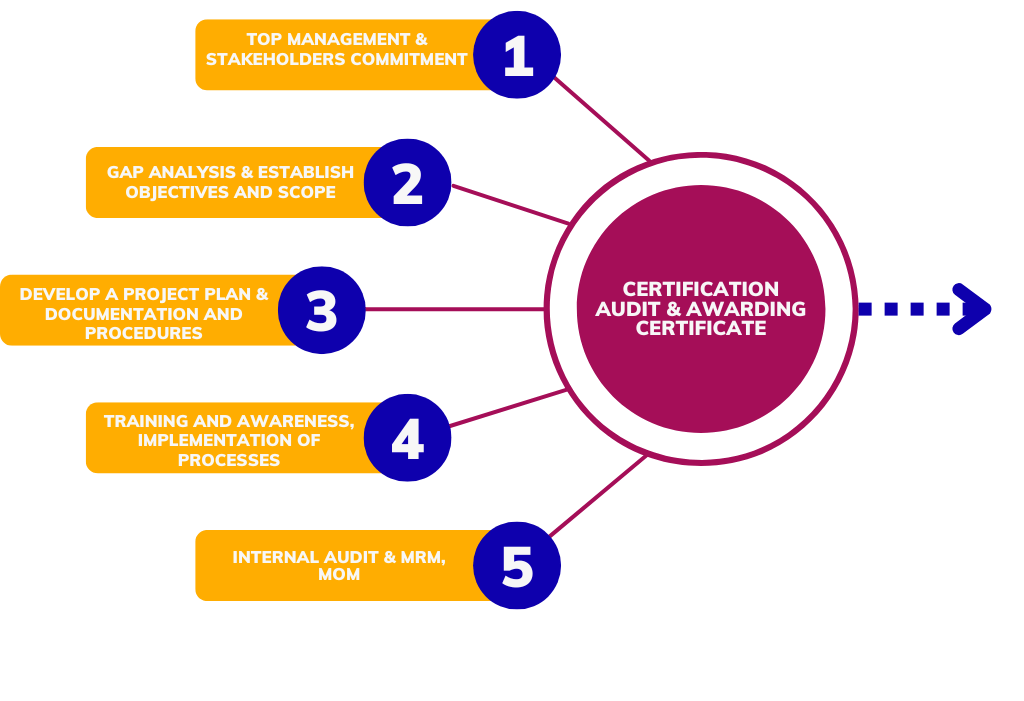
Approach and Methodology used to implement Management System Standard

Colorful Minimalist Linear Steps Circular Diagram 1 e1712599893569 Consultants Consultants

Implementing an ISO  standards involves a structured methodology to ensure that the organization effectively meets the requirements of the chosen standard and achieves certification. Sometimes defined methodology may vary depending on factors such as the size of the organization, its industry, and the complexity of the ISO standard being implemented, the following steps provide a basic framework

Ellipse 6 copy Consultants Consultants

OUR

Process

1, Determine the ISO Standard

2. Understand the Requirements

3. Training and Awareness

4. Implement the System

5. Internal Audit

6. Certification

partner_img Consultants Consultants

Benefits of having ISO Certification

Enhanced Credibility and Reputation

Legal and Regulatory Compliance

Enhanced Customer Satisfaction

Access to Global Markets

Environmental Sustainability

Information Security

Our Achievements and Success

Professional Experts
0 +
Years Experience
0 +
Projects
0 +
Satisfied Customers
0 %

Our Clients

WhatsApp Image 2023 05 12 at 8.24.31 PM e1684164170667
WhatsApp Image 2023 05 12 at 8.16.53 PM e1684163940587
WhatsApp Image 2023 05 12 at 8.22.55 PM
WhatsApp Image 2023 05 12 at 8.04.13 PM 3 e1684163886384
WhatsApp Image 2023-05-12 at 8.15.32 PM

OUR

SERVICES

ISO 9001 Certification
ISO 45001 Certification
ISO 14001 Certification
ISO 22000 Certification
ISO 13485 Certification
ISO 27001 Certification
ISO 20000-1 Certification
ISO 29001 Certification
Payment Card Security for Riffa Merchants

PCI DSS Readiness in Riffa for Safer Payment Card Environments

Riffa organisations considering PCI DSS need a route that fits their actual scope, evidence and customer expectations.

Define the cardholder data environment before selecting a validation route

PCI DSS readiness starts by tracing payment data from the point of capture to every system, provider and administrative path that can affect its security. In practical terms, the work should reduce payment-card data risk by defining the cardholder data environment, limiting storage, securing systems, controlling access, monitoring activity and maintaining evidence required by the applicable PCI validation route.

PCI DSS validation depends on merchant or service-provider type, transaction environment and programme requirements from acquiring banks or card brands. It is not an ISO certification. A PCI DSS readiness review is more useful when it starts with the real product, service or process rather than the language of a template.

Retail, hospitality, e-commerce and service businesses in Riffa may accept card payments through terminals, websites, call handling or third-party platforms, each creating different PCI boundaries. In PCI DSS work involving retail merchants or e-commerce businesses, the strongest approach connects requirements to actual responsibilities, records and decision points instead of creating a separate compliance layer.

Qualitcert can support Riffa organisations by reviewing the current state, clarifying the PCI DSS scope, strengthening cardholder data environment and network security, and checking whether evidence is ready for the relevant audit, appraisal, assessment or customer review. After that baseline is clear, PCI DSS gaps can be prioritised by risk, customer impact and assessment importance.

Local Business Context

Payment Security Begins With Knowing Where Card Data Actually Travels

The local operating context affects how cardholder data environment, network security and third-party responsibilities should be implemented.

East Riffa and West Riffa combine commercial, community and service activity, while the wider Southern Area includes healthcare, education and industrial operations relevant to many PCI DSS scopes. That variety means PCI DSS controls should be scaled to the organisation's real risk profile rather than copied from a larger or unrelated business.

Customer tenders, group requirements and cross-border contracts can change the level of PCI DSS evidence expected from a Riffa organisation. A defensible PCI DSS programme therefore explains both what is in scope and why important exclusions, dependencies or third parties are treated the way they are.

A practical PCI DSS implementation in Riffa should reflect the way hospitality operations and payment service providers operate, including hand-offs to suppliers, contractors and customers. The PCI DSS boundary should follow those interfaces rather than stop at an organisation chart.

Operational Value

What PCI DSS Readiness Improves in Day-to-Day Security

Well-designed controls should create visible operational value while making PCI DSS evidence easier to explain and maintain.

Smaller card-data exposure

Data-flow analysis can remove unnecessary storage and shrink the cardholder data environment.

Security duties become clearer

Merchants, processors, gateways, hosting providers and internal teams can separate shared responsibilities.

Technical controls gain evidence

Configuration, access, logging, scans and testing can be maintained as ongoing security practices.

Validation becomes more efficient

The correct SAQ, ROC or other evidence route can be selected from the actual payment environment.

Riffa Use Cases

Payment Environments That Create Different PCI DSS Risks

The examples below show how the requirements can translate into different Riffa operating environments without forcing every sector into the same model.

01

Retail merchants

Point-of-sale networks, store systems and support access can affect PCI scope.

02

E-commerce businesses

Payment pages, scripts, integrations and third-party service providers create web-specific card-data risk.

03

Hospitality operations

Reservation, front-desk and payment systems can span multiple environments and service providers.

04

Payment service providers

Higher-assurance validation may be required where services directly support cardholder data processing.

05

Call centres

Telephone payments can expose card data through agent desktops, recordings or manual handling.

06

Managed IT providers in a PCI DSS scope

Remote access and support services can affect the security of clients' cardholder data environments.

Implementation Route

From Payment Flow Mapping to PCI Validation Evidence

The sequence below moves from scope and current-state understanding to implemented controls, evidence and independent review readiness.

01

Map payment flows

Document where account data enters, moves, is processed, stored or transmitted.

02

Confirm PCI scope and validation route

Identify merchant or service-provider responsibilities and the applicable assessment method.

03

Reduce unnecessary exposure

Eliminate prohibited or unneeded storage and segment systems where appropriate.

04

Implement PCI controls

Strengthen secure configuration, access, encryption, logging, vulnerability management and security policies.

05

Test the environment

Complete scans, penetration testing and other required technical assurance activities at the applicable frequency.

06

Assemble validation evidence

Organise attestations, assessment outputs, policies and operating records for the relevant compliance channel.

Evidence Control

PCI DSS Evidence That Connects Technical Controls to Validation

Records should be current, attributable and relevant to the defined PCI DSS scope; volume is less important than traceability and use.

Records Worth Organising Early: PCI DSS

  • Payment data-flow diagrams
  • CDE asset inventory
  • Network diagrams
  • Secure configuration standards
  • Access review records
  • Log-monitoring evidence
  • Vulnerability scan reports
  • Penetration test reports
  • Service-provider compliance evidence
  • SAQ/ROC and attestation records
Evidence is strongest when the responsible team can explain when it was created, what decision it supports and how exceptions are handled.

Problems to Correct Before Review: PCI DSS

These weaknesses can undermine PCI DSS readiness even when the organisation has written procedures and good intentions.

  • Assuming outsourced payment processing automatically removes all PCI responsibilities.
  • Storing sensitive authentication data after authorisation when it is prohibited.
  • Forgetting browser scripts and third-party components that can affect e-commerce payment pages.
  • Running scans while leaving account-data flows undocumented.
  • Using an SAQ that does not match the actual payment architecture.
Correcting these PCI DSS issues before external review usually reduces clarification, repeat evidence requests and avoidable corrective actions.
Connected Assurance Services

Where PCI DSS and this requirement share business processes, consider Riffa ISO/IEC 27001 readiness support so common controls can be coordinated without blurring the two scopes.

A connected requirement for PCI DSS may be SOC 2 support for Riffa organisations; review it separately and reuse evidence only where the underlying control genuinely serves both scopes.

For a broader PCI DSS assurance programme, Vulnerability Assessment & Penetration Testing (VAPT) services in Riffa can complement this work while retaining its own audit, assessment or review criteria.

Common Questions

PCI DSS Questions From Riffa Merchants and Service Providers

These answers clarify common scope, evidence and implementation questions for organisations considering PCI DSS in Riffa.

What is PCI DSS?

PCI DSS is an industry security standard for organisations that store, process or transmit payment card account data, and for systems that can affect its security.

Is PCI DSS an ISO certification?

No. PCI DSS has its own assessment and validation framework governed by the payment card industry.

How does a Riffa merchant know which SAQ applies?

The correct SAQ depends on how payments are accepted and which systems or providers are involved. The acquiring bank or relevant compliance programme should confirm the route.

Does using a payment gateway remove PCI scope?

It can reduce scope, but the merchant may still have responsibilities for websites, access, providers or other systems that affect payment security.

What is the cardholder data environment?

It includes people, processes and technologies that store, process or transmit cardholder data or sensitive authentication data, plus connected systems that can affect security.

Are vulnerability scans required?

Depending on the environment, internal or external scans by qualified parties may be required at defined intervals and after significant changes.

When is penetration testing required?

PCI DSS includes penetration-testing requirements for applicable environments, with scope and frequency based on the standard and system changes.

Can card numbers be stored?

Storage must be minimised and protected according to PCI DSS; sensitive authentication data has stricter prohibitions after authorisation.

Why are service-provider attestations important?

They help show which PCI responsibilities a third party covers and which remain with the merchant or customer.

How can Qualitcert support PCI DSS readiness in Riffa?

Qualitcert can help map payment flows, determine likely scope, review controls and organise evidence for the applicable validation route.

Plan the Next Step

Map Your Payment Environment Before PCI DSS Validation

Bring the procedures, evidence and customer requirements currently driving your PCI DSS work. Qualitcert can review what is usable, what needs strengthening and how your team can prepare for the relevant PCI DSS independent review.

Review Your PCI DSS Readiness →
Scroll to Top