

ISO Certifications
Uga
nda
Consulting &
ISO Certifications

-ISO Certification-
QUALIT
CERT
CONSULTING AND ISO CERTIFICATIONS
Qualitcert offers specialized ISO 9001 certification consulting services in Uganda, helping organizations establish and maintain a robust Quality Management System (QMS) that aligns with ISO 9001 standards. Their expert consultants begin with a thorough assessment of current quality management practices to identify gaps and areas for improvement. Based on this analysis, Qualitcert develops a tailored action plan to meet ISO 9001 requirements, focusing on enhancing customer satisfaction, operational efficiency, and continuous improvement. They provide hands-on support with the development of necessary documentation, staff training, and the integration of quality management practices into everyday operations. Additionally, Qualitcert assists in conducting internal audits and preparing for the final certification audit to ensure full compliance and readiness. By partnering with Qualitcert, businesses in Uganda can achieve ISO 9001 certification, demonstrating their commitment to quality excellence and gaining a competitive advantage in the market.
Get In Touch


Approach and Methodology used to implement Management System Standard
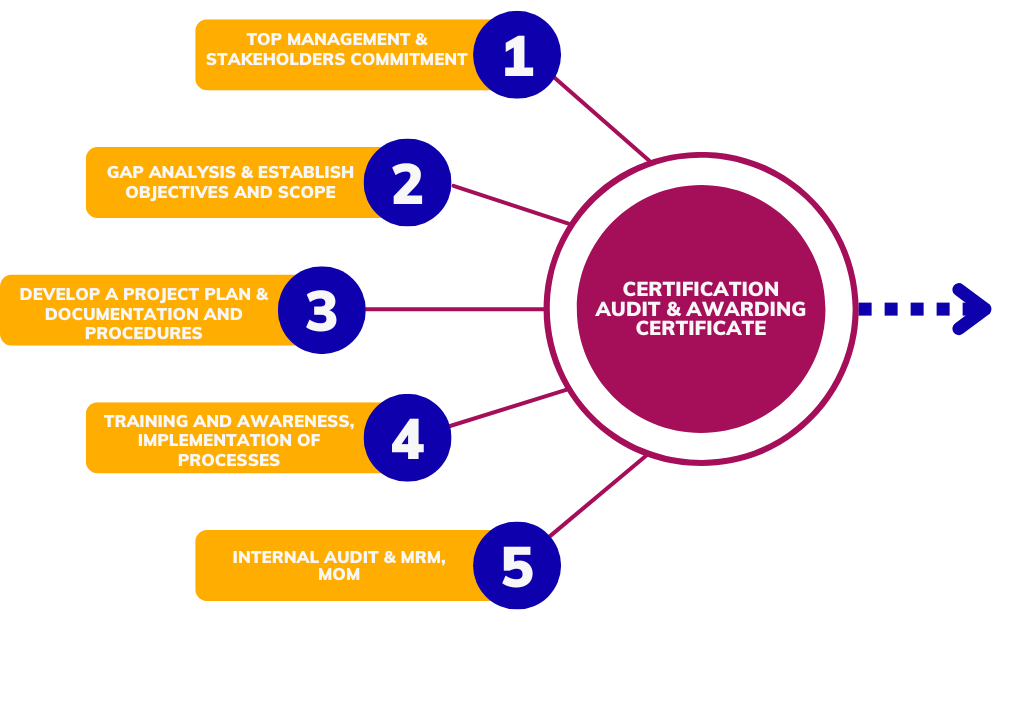
Implementing an ISO standards involves a structured methodology to ensure that the organization effectively meets the requirements of the chosen standard and achieves certification. Sometimes defined methodology may vary depending on factors such as the size of the organization, its industry, and the complexity of the ISO standard being implemented, the following steps provide a basic framework

OUR
Process
1, Determine the ISO Standard
2. Understand the Requirements
3. Training and Awareness
4. Implement the System
5. Internal Audit
6. Certification

Benefits of having ISO Certification
Enhanced Credibility and Reputation
Legal and Regulatory Compliance
Enhanced Customer Satisfaction
Access to Global Markets
Environmental Sustainability
Information Security
Our Achievements and Success
Our Clients





OUR
SERVICES
ISO 9001 Certification Consulting Services in Uganda for Reliable Delivery
ISO 9001 helps organisations in Uganda standardise processes, control supplier variation and strengthen customer confidence across manufacturing, agriculture, logistics, construction and services.
Build a quality system around how work actually moves
ISO 9001 provides a process-based framework for understanding customer requirements, assigning responsibilities, controlling operations, measuring results and improving performance.
Ugandan organisations often coordinate local suppliers, imported materials, regional transport, contractors and customer commitments through several functions. Quality failures commonly appear at handovers between purchasing, warehousing, production, delivery and support.
A practical QMS defines process ownership, acceptance criteria, inspection points, approval authority, complaint handling and evidence retention. It also gives management reliable indicators for distinguishing isolated errors from recurring system weaknesses.
Qualitcert supports gap analysis, process mapping, controlled documentation, internal auditor development, management review and certification readiness without creating unnecessary bureaucracy.
Quality priorities across Uganda's production and service economy
Growing supply chains, tender requirements and multi-site operations require repeatable processes and traceable decisions.
Coffee, dairy, food and light-manufacturing businesses need dependable supplier controls, production criteria, inspection and product release. Construction firms need consistent material approval, site inspection, variation control and handover records.
Logistics, healthcare, telecom and professional-service organisations face different risks, including incomplete records, weak escalation, inconsistent onboarding and variable response times.
A shared QMS can connect teams in Kampala, Entebbe, Jinja, Mbarara and regional sites through common procedures, measurable objectives and one corrective-action method.
Where ISO 9001 creates measurable value
The strongest benefits appear when quality objectives are connected to customer, delivery and cost performance.
More dependable delivery
Defined inputs, checks and acceptance criteria reduce avoidable variation between teams, branches and shifts.
Stronger customer confidence
Complaint trends, contract review and satisfaction data are managed through an auditable process.
Better supplier control
Approval, monitoring and re-evaluation criteria make purchasing decisions more evidence-based.
Practical improvement
Root-cause analysis and management review turn recurring problems into controlled improvement actions.
How ISO 9001 can be applied in Ugandana
A quality system should reflect the risks, customer promises and evidence expected in the organisation's own sector.
Coffee and agricultural exports
Control supplier approval, grading, processing, traceability, packing and shipment evidence.
Dairy and food processing
Standardise receiving, production, inspection, packaging, release and complaints.
Construction and engineering
Connect design review, material approval, site inspection, variations and handover.
Transport and logistics
Define booking, handling, inventory, delivery evidence and claims management.
Healthcare and distribution
Control procurement, storage, traceability, complaints and service quality.
Financial and professional services
Improve onboarding, approvals, case records, service levels and feedback.
A process-led route from gap analysis to certification
The sequence below keeps implementation focused on operating evidence, not unnecessary documentation.
Confirm scope and context
Define sites, products, services, interested parties and the boundaries of the quality management system.
Map core processes
Identify inputs, outputs, owners, risks, controls, measures and interactions across the customer journey.
Design QMS controls
Prepare policies, procedures, forms and records only where they support consistency or required evidence.
Operate and measure
Use the system, monitor objectives, evaluate suppliers, record issues and collect customer feedback.
Audit and review
Conduct internal audits, close findings and hold a management review using reliable performance information.
Prepare for certification
Complete readiness checks, organise objective evidence and support responses through the external audit stages.
Documents and records that support ISO 9001 readiness
The documented information should be proportionate to process complexity, competence needs, customer obligations and business risk.
Common QMS evidence
- QMS scope statement
- Quality policy and objectives
- Process maps and responsibilities
- Contract review records
- Approved supplier evaluations
- Operational work instructions
- Inspection or service checklists
- Nonconformity and CAPA records
- Internal audit programme
- Management review minutes
Quality system mistakes to avoid
Certification delays often result from a system that looks complete on paper but is not connected to daily management.
- Writing procedures that do not match actual work practices.
- Using generic objectives without owners, baselines or review dates.
- Closing corrective actions without verifying whether the cause was removed.
- Auditing clauses only instead of testing process effectiveness and interfaces.
- Treating management review as a presentation rather than a decision-making meeting.
Related ISO 9001 Services for Ugandan Organisations
For a connected requirement, review ISO 14001 certification consulting services in Uganda to coordinate shared governance, documentation and management responsibilities.
For a connected requirement, review ISO 45001 certification consulting services in Uganda where common risks, suppliers or operational controls should be aligned.
For a connected requirement, review ISO 13485 certification consulting services in Uganda to reduce duplicated work and build a coherent assurance programme.
ISO 9001 questions from organisations in Ugandana
These answers address scope, documentation, auditing and practical implementation decisions.
What is the main purpose of ISO 9001 certification in Ugandana?
ISO 9001 provides a structured quality management system for consistently meeting customer and applicable requirements, monitoring process performance and improving results.
Can a small Ugandan business implement ISO 9001?
Yes. The standard is scalable. A small organisation can use concise process maps, responsibilities and records rather than adopting complex documentation designed for a large enterprise.
Does ISO 9001 require a quality manual?
A formal quality manual is not mandatory, but many organisations use one concise overview to explain scope, process interaction and references to controlled information.
How should quality objectives be selected?
Objectives should address relevant business and customer priorities, have measurable indicators, assigned responsibility, resources and planned review dates.
What is process-based internal auditing?
It follows how a process operates from inputs to outputs, tests interfaces with other processes and evaluates whether controls achieve the intended result.
How are outsourced activities controlled?
The organisation should define requirements, select capable providers, monitor performance and retain evidence proportionate to the risk of the outsourced activity.
What evidence is needed for corrective action?
Evidence normally includes the problem, containment, cause analysis, planned action, implementation, responsibility and verification that recurrence risk was reduced.
Can ISO 9001 be integrated with other ISO standards?
Yes. Its management-system structure aligns well with ISO 14001, ISO 45001, ISO 27001 and other standards, allowing shared audits, objectives and review processes.
How long should records be retained?
Retention should reflect customer contracts, legal obligations, product or service risk and the period needed to demonstrate effective control.
How does Qualitcert support ISO 9001 readiness in Ugandana?
Qualitcert helps with gap analysis, process mapping, documentation, staff awareness, internal audits, corrective action and preparation for certification assessment.
Design an ISO 9001 Roadmap for Your Uganda Operations
Share your scope, sites, customer requirements and current procedures. Qualitcert can help build a practical QMS and certification-readiness plan.