

ISO Certifications
Om
an
Consulting &
ISO Certifications
-ISO Certification-
QUALIT
CERT
ISO 22000 Certification & Consulting Service in Oman
ISO Certification Process – Step by Step Guide
The ISO certification process helps organizations implement international standards to improve quality, safety, efficiency, and compliance. Below is a structured step-by-step ISO certification process followed by professional ISO consultants and certification bodies.
ISO Application
The organization submits an application for ISO certification and defines the scope of certification including departments, processes, and operations.
Gap Analysis
ISO consultants analyze the current management system and identify gaps between existing processes and ISO standard requirements.
ISO Documentation
Preparation of ISO manuals, procedures, policies, risk assessments, and records required to comply with ISO standards.
System Implementation
ISO processes are implemented across departments with employee training, process control, and compliance monitoring.
Internal Audit
Internal auditors review the management system to verify compliance and identify corrective actions before the certification audit.
Management Review
Top management evaluates the effectiveness of the ISO management system and ensures readiness for certification.
Certification Audit
An accredited certification body conducts an external audit to verify compliance with ISO standards.
ISO Certification
After successful audit completion, the organization receives the official ISO certificate demonstrating compliance with international standards.
Surveillance Audits
Annual surveillance audits ensure continuous compliance and improvement of the ISO management system.
Please Reach Us Today


Approach and Methodology used to implement Management System Standard
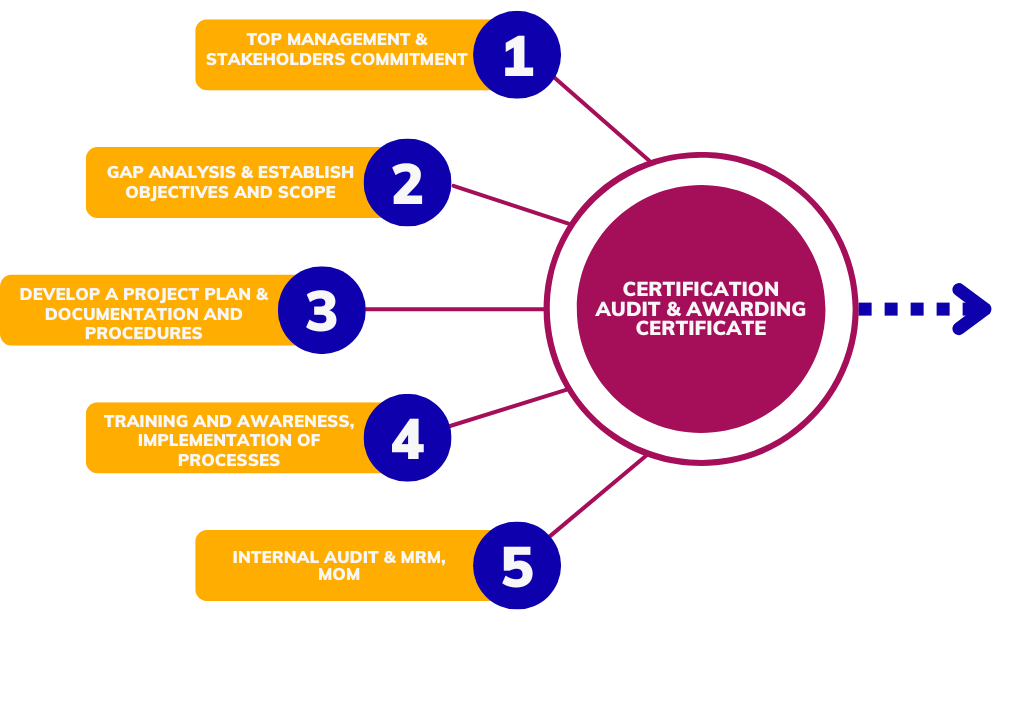
Implementing an ISO standards involves a structured methodology to ensure that the organization effectively meets the requirements of the chosen standard and achieves certification. Sometimes defined methodology may vary depending on factors such as the size of the organization, its industry, and the complexity of the ISO standard being implemented, the following steps provide a basic framework


Benefits of having ISO Certification
Enhanced Credibility and Reputation
Legal and Regulatory Compliance
Enhanced Customer Satisfaction
Access to Global Markets
Environmental Sustainability
Information Security
Our Achievements and Success
Our Clients





OUR
SERVICES
ISO 22000: Build a Practical Food Safety Management System for Oman
For organisations across Oman, ISO 22000 provides a structured way to control food-safety hazards, prerequisite programmes, suppliers, traceability and recall readiness, with controls adapted to head offices, ports, industrial facilities, project sites, mines, hotels, warehouses and regional branches.
ISO 22000 Implementation Aligned with the Operating Environment in Oman
Businesses operating in Oman span oil, gas and energy, ports, logistics and free zones, mining and materials, manufacturing and engineering and other specialised services. For ISO 22000, the management approach must be scaled to the actual sites, customers, suppliers and operational risks.
Because organisations may coordinate activities across muscat, industrial ports, free zones, remote project sites and regional branches, isolated procedures are rarely enough. The food safety management system should organise food hazards, hygiene, supplier controls, traceability, process monitoring and recall readiness as part of routine business control.
Qualitcert supports organisations in Oman by adapting the implementation work to products, ingredients, facilities, process flows, storage, distribution and outsourced food-chain activities. The service focuses on practical preparation, documented controls, internal review and readiness for the relevant independent assessment.
Implementation Priorities for ISO 22000 in Oman
The system should reflect widely distributed locations, port and free-zone operations, remote industrial and project sites and energy, mining and tourism activities.
Hazard Analysis
Assess hazards at each process step and determine controls based on severity, likelihood and operational conditions. In Oman, this is especially relevant where organisations manage widely distributed locations.
Temperature and Hygiene Control
Maintain practical monitoring for storage, preparation, transport, cleaning and personal hygiene. In Oman, this is especially relevant where organisations manage port and free-zone operations.
Supplier and Ingredient Assurance
Define approval, specification, verification and nonconformity controls for materials and outsourced services. In Oman, this is especially relevant where organisations manage remote industrial and project sites.
Traceability and Recall Readiness
Ensure affected products can be identified, isolated, communicated and withdrawn efficiently when necessary. In Oman, this is especially relevant where organisations manage energy, mining and tourism activities.
ISO 22000 Applications Across Key Sectors in Oman
The exact controls should be adapted to the sector, operating model, customer commitments and risks present in Oman.
Oil, Gas and Energy
Apply food hazards, hygiene, supplier controls, traceability, process monitoring and recall readiness across high-risk assets, contractors, maintenance, utilities and operationally critical services, with evidence matched to the services and operating risks present in Oman.
Ports, Logistics and Free Zones
Control food hazards, hygiene, supplier controls, traceability, process monitoring and recall readiness across shipments, warehouses, fleets, partner interfaces and time-sensitive service handovers, with evidence matched to the services and operating risks present in Oman.
Mining and Materials
Document food hazards, hygiene, supplier controls, traceability, process monitoring and recall readiness across extraction, processing, heavy equipment, laboratories, contractors and remote operations, with evidence matched to the services and operating risks present in Oman.
Manufacturing and Engineering
Verify food hazards, hygiene, supplier controls, traceability, process monitoring and recall readiness across production planning, equipment, engineering changes, suppliers, inspection and release, with evidence matched to the services and operating risks present in Oman.
Tourism and Hospitality
Strengthen food hazards, hygiene, supplier controls, traceability, process monitoring and recall readiness across guest or customer services, facilities, suppliers, payments, seasonal demand and multi-shift operations, with evidence matched to the services and operating risks present in Oman.
Food and Fisheries
Coordinate food hazards, hygiene, supplier controls, traceability, process monitoring and recall readiness across suppliers, processing, storage, handling, distribution and customer-facing food operations, with evidence matched to the services and operating risks present in Oman.
From Food-Chain Scope to ISO 22000 Certification Readiness
The sequence should be aligned with products, process flows, intended use, facilities and the organisation's role in the food chain.
Define Scope and Food-Chain Role
Confirm products, processes, sites, services, customers and external providers included in the system.
Map Processes and Product Flow
Document process steps from receipt through storage, processing, dispatch or service.
Establish Prerequisite Programmes
Define foundational hygiene, cleaning, pest control, maintenance, personnel and facility controls.
Conduct Hazard Analysis
Identify hazards, acceptable levels, control measures and the reasoning behind control categorisation.
Set Monitoring and Corrective Action
Define limits or action criteria, responsibilities, records and responses to loss of control.
Build Traceability and Emergency Arrangements
Test identification, withdrawal, recall, communication and continuity arrangements.
Verify the Management System
Complete verification activities, internal audit, management review and corrective action.
Prepare for Certification
Confirm implementation evidence, staff awareness and closure of readiness gaps before external audit.
ISO 22000 Documents, Food Safety Records and Project Factors
Records must demonstrate that hazards are evaluated, controls are monitored and deviations are handled effectively.
Typical Food Safety Documents and Records
- Food safety policy and objectives
- Scope and food-chain context
- Product descriptions and intended use
- Process-flow diagrams
- Hazard-analysis records
- Prerequisite programme procedures
- Control-plan and monitoring records
- Cleaning and sanitation records
- Supplier approval and receiving records
- Traceability and recall-test records
- Verification and internal-audit records
- Management-review and corrective-action records
Scope, Effort and Timeline Factors
The required effort should be estimated from the actual scope and current level of readiness rather than from a single package applied to every organisation.
- Number of products, recipes and process lines
- Complexity of facilities and food-handling steps
- Existing HACCP studies and prerequisite programmes
- Cold-chain and outsourced logistics dependencies
- Supplier base and imported-material controls
- Allergen, microbiological and cross-contamination exposure
- Availability of monitoring and verification records
- Number of sites included in certification scope
Why Choose Qualitcert for ISO 22000 Support in Oman?
Qualitcert helps food-sector organisations connect food-safety hazards with practical operational controls, responsibilities and records.
The implementation support is designed to prepare the organisation for an independent certification audit without replacing the certification body's assessment or decision.
Process Mapping
Document the actual movement of ingredients, products, people and information through the operation.
Hazard-Analysis Facilitation
Support structured evaluation of hazards, controls and monitoring requirements.
PRP Development
Define practical prerequisite programmes suited to the facility and food-chain activity.
Traceability Testing
Prepare and test product identification, withdrawal and recall arrangements.
Internal Audit
Evaluate conformity and implementation across departments, shifts and operating locations.
Improvement Planning
Turn deviations, complaints, verification findings and audit results into controlled action.
ISO 22000 Support Across Oman
Support can be adapted for organisations operating from Muscat, industrial ports, free zones, regional cities, remote project sites and tourism locations across Oman.
Distributed operations should define how central management, local infrastructure, contractor activities and site-specific evidence are controlled.
ISO 22000 Questions from Organisations in Oman
These answers provide general guidance for Oman; the final scope depends on the organisation's activities, locations, risks and current evidence.
What is ISO 22000?
ISO 22000 specifies requirements for a food safety management system for organisations directly or indirectly involved in the food chain.
Is ISO 22000 the same as HACCP?
No. HACCP is a hazard-control methodology, while ISO 22000 includes hazard analysis together with management-system requirements, prerequisite programmes, communication, verification and continual improvement.
Who can obtain ISO 22000 certification in Oman?
Manufacturers, caterers, hotels, logistics providers, warehouses, importers, distributors, packaging providers and other food-chain organisations may implement the standard.
How long does ISO 22000 implementation take?
The period depends on product range, process complexity, site conditions, existing HACCP controls, record availability and the number of locations in scope. For Oman, the estimate should also account for widely distributed locations and port and free-zone operations where relevant.
Can ISO 22000 cover multiple operating locations in Oman?
Yes. Common management controls may be centralised, but each site must maintain process-specific hazard analysis, monitoring and operational evidence.
Does ISO 22000 require a recall test?
The organisation must maintain traceability and arrangements for withdrawal or recall. Testing these arrangements helps demonstrate that they work within the required time.
Can ISO 22000 cover more than one branch?
Yes. A multi-site scope may be possible when central and site-specific responsibilities, processes and records are clearly defined.
What evidence is checked during the audit?
Auditors may review hazard analysis, monitoring records, supplier controls, cleaning records, traceability tests, verification, internal audits, management reviews and corrective actions.
Who issues the ISO 22000 certificate?
An independent certification body conducts the certification audit and makes the certification decision.
Can ISO 22000 be integrated with ISO 9001?
Yes. Common management processes such as objectives, document control, internal audit, management review and corrective action can be integrated.
Plan Your ISO 22000 Readiness Review in Oman
Share the activities, locations, systems, products or services you want included. Qualitcert can help define a practical scope for head offices, ports, industrial facilities, project sites, mines, hotels, warehouses and regional branches.