










Global ISO Certification Consultant Services – Qualitcert

QualitCert Get a Quote
ISO Certifications

Bang

alore

Consulting &
ISO Certifications
pexels sampath nayak 7417029 scaled
-ISO Certification-

ISO 22000 Certification & Consulting Service in Bangalore

QUALIT

CERT

CONSULTING AND ISO CERTIFICATIONS

Qualitcert, a trusted provider for ISO 22000 certification and consulting services in Bangalore, India, which offers a comprehensive support in  Specializing in food safety management systems, Qualitcert assists organizations in implementing robust frameworks aligned with ISO 22000 standards. Their approach involves a thorough assessment of food safety hazards and risks, followed by tailored strategies to enhance food safety practices and compliance. With expert guidance from Qualitcert consultants, businesses receive support in documentation, training, and system integration to ensure effective implementation of food safety measures. Qualitcert also facilitates preparation for certification audits, enabling organizations to achieve ISO 22000 accreditation and demonstrate their commitment to delivering safe and quality food products. Through their services, Qualitcert empowers businesses in Bangalore to uphold the highest standards of food safety while enhancing consumer trust and regulatory compliance.

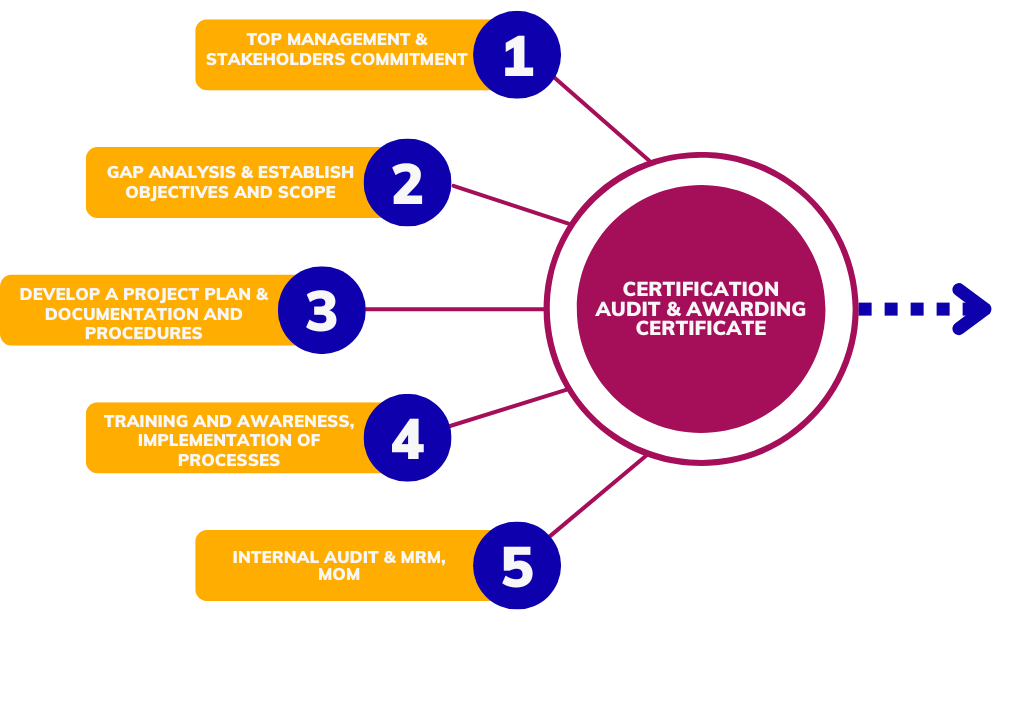
ISO Certification Process – Step by Step Guide

The ISO certification process helps organizations implement international standards to improve quality, safety, efficiency, and compliance. Below is a structured step-by-step ISO certification process followed by professional ISO consultants and certification bodies.

PLAN
IMPLEMENT
CERTIFY
📋

ISO Application

The organization submits an application for ISO certification and defines the scope of certification including departments, processes, and operations.

🔍

Gap Analysis

ISO consultants analyze the current management system and identify gaps between existing processes and ISO standard requirements.

📄

ISO Documentation

Preparation of ISO manuals, procedures, policies, risk assessments, and records required to comply with ISO standards.

System Implementation

ISO processes are implemented across departments with employee training, process control, and compliance monitoring.

🧪

Internal Audit

Internal auditors review the management system to verify compliance and identify corrective actions before the certification audit.

📊

Management Review

Top management evaluates the effectiveness of the ISO management system and ensures readiness for certification.

🏭

Certification Audit

An accredited certification body conducts an external audit to verify compliance with ISO standards.

🏆

ISO Certification

After successful audit completion, the organization receives the official ISO certificate demonstrating compliance with international standards.

🔄

Surveillance Audits

Annual surveillance audits ensure continuous compliance and improvement of the ISO management system.

Get In Touch

Test
afd9a249 perf wp theme group 8796

Approach and Methodology used to implement Management System Standard

Colorful Minimalist Linear Steps Circular Diagram 1 e1712599893569

Implementing an ISO  standards involves a structured methodology to ensure that the organization effectively meets the requirements of the chosen standard and achieves certification. Sometimes defined methodology may vary depending on factors such as the size of the organization, its industry, and the complexity of the ISO standard being implemented, the following steps provide a basic framework

Ellipse 6 copy
OUR
Process

1, Determine the ISO Standard

2. Understand the Requirements

3. Training and Awareness

4. Implement the System

5. Internal Audit

6. Certification

partner_img
Benefits of having ISO Certification

Enhanced Credibility and Reputation

Legal and Regulatory Compliance

Enhanced Customer Satisfaction

Access to Global Markets

Environmental Sustainability

Information Security

Our Achievements and Success
Professional Experts
0 +
Years Experience
0 +
Projects
0 +
Satisfied Customers
0 %
Our Clients
WhatsApp Image 2023 05 12 at 8.24.31 PM e1684164170667
WhatsApp Image 2023 05 12 at 8.16.53 PM e1684163940587
WhatsApp Image 2023 05 12 at 8.22.55 PM
WhatsApp Image 2023 05 12 at 8.04.13 PM 3 e1684163886384
WhatsApp Image 2023-05-12 at 8.15.32 PM
OUR
SERVICES
ISO 9001 Certification
ISO 45001 Certification
ISO 14001 Certification
ISO 22000 Certification
ISO 13485 Certification
ISO 27001 Certification
ISO 20000-1 Certification
ISO 29001 Certification
Food safety management across the chain

ISO 22000 Consulting in Bangalore for a Controlled Food Safety Management System

Create an FSMS that integrates prerequisite programmes, hazard analysis, OPRPs, CCPs, traceability, emergency response and continual improvement.

Build food safety controls that remain effective during growth

Food manufacturers, central kitchens, ingredient suppliers, caterers and cold-chain operators in Bangalore need controls that work across people, facilities, suppliers and changing production demands. ISO 22000 provides the management system framework for that coordination.

We help establish the FSMS scope, food safety policy, communication routes, prerequisite programmes and competent food safety team before completing a structured hazard analysis.

Control measures are assessed and classified as OPRPs or CCPs using defined criteria. Monitoring, correction, corrective action, verification and validation are designed around real process conditions.

Traceability exercises, withdrawal and recall readiness, supplier controls, internal audits and management review ensure the system can respond when products, processes or risks change.

Bangalore Food Chain Context

FSMS needs across Bangalore's food manufacturing and service network

ISO 22000 connects operational hazard control with leadership accountability, communication and measurable system performance.

Bangalore's mix of food processing, institutional catering, retail supply, cloud kitchens and temperature-controlled distribution creates multiple hand-offs where food safety information can be lost.

An effective FSMS defines responsibilities from supplier approval and receiving through processing, storage, transport and customer communication.

Qualitcert helps organisations align PRPs, OPRPs, CCPs, traceability records and verification plans so controls are both technically sound and audit-ready.

Food Safety Value

Business benefits of a structured FSMS

Food safety performance improves when preventive controls and management-system discipline reinforce each other.

More reliable hazard control

Hazard analysis and validated control measures reduce dependence on end-product testing alone.

Faster traceability decisions

Lot coding, material links and distribution records support efficient withdrawal and investigation.

Stronger customer confidence

Certification evidence helps answer retailer, hospitality, export and contract-manufacturing requirements.

Better cross-functional control

Procurement, production, maintenance, quality, warehousing and logistics work through one food safety framework.

Food Chain Applications

Where ISO 22000 supports Bangalore food businesses

The FSMS scope can cover manufacturing, packaging, storage, transport, catering and supporting food-chain services.

01

Food Manufacturing

Integrate PRPs, hazard analysis, process controls, verification and traceability.

02

Central and Cloud Kitchens

Control receiving, preparation, cooking, holding, dispatch and allergen risks.

03

Dairy and Beverage Operations

Manage sanitation, temperature, contamination, utilities and distribution controls.

04

Institutional Catering

Standardise food safety across hospitals, campuses, factories and corporate facilities.

05

Cold Chain and Warehousing

Protect temperature integrity, hygiene, stock rotation and traceability.

06

Ingredient and Packaging Suppliers

Demonstrate reliable controls for materials that influence product safety.

FSMS Implementation Route

A food safety journey from PRPs to certification

The sequence builds technical control first, then verifies that the wider management system sustains it.

01

Define scope and food chain

Identify products, processes, sites, customers, external providers and applicable food safety requirements.

02

Strengthen prerequisite programmes

Review hygiene, sanitation, pest control, utilities, maintenance, personnel practices and storage controls.

03

Conduct hazard analysis

Confirm product descriptions and flow diagrams, identify hazards and assess their significance.

04

Classify and validate controls

Determine OPRPs and CCPs, establish action criteria or critical limits and validate control effectiveness.

05

Operate, verify and test

Monitor controls, manage deviations, conduct verification, test traceability and evaluate emergency arrangements.

06

Audit and prepare for certification

Complete internal audits, management review, corrective action and evidence readiness for external assessment.

FSMS Documentation

Food safety plans, procedures and records

The evidence set should connect food safety policy and objectives with practical controls at each process step.

Typical ISO 22000 records

  • FSMS scope and policy
  • Food safety team records
  • Product descriptions and flow diagrams
  • PRP procedures and inspections
  • Hazard analysis worksheets
  • OPRP and CCP control plans
  • Monitoring and deviation records
  • Supplier approval records
  • Traceability and withdrawal tests
  • Verification and management review records
Monitoring records should identify the product or batch, time, result, responsible person and action taken when criteria were not met.

Food safety system errors to avoid

An FSMS can appear detailed while still failing to explain how hazards, controls and verification decisions were reached.

  • Treating all controls as CCPs without using a consistent classification approach.
  • Relying on finished-product testing instead of validating preventive measures.
  • Using flow diagrams that do not match actual rework, storage or transfer steps.
  • Running mock recalls without testing quantity reconciliation and decision speed.
  • Failing to reassess hazards after ingredient, supplier, process or packaging changes.
A strong FSMS is technically justified, routinely followed and actively reviewed when food-chain information changes.
Food Safety Services

For a connected requirement, review HACCP services in Bangalore to coordinate shared governance, documentation and management responsibilities.

For a connected requirement, review ISO 9001 services in Bangalore where common risks, suppliers or operational controls should be aligned.

For a connected requirement, review ISO 45001 services in Bangalore to reduce duplicated work and build a coherent assurance programme.

FSMS FAQs

ISO 22000 questions from food organisations in Bangalore

The following answers distinguish FSMS requirements, PRPs, OPRPs, CCPs and traceability.

What is the purpose of ISO 22000?

ISO 22000 provides a Food Safety Management System framework that combines management controls, prerequisite programmes, hazard analysis and operational food safety control.

Who can use ISO 22000?

Food manufacturers, processors, caterers, storage and transport providers, packaging suppliers and other organisations in the food chain can use it.

What is the difference between a PRP and an OPRP?

PRPs maintain the general hygienic environment, while OPRPs are hazard-specific controls identified through hazard analysis and managed with defined action criteria.

How is a CCP managed under ISO 22000?

A CCP has a validated control measure, measurable critical limits, monitoring, planned corrections and corrective action, plus verification records.

Does ISO 22000 replace HACCP?

It incorporates HACCP-based hazard-control principles within a broader management system that also covers leadership, communication, objectives, audits and review.

Why are flow diagrams important?

They provide the basis for hazard analysis and must accurately represent process steps, rework, storage, transfers and outsourced activities.

What is a traceability test?

It is a planned exercise that checks whether materials, processing records and distribution information can identify affected product accurately and promptly.

Are laboratory tests enough to prove food safety?

No. Testing samples only part of production. Preventive controls, monitoring, verification and process discipline are necessary to manage food safety consistently.

How often should hazard analysis be reviewed?

It should be reviewed after significant changes and at planned intervals to confirm that products, processes, suppliers and scientific assumptions remain valid.

How does Qualitcert support ISO 22000 certification in Bangalore?

Qualitcert can assist with PRP review, hazard analysis, control plans, documentation, training, traceability exercises, internal audits and certification preparation.

Create a dependable FSMS

Plan ISO 22000 Certification for Your Bangalore Food Operations

Review your food chain, PRPs, hazard controls and traceability system, then build a practical route to certification.

Start the FSMS Assessment
Scroll to Top