
ISO Certifications
Rwanda
Consulting &
ISO Certifications

-ISO Certification-
ISO 17025 Certification Services in Rwanda
QUALIT
CERT
CONSULTING AND ISO CERTIFICATIONS
In Rwanda, Qualitcert offers ISO 17025 certification services, which are essential for testing and calibration labs looking to prove their dependability and technical proficiency. In order to guarantee accurate and consistent findings, this international standard lays forth the specifications for quality management systems and technical expertise in laboratory operations. Labs may boost their reputation, increase operational effectiveness, and get a competitive advantage in domestic and international markets by earning ISO 17025 accreditation. Through the certification process, Qualitcert’s experience helps firms apply best practices, stay in compliance, and ultimately build client and stakeholder trust in the caliber of their testing and calibration services.
Get In Touch


Approach and Methodology used to implement Management System Standard
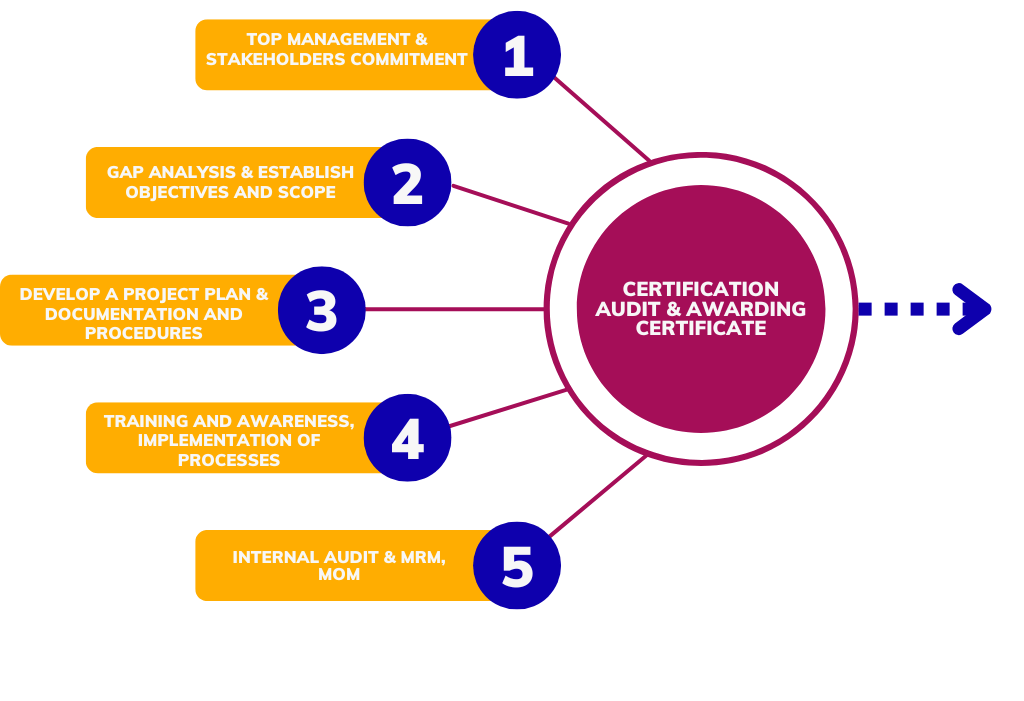
Implementing an ISO standards involves a structured methodology to ensure that the organization effectively meets the requirements of the chosen standard and achieves certification. Sometimes defined methodology may vary depending on factors such as the size of the organization, its industry, and the complexity of the ISO standard being implemented, the following steps provide a basic framework

OUR
Process
1, Determine the ISO Standard
2. Understand the Requirements
3. Training and Awareness
4. Implement the System
5. Internal Audit
6. Certification

Benefits of having ISO Certification
Enhanced Credibility and Reputation
Legal and Regulatory Compliance
Enhanced Customer Satisfaction
Access to Global Markets
Environmental Sustainability
Information Security
Our Achievements and Success
Our Clients





OUR
SERVICES
ISO 17025 Certification Services in Rwanda for Reliable Testing and Calibration
ISO/IEC 17025 helps laboratories in Rwanda demonstrate technical competence, valid methods, measurement traceability and dependable reporting.
Prove that laboratory results are technically valid
ISO/IEC 17025 defines competence requirements for testing and calibration laboratories, covering impartiality, personnel, facilities, equipment, methods, traceability and reporting.
Laboratory credibility depends on more than procedures. Staff authorisation, environmental conditions, method verification, reference materials, calibration status and data integrity must support each result.
An effective system evaluates measurement uncertainty where required, uses proficiency testing or suitable comparisons and monitors quality-control trends.
Qualitcert supports scope definition, method files, uncertainty evaluation, equipment control, internal audit and accreditation-readiness preparation.
Reliable laboratory evidence for Rwanda's health, trade and infrastructure
Testing and calibration results influence water safety, food release, healthcare decisions, construction acceptance and export trade.
Food, water and public-health laboratories need methods suited to the samples and ranges they actually test, with verification under local conditions.
Construction, mining and agricultural laboratories need controlled sampling, equipment, calculations, technical review and defensible reporting.
Sample receipt, identification, storage and disposal are essential because chain-of-custody weaknesses can invalidate otherwise correct analysis.
How ISO 17025 strengthens technical confidence
The standard helps laboratories reduce avoidable variation and make competence visible to customers and assessors.
More defensible results
Method, equipment, environmental and quality-control records support technical validity.
Clearer competence authorisation
Training, observation and performance evidence define which personnel may perform and approve work.
Improved measurement confidence
Traceability and uncertainty evaluation clarify the quality and limitations of reported results.
Stronger customer acceptance
A structured competence system supports tenders, supply-chain approval and accreditation readiness.
ISO 17025 use cases across Rwanda
Each laboratory should define a precise scope that matches methods, matrices, ranges, equipment and capability.
Food and water laboratories
Manage chemical and microbiological methods, controls, traceability and reporting.
Public health laboratories
Control specimen handling, methods, equipment, quality control and release.
Construction materials testing
Verify concrete, soil, aggregate and mechanical testing competence.
Coffee and tea testing
Control sampling, moisture, grading, residue or quality methods and records.
Calibration services
Establish traceability, uncertainty, environmental controls and intervals.
Environmental laboratories
Control field sampling, preservation, analysis, blanks and detection limits.
From technical scope to ISO 17025 assessment
The route must develop technical evidence for every activity included in the proposed laboratory scope.
Define scope and impartiality
List tests or calibrations, methods, ranges, locations and risks to impartiality.
Evaluate personnel competence
Set competence criteria, train, observe, authorise and monitor each technical role.
Control methods and equipment
Verify methods, maintain equipment, manage standards and monitor environmental conditions.
Establish result validity
Plan quality control, proficiency testing, interlaboratory comparison and trend review.
Audit technical processes
Sample jobs from receipt through calculation, review, reporting and record retention.
Prepare for assessment
Complete management review, corrective action and an evidence index for the accreditation body.
Technical and management records for ISO 17025
Records must support reconstruction of work and demonstrate that competence and result-validity controls were applied.
Typical laboratory evidence
- Defined accreditation scope
- Impartiality risk assessment
- Personnel competence records
- Method verification or validation
- Equipment and calibration records
- Measurement uncertainty budgets
- Reference material records
- Proficiency testing results
- Sample and test worksheets
- Audit and management review records
Laboratory readiness mistakes
Assessment findings often arise when management procedures exist but method-level technical evidence is incomplete.
- Listing methods in scope without current verification or validation evidence.
- Authorising analysts based only on training attendance.
- Using calibration certificates without checking traceability and suitability.
- Calculating uncertainty once and not reviewing changes in contributors.
- Participating in proficiency testing without analysing unsatisfactory or questionable results.
Related ISO/IEC 17025 Services for Rwandan Organisations
For a connected requirement, review ISO 9001 certification services in Rwanda to coordinate shared governance, documentation and management responsibilities.
For a connected requirement, review ISO 13485 certification services in Rwanda where common risks, suppliers or operational controls should be aligned.
For a connected requirement, review ISO 14001 certification services in Rwanda to reduce duplicated work and build a coherent assurance programme.
ISO 17025 questions from laboratories in Rwanda
These answers cover scope, methods, uncertainty, traceability, competence and result validity.
Is ISO 17025 certification or accreditation?
Laboratories are generally accredited to ISO/IEC 17025 by an accreditation body for a defined technical scope.
Can a small laboratory implement ISO 17025?
Yes. The system can be proportionate, but the laboratory must still demonstrate competence, valid methods, traceability and quality assurance for its scope.
What is method verification?
Verification confirms that a laboratory can achieve acceptable performance when implementing an established standard method.
When is method validation needed?
Validation is commonly required for non-standard, laboratory-developed, modified or out-of-scope methods.
Why is measurement uncertainty important?
It describes the dispersion associated with a measurement result and supports interpretation, comparability and conformity decisions.
What is metrological traceability?
It is the property of a result linked to a reference through a documented unbroken chain of calibrations, each contributing to uncertainty.
How is personnel competence demonstrated?
Through defined criteria, training, observation, practical evaluation, quality-control performance and formal authorisation.
Is proficiency testing always required?
The laboratory should use proficiency testing or suitable interlaboratory comparison where available and appropriate within a planned result-validity strategy.
What is a decision rule?
It explains how measurement uncertainty is considered when a laboratory reports conformity with a specification.
How does Qualitcert support ISO 17025 readiness in Rwanda?
Qualitcert can support scope design, method and equipment controls, uncertainty, competence, audits, management review and assessment readiness.
Prepare Your Rwanda Laboratory for ISO 17025 Assessment
Share your proposed scope, methods, equipment list and quality-control data. Qualitcert can help organise an accreditation-readiness programme.