






Global ISO Certification Consultant Services – Qualitcert

QualitCert Get a Quote
ISO Certifications

libya

Consulting &
ISO Certifications
-ISO Certification-

ISO 14001 Certification Services in Libya

QUALIT

CERT

CONSULTING AND ISO CERTIFICATIONS

Qualitcert provides expert ISO 14001 Certification services in Libya, helping organizations design, implement, and manage effective Environmental Management Systems (EMS). Achieving ISO 14001 Certification in Libya is vital for businesses that want to demonstrate their commitment to sustainability, meet environmental regulations, and enhance their international reputation. Qualitcert offers complete support throughout the certification process, including gap analysis, EMS documentation, employee training, and audit preparation, ensuring a smooth and hassle-free journey. With the guidance of skilled ISO 14001 consultants in Libya, companies can identify environmental risks, optimize resource utilization, and improve overall operational efficiency. Whether small enterprises or large corporations, Qualitcert’s customized approach ensures that organizations across all industries achieve ISO 14001 compliance in Libya with minimal disruption while strengthening their commitment to environmental responsibility.

Get In Touch

Test
Consultants Consultants
afd9a249 perf wp theme group 8796 Consultants Consultants
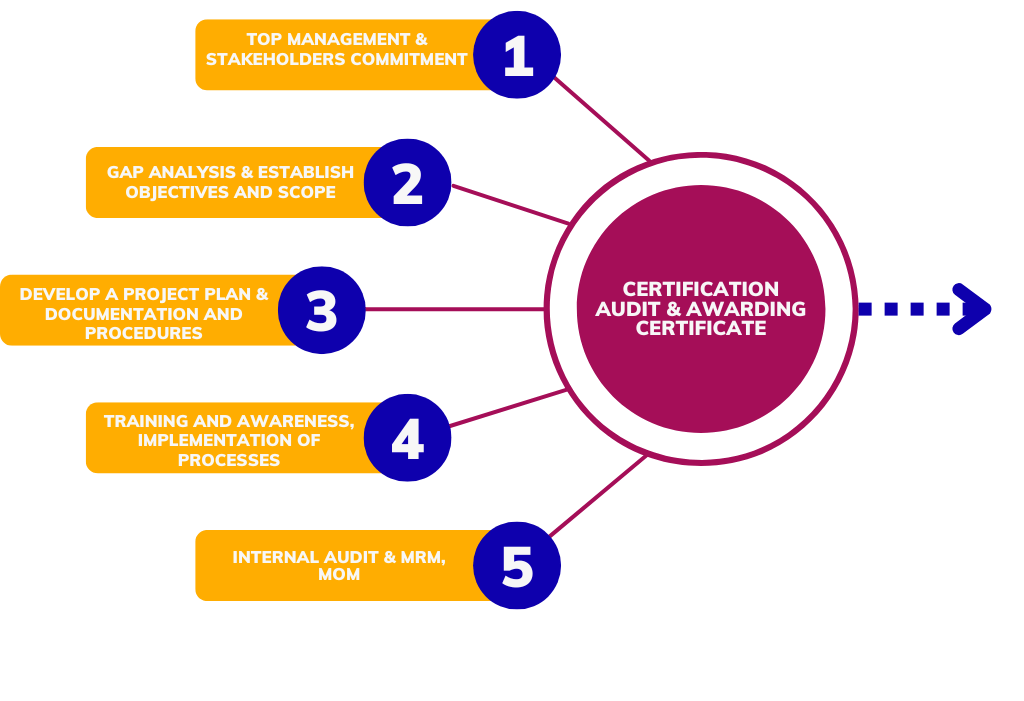
Approach and Methodology used to implement Management System Standard
Colorful Minimalist Linear Steps Circular Diagram 1 e1712599893569 Consultants Consultants

Implementing an ISO  standards involves a structured methodology to ensure that the organization effectively meets the requirements of the chosen standard and achieves certification. Sometimes defined methodology may vary depending on factors such as the size of the organization, its industry, and the complexity of the ISO standard being implemented, the following steps provide a basic framework

Ellipse 6 copy Consultants Consultants
OUR
Process

1, Determine the ISO Standard

2. Understand the Requirements

3. Training and Awareness

4. Implement the System

5. Internal Audit

6. Certification

partner_img Consultants Consultants
Benefits of having ISO Certification

Enhanced Credibility and Reputation

Legal and Regulatory Compliance

Enhanced Customer Satisfaction

Access to Global Markets

Environmental Sustainability

Information Security

Our Achievements and Success
Professional Experts
0 +
Years Experience
0 +
Projects
0 +
Satisfied Customers
0 %
Our Clients
WhatsApp Image 2023 05 12 at 8.24.31 PM e1684164170667
WhatsApp Image 2023 05 12 at 8.16.53 PM e1684163940587
WhatsApp Image 2023 05 12 at 8.22.55 PM
WhatsApp Image 2023 05 12 at 8.04.13 PM 3 e1684163886384
WhatsApp Image 2023-05-12 at 8.15.32 PM
OUR
SERVICES
ISO 9001 Certification
ISO 45001 Certification
ISO 14001 Certification
ISO 22000 Certification
ISO 13485 Certification
ISO 27001 Certification
ISO 20000-1 Certification
ISO 29001 Certification
Environmental Control for Libya Facilities

ISO 14001 Certification Services in Libya for Practical Environmental Performance

ISO 14001 helps organisations identify how their activities affect air, water, land, resources and communities, then manage those impacts through measurable controls and continual improvement.

Translate environmental responsibility into site controls

Environmental performance is shaped by routine decisions: how fuel is stored, how waste is segregated, how chemicals are handled, how contractors work and how abnormal events are contained. ISO 14001 brings those decisions into one Environmental Management System.

In Libya, organisations may operate workshops, depots, construction sites, offices, warehouses, clinics or industrial facilities with very different environmental aspects. The system must therefore be based on actual activities and life-cycle thinking rather than a generic policy.

A useful implementation identifies significant aspects, evaluates compliance obligations, sets operational controls and prepares for spills, fires, releases or other environmental emergencies. Monitoring should focus on the indicators that matter to the organisation’s impacts.

Qualitcert helps establish the aspect register, legal and other obligations process, objectives, procedures, competence controls, internal audit and management review needed for certification readiness.

Libya Business Context

Environmental priorities across Libya operations

Industrial activity, construction, transport and resource-intensive services benefit from disciplined environmental planning and evidence.

An oilfield service base may focus on fuel, chemicals, contaminated materials and spill response. A construction contractor may prioritise dust, noise, waste and subcontractor controls. A hotel or office portfolio may concentrate on water, energy and waste reduction.

ISO 14001 provides a method to rank these issues, assign controls and monitor results. It also helps the organisation respond to customer environmental requirements and demonstrate that compliance obligations are actively evaluated.

Environmental objectives should be realistic and supported by resources. Waste reduction, leak prevention, improved segregation and resource efficiency often create both compliance value and operating savings.

Environmental Value

ISO 14001 Benefits for Organisations in Libya

Environmental gains become sustainable when aspects, obligations and objectives influence daily operations.

Reduced environmental risk

Significant aspects receive defined controls and emergency arrangements.

Clearer compliance oversight

Obligations are identified, reviewed and evaluated systematically.

Lower resource waste

Objectives can target fuel, water, materials and disposal costs.

Improved stakeholder trust

Documented performance supports tenders, customers and community expectations.

Industry Applications

Environmental Applications Across Libya Sectors

The examples below show how requirements and evidence change according to operating context, risk and customer expectations.

01

Energy and oilfield services

Manage fuels, chemicals, waste streams and spill readiness.

02

Construction projects

Control dust, noise, waste, excavation and subcontractors.

03

Ports and logistics

Address vehicle emissions, cargo handling and waste control.

04

Food facilities

Manage effluent, organic waste, refrigeration and resource use.

05

Healthcare operations

Control clinical waste, chemicals and emergency releases.

06

Hospitality portfolios

Improve water, energy, purchasing and waste performance.

EMS Implementation Route

From Environmental Review to Certification Readiness

Each stage should produce evidence that can be reviewed, maintained and improved by the responsible team.

01

Understand context

Identify environmental conditions, stakeholders and site boundaries.

02

Evaluate aspects

Rank activities, products and services by environmental significance.

03

Map obligations

Maintain applicable legal, permit and customer requirements.

04

Establish controls

Implement procedures, training, monitoring and emergency plans.

05

Evaluate performance

Review inspections, measurements, incidents and compliance status.

06

Complete readiness

Conduct internal audit, management review and corrective action.

Controlled Evidence

Environmental Documents and Operational Records

Documentation should reflect the actual scope, risk and operating methods rather than a generic template set.

Typical Controlled Information

  • EMS scope
  • Environmental policy
  • Aspect-impact register
  • Compliance obligations register
  • Objectives programme
  • Waste management procedure
  • Chemical handling controls
  • Emergency response plan
  • Inspection and monitoring records
  • Compliance evaluation results
Records should be current, attributable, retrievable and retained according to operational, contractual and compliance needs.

Common Readiness Mistakes

These weaknesses often reduce confidence during internal audit, customer review or independent assessment.

  • Listing aspects without significance criteria.
  • Copying legal registers without evaluating compliance.
  • Ignoring contractor and outsourced activity impacts.
  • Setting environmental objectives without baseline data.
  • Testing emergency plans only on paper.
Early gap analysis allows the organisation to correct system weaknesses before formal assessment.
Related Libya Services

Where requirements overlap, review ISO 45001 services in Libya to align shared responsibilities, records and improvement activities without duplicating controls.

Where requirements overlap, review ISO 50001 services in Libya to align shared responsibilities, records and improvement activities without duplicating controls.

Where requirements overlap, review ISO 9001 services in Libya to align shared responsibilities, records and improvement activities without duplicating controls.

Frequently Asked Questions

ISO 14001 Questions for Libya Facilities

The answers below address scope, implementation evidence, assessment readiness and practical control decisions.

What is an environmental aspect?

It is an element of an organisation’s activities, products or services that can interact with the environment.

How are significant aspects determined?

The organisation applies defined criteria such as severity, frequency, legal concern, stakeholder interest and control capability.

Does ISO 14001 require zero environmental impact?

No. It requires systematic control, compliance commitment and continual improvement appropriate to the organisation’s context.

What is life-cycle perspective?

It means considering environmental influence from design and purchasing through use, transport and end-of-life, without requiring a full life-cycle assessment.

How often should compliance be evaluated?

At planned intervals appropriate to the obligation, risk, permit conditions and organisational change.

Are contractors included in the EMS?

Yes, where their work can create environmental impacts or affect the organisation’s environmental performance.

What environmental records do auditors sample?

They may review aspect evaluations, permits, inspections, waste records, monitoring results, incidents, drills and corrective actions.

Can ISO 14001 reduce costs?

It can support savings through reduced waste, better resource use, fewer incidents and stronger operational discipline.

How does internal audit differ from an inspection?

An inspection checks a condition or activity; an internal audit evaluates whether the EMS conforms and works effectively.

What support does Qualitcert provide in Libya?

Qualitcert supports aspect assessment, compliance processes, documentation, training, internal audit and certification preparation.

Speak with Qualitcert

Build Environmental Controls That Work at the Site Level

Discuss your facilities, activities and key environmental concerns with Qualitcert to plan a practical ISO 14001 implementation in Libya.

Start an EMS Readiness Review →
Scroll to Top