
ISO Certifications
Tanzania
Consulting &
ISO Certifications

-ISO Certification-
QUALIT
CERT
CONSULTING AND ISO CERTIFICATIONS
Qualitcert offers specialized ISO 14001 certification services in Tanzania, focusing on helping organizations develop and implement effective environmental management systems. Their expert consultants provide tailored solutions to guide businesses through the entire certification process, from initial environmental impact assessments and policy development to implementation and audit preparation. Qualitcert’s approach includes identifying environmental aspects and impacts, setting objectives and targets, implementing operational controls, and ensuring compliance with regulatory requirements. By partnering with Qualitcert, organizations in Tanzania can achieve ISO 14001 certification, demonstrating their commitment to environmental sustainability, reducing environmental footprints, and enhancing operational efficiency. This certification not only improves environmental performance but also boosts market competitiveness and stakeholder trust. Qualitcert’s practical and systematic methodology ensures that Tanzanian businesses can integrate environmental management into their core operations, fostering a culture of continuous improvement and sustainability while complying with international standards.
Get In Touch


Approach and Methodology used to implement Management System Standard
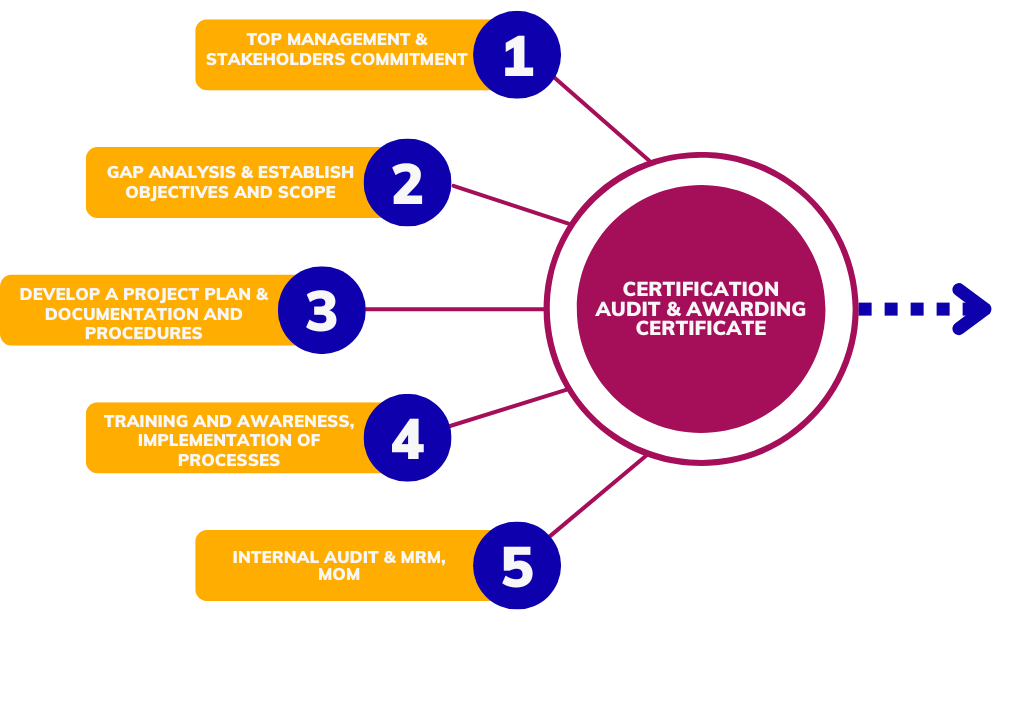
Implementing an ISO standards involves a structured methodology to ensure that the organization effectively meets the requirements of the chosen standard and achieves certification. Sometimes defined methodology may vary depending on factors such as the size of the organization, its industry, and the complexity of the ISO standard being implemented, the following steps provide a basic framework

OUR
Process
1, Determine the ISO Standard
2. Understand the Requirements
3. Training and Awareness
4. Implement the System
5. Internal Audit
6. Certification

Benefits of having ISO Certification
Enhanced Credibility and Reputation
Legal and Regulatory Compliance
Enhanced Customer Satisfaction
Access to Global Markets
Environmental Sustainability
Information Security
Our Achievements and Success
Our Clients





OUR
SERVICES
ISO 14001 Certification Consulting Services in Tanzania for Controlled Environmental Performance
ISO 14001 helps Tanzanian organisations identify environmental aspects, manage obligations and improve controls for water, waste, emissions, land, biodiversity and resource use.
Turn environmental commitments into managed operational controls
ISO 14001 provides a structured framework for identifying environmental aspects, evaluating risks and opportunities, meeting compliance obligations and improving environmental performance.
Facilities in Tanzania may manage water, wastewater, fuel, chemicals, packaging, organic waste, dust, emissions and contractor activities within the same operational boundary.
An effective EMS links significant aspects to operating criteria, monitoring, competence, emergency response and corrective action. Lifecycle thinking also brings procurement, transport, product use and disposal into management decisions.
Qualitcert supports aspect-impact evaluation, compliance registers, objectives, operational controls, internal audits, management review and certification preparation.
Environmental priorities for Tanzania's coastal, industrial and natural-resource activities
Ports, mining, tourism, agriculture, construction and energy projects require evidence-based environmental governance.
Port, fuel-storage and transport operations need disciplined spill prevention, stormwater controls, waste management and emergency preparedness.
Mining, quarrying and construction activities must address land disturbance, dust, water, spoil, noise and contractor behaviour. Food processors and hotels benefit from structured water, wastewater and waste-reduction programmes.
ISO 14001 gives management a consistent method to assign owners, establish baselines, monitor results and verify that improvement projects remain effective.
How an EMS supports responsible growth
Environmental performance improves when legal, operational and resource-efficiency decisions are managed through the same system.
Clearer compliance control
Legal and permit duties are assigned, updated, evaluated and supported by evidence.
Lower resource waste
Objectives for water, materials, fuel and energy can reduce avoidable consumption and cost.
Improved incident prevention
Controls for chemicals, effluent, waste and contractors reduce the likelihood and impact of environmental events.
Stronger stakeholder trust
Customers, communities and investors receive a more credible view of environmental governance and progress.
ISO 14001 applications across Tanzanian sectors
Each environmental management system should reflect the aspects the organisation controls and those it can influence.
Mining and quarrying
Manage land disturbance, water, dust, waste, fuel and rehabilitation obligations.
Ports and marine logistics
Control spills, waste, stormwater, vessel support and emergency response.
Tourism and hospitality
Address water, wastewater, waste, energy and biodiversity-sensitive operations.
Agricultural processing
Improve water use, chemicals, organic waste, packaging and transport controls.
Construction projects
Manage erosion, spoil, dust, noise, fuel storage and subcontractor practices.
Energy and utilities
Control emissions, oils, chemicals, waste, water and emergency situations.
From environmental review to certification evidence
The route starts with understanding real impacts and ends with demonstrated control, evaluation and improvement.
Establish context and scope
Define sites, activities, environmental conditions, stakeholders and organisational boundaries.
Evaluate aspects and duties
Identify impacts, determine significance and compile applicable legal, permit and contractual obligations.
Plan objectives and controls
Set measurable programmes and define operating criteria for significant aspects and compliance risks.
Implement at site level
Train responsible people, control contractors, maintain equipment and prepare for credible emergencies.
Monitor and evaluate
Track indicators, inspect controls, evaluate compliance and investigate environmental nonconformities.
Audit, review and certify
Complete internal audits, management review, corrective actions and external certification readiness.
Environmental documents, registers and records
Documented information should show the logic from aspect identification through control, measurement, compliance evaluation and improvement.
Typical EMS documentation
- Environmental policy
- EMS scope and context review
- Aspect-impact register
- Legal and permit register
- Environmental objectives plan
- Waste and chemical controls
- Emergency response arrangements
- Monitoring and inspection records
- Compliance evaluation results
- Audit and management review records
Common EMS weaknesses
An environmental system can fail even with many procedures when the underlying risk evaluation is incomplete or operating criteria are unclear.
- Listing aspects without a consistent method for determining significance.
- Maintaining a legal register without evaluating actual compliance.
- Setting reduction targets without reliable baselines or normalised data.
- Ignoring environmental controls for contractors and temporary work.
- Recording incidents without reviewing root causes and preventive changes.
Related ISO 14001 Services for Tanzanian Organisations
For a connected requirement, review ISO 9001 certification consulting services in Tanzania to coordinate shared governance, documentation and management responsibilities.
For a connected requirement, review ISO 45001 certification consulting services in Tanzania where common risks, suppliers or operational controls should be aligned.
For a connected requirement, review ISO 22000 certification consulting services in Tanzania to reduce duplicated work and build a coherent assurance programme.
ISO 14001 questions for organisations operating in Tanzaniana
The answers below focus on aspects, compliance, life-cycle thinking and environmental performance evidence.
What does ISO 14001 require an organisation to manage?
It requires the organisation to manage environmental aspects, compliance obligations, risks and opportunities, objectives, operational controls, emergencies, performance evaluation and improvement.
How is a significant environmental aspect determined?
The organisation defines a consistent method using factors such as scale, severity, frequency, legal concern, stakeholder interest and the degree of control or influence.
Does ISO 14001 guarantee legal compliance?
Certification does not guarantee that breaches can never occur. It requires a systematic process to identify obligations, maintain controls, evaluate compliance and correct problems.
What is life-cycle thinking in ISO 14001?
It means considering environmental impacts across stages such as design, purchasing, transport, use and end of life, without necessarily performing a formal life-cycle assessment.
Are environmental objectives required?
Yes. Relevant objectives should be measurable where practicable and supported by actions, resources, responsibilities, timeframes and evaluation methods.
How should contractors be managed under an EMS?
Environmental requirements should be communicated through procurement, induction, permits, supervision, inspection and performance review according to the contractor risk.
What emergency scenarios should be considered?
Credible scenarios may include spills, firewater contamination, chemical release, effluent failure, fuel leakage or extreme weather impacts, depending on site conditions.
Can ISO 14001 support tender requirements?
Yes. Certification and well-organised environmental evidence can support supplier qualification, project submissions and customer sustainability expectations.
How often should compliance be evaluated?
The frequency should reflect the obligation and risk. High-risk permits may need frequent checks, while other duties may be reviewed on a planned annual cycle.
What support does Qualitcert provide for ISO 14001 in Tanzaniana?
Support can include environmental review, aspect and legal-register development, objective planning, documentation, training, audits and certification readiness.
Map an ISO 14001 Programme for Your Tanzania Facilities
Provide your activities, obligations, aspect registers and current controls. Qualitcert can help structure a practical EMS and audit-readiness programme.