









Global ISO Certification Consultant Services – Qualitcert

QualitCert Get a Quote

ISO Certifications

ken

ya

Consulting &

ISO Certifications

-ISO Certification-

ISO 13485 Certification Services in Kenya

QUALIT

CERT

CONSULTING AND ISO CERTIFICATIONS

Qualitcert offers full-service ISO 13485 certification in Kenya, enabling medical device companies to improve their quality control procedures. By providing knowledgeable advice, we assist businesses in adhering to the strict regulations that control the development, manufacture, and sale of medical devices, guaranteeing the security and effectiveness of their goods. Comprehensive evaluations, gap analyses, and training programs are all part of our customized strategy, which gives your staff the tools they need to stay compliant and keep improving procedures. Your company may show its dedication to quality and dependability by earning ISO 13485 certification, giving it a competitive advantage in the market and building stakeholder and consumer trust. Join forces with Qualitcert right now to improve your quality management standards and expedite your certification process.

Please Reach Us Today

Test
afd9a249 perf wp theme group 8796

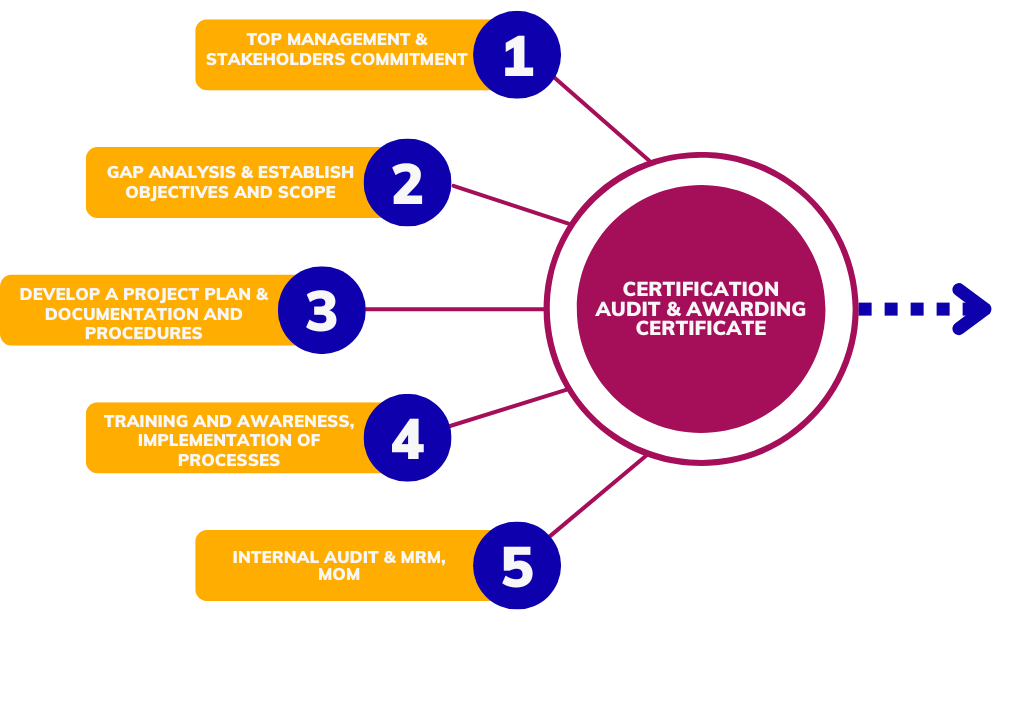
Approach and Methodology used to implement Management System Standard

Colorful Minimalist Linear Steps Circular Diagram 1 e1712599893569

Implementing an ISO standards involves a structured methodology to ensure that the organization effectively meets the requirements of the chosen standard and achieves certification. Sometimes defined methodology may vary depending on factors such as the size of the organization, its industry, and the complexity of the ISO standard being implemented, the following steps provide a basic framework

Ellipse 6 copy

OUR

Process

1, Determine the ISO Standard

2. Understand the Requirements

3. Training and Awareness

4. Implement the System

5. Internal Audit

6. Certification

partner_img

Benefits of having ISO Certification

Enhanced Credibility and Reputation

Legal and Regulatory Compliance

Enhanced Customer Satisfaction

Access to Global Markets

Environmental Sustainability

Information Security

Our Achievements and Success

Professional Experts
0 +
Years Experience
0 +
Projects
0 +
Satisfied Customers
0 %

Our Clients

WhatsApp Image 2023 05 12 at 8.24.31 PM e1684164170667
WhatsApp Image 2023 05 12 at 8.16.53 PM e1684163940587
WhatsApp Image 2023 05 12 at 8.22.55 PM
WhatsApp Image 2023 05 12 at 8.04.13 PM 3 e1684163886384
WhatsApp Image 2023-05-12 at 8.15.32 PM

OUR

SERVICES

ISO 9001 Certification
ISO 45001 Certification
ISO 14001 Certification
ISO 22000 Certification
ISO 13485 Certification
ISO 27001 Certification
ISO 20000-1 Certification
ISO 29001 Certification
Medical Device Quality in Kenya

ISO 13485 Certification Services in Kenya for Controlled Medical Device Quality Systems

ISO 13485 helps medical device organisations control design, sourcing, production, distribution and post-market activities through a risk-based quality management system.

Build device controls around safety, traceability and regulatory evidence

ISO 13485 is a quality management system standard developed specifically for medical devices and related services. It requires disciplined control of product realisation, suppliers, cleanliness, validation, traceability, nonconforming product, complaints and corrective action.

Medical device businesses in Kenya may operate as importers, distributors, assemblers, service providers or manufacturers. Each role creates a different quality-system scope, but all need clear evidence that responsibilities, product status and regulatory commitments are understood.

Unlike a general quality system, ISO 13485 places stronger emphasis on documented procedures, risk-based control and records that support product safety throughout the device life cycle. Software, sterile products, measuring equipment and outsourced processes may require additional validation and monitoring.

Qualitcert helps organisations interpret scope, map device processes, prepare controlled documentation, assess suppliers, structure CAPA, organise complaint and vigilance records, conduct internal audits and prepare for certification.

Kenya Medical Device Context

Quality control for imported, assembled and supported devices

Kenyan healthcare supply chains include distributors, diagnostic suppliers, local assemblers, service teams and organisations supporting public and private facilities.

Imported devices can arrive with manufacturer records that do not fully match local branding, model variants, storage arrangements or servicing responsibilities. The Kenya organisation should understand which records it owns, which it receives and how product changes are communicated.

Supplier control is especially important where quality depends on overseas manufacturers, sterilisation providers, calibration services, software developers or logistics partners. Approval and monitoring should reflect the effect of each supplier on device conformity.

Post-delivery information also matters. Complaints, returned products, service reports and adverse-event information can reveal issues that incoming inspection or final release did not detect.

Medical Device Assurance

How ISO 13485 strengthens device operations

The system supports regulatory readiness, safer products and more reliable evidence across the supply chain.

Improved device traceability

Product, lot, serial, supplier and distribution records support investigation and field action.

Stronger supplier control

Risk-based approval and monitoring focus attention on critical products, processes and services.

More disciplined CAPA

Complaint, audit and process data are analysed to identify causes and verify corrective-action effectiveness.

Better customer confidence

Hospitals, partners and regulators receive clearer evidence of controlled device-quality responsibilities.

Medical Device Applications

ISO 13485 use cases in Kenya

The QMS should be tailored to the organisation's role and the device categories within its scope.

01

Device importers and distributors

Control supplier approval, storage, transport, product identification, complaints and recall support.

02

Diagnostic equipment suppliers

Manage installation, calibration, servicing, spare parts, technical records and customer feedback.

03

Local device assemblers

Control specifications, components, work instructions, inspection, process validation and release.

04

Sterile product suppliers

Address sterile-barrier integrity, environmental controls, outsourced sterilisation and traceability.

05

Hospital supply organisations

Manage product status, storage conditions, expiry, complaints, returned goods and field notifications.

06

Digital and connected devices

Control software changes, cybersecurity responsibilities, configuration, validation and technical support.

Device QMS Journey

A risk-based route to ISO 13485 certification

Implementation begins with regulatory role and product scope, then builds evidence around device risk and process effectiveness.

01

Define role and scope

Confirm device categories, sites, regulatory roles, exclusions and outsourced activities.

02

Map life-cycle processes

Document design, purchasing, receiving, production, storage, distribution, installation, service and feedback.

03

Establish risk-based controls

Align procedures, acceptance criteria, validation and records with product and process risk.

04

Control suppliers and changes

Qualify providers, approve specifications and evaluate changes before they affect conformity.

05

Audit operational evidence

Test traceability, release, complaints, CAPA, calibration, training and document control.

06

Review and certify

Complete management review, corrective action and preparation for the certification audit.

Medical Device Documentation

Documents and records commonly reviewed for ISO 13485

The final evidence set depends on the organisation's regulatory role, device risk, processes and permitted exclusions.

Typical device QMS records

  • QMS scope and quality manual
  • Medical device file or product dossier
  • Risk management references
  • Supplier approval records
  • Purchasing and inspection records
  • Validation protocols and reports
  • Identification and traceability logs
  • Complaint and vigilance records
  • CAPA and nonconformity records
  • Internal audit and management review
Product and quality records should be retained for periods appropriate to device life, regulatory obligations and contractual requirements.

Medical device QMS gaps

Weak systems often use general quality procedures without addressing device-specific evidence and regulatory responsibilities.

  • Applying ISO 9001 procedures without adding medical device controls.
  • Approving critical suppliers only on price or basic certificates.
  • Treating servicing and installation as informal customer support.
  • Closing complaints before evaluating reportability and product impact.
  • Changing components, software or packaging without documented review.
Audit readiness improves when each device family can be traced to applicable specifications, controls, release evidence and post-market feedback.
Medical Device Assurance Links

Organisations preparing products for European markets can review CE Marking services in Kenya.

Broader organisational quality controls can connect with ISO 9001 certification services in Kenya.

Testing and calibration competence can be supported by ISO 17025 certification services in Kenya.

Medical Device QMS FAQs

ISO 13485 questions from Kenya-based device organisations

These answers address scope, documentation, suppliers, risk, complaints and certification.

Who can seek ISO 13485 certification in Kenya?

Manufacturers, assemblers, importers, distributors, service providers and critical suppliers can seek certification where their activities fall within a defined medical device QMS scope.

Is ISO 13485 the same as ISO 9001?

No. ISO 13485 is tailored to medical devices and places greater emphasis on documented controls, regulatory requirements, traceability, validation and risk.

Can design and development be excluded?

An exclusion may be possible when design is not the organisation's responsibility and the exclusion is permitted and justified within the applicable scope.

What is a medical device file?

It is controlled information for a device type or family describing specifications, processes, installation, servicing and other records needed to demonstrate conformity.

How should critical suppliers be evaluated?

Evaluation should consider the supplier's effect on device conformity, capability, quality history, controls, change notification and monitoring evidence.

When is process validation required?

Validation is required when process results cannot be fully verified by later monitoring or measurement, or where deficiencies may become apparent only after use.

How are complaints managed under ISO 13485?

Complaints are documented, evaluated, investigated where appropriate and assessed for reporting, corrective action and feedback to risk management.

Does ISO 13485 require risk management?

Yes. Risk-based approaches are expected across QMS processes, and product risk management should be linked to applicable device requirements.

Can distributors use ISO 13485?

Yes. Their scope may focus on supplier control, storage, transport, traceability, complaints, field actions and regulatory communication.

How does Qualitcert support ISO 13485 in Kenya?

Qualitcert can support scope definition, documentation, supplier controls, CAPA, traceability, internal audit and certification preparation.

Strengthen Device Evidence

Prepare your medical device QMS for certification review

Share your device categories, regulatory role, suppliers and current procedures. Qualitcert can help structure an ISO 13485 plan suited to your Kenya operations.

Request a Device QMS Review →
Scroll to Top