








Global ISO Certification Consultant Services – Qualitcert

QualitCert Get a Quote

ISO Certifications

Salalah

Consulting &

ISO Certifications

-ISO Certification-

HITRUST Certification Services in Salalah

QUALIT

CERT

CONSULTING AND ISO CERTIFICATIONS

Leading HITRUST (Health Information Trust Alliance) certification services provider in Salalah, Qualitcert specializes in assisting businesses in the healthcare and associated sectors in becoming compliant with the HITRUST Common Security Framework (CSF). Their knowledgeable consultants walk companies through each stage of the certification process, from the first readiness evaluations to the installation of required controls and the completion of in-depth gap studies. Healthcare enterprises have specific security and privacy needs, and Qualitcert’s HITRUST services are built to suit these needs while also adhering to industry standards and legal regulations like GDPR and HIPAA. Qualitcert helps companies build strong security postures, reduce risks, and safeguard critical health data by utilizing their extensive experience in risk management and cybersecurity. Qualitcert assists by concentrating on providing individualized solutions.

Please Reach Us Today

Test
Consultants Consultants
afd9a249 perf wp theme group 8796 Consultants Consultants

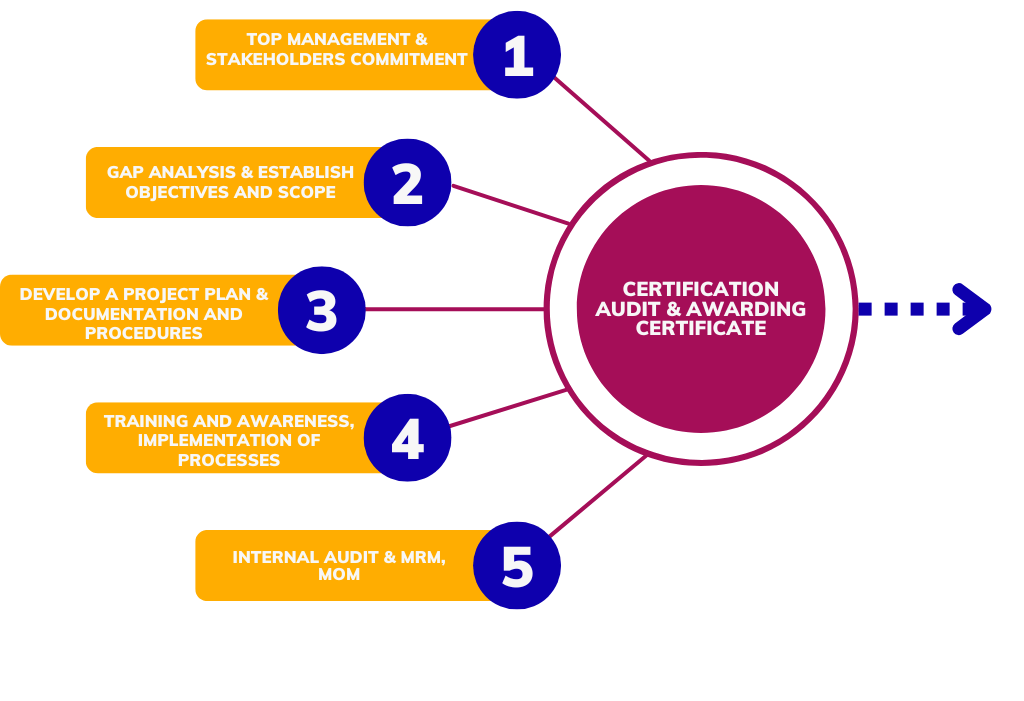
Approach and Methodology used to implement Management System Standard

Colorful Minimalist Linear Steps Circular Diagram 1 e1712599893569 Consultants Consultants

Implementing an ISO standards involves a structured methodology to ensure that the organization effectively meets the requirements of the chosen standard and achieves certification. Sometimes defined methodology may vary depending on factors such as the size of the organization, its industry, and the complexity of the ISO standard being implemented, the following steps provide a basic framework

Ellipse 6 copy Consultants Consultants

OUR

Process

1, Determine the ISO Standard

2. Understand the Requirements

3. Training and Awareness

4. Implement the System

5. Internal Audit

6. Certification

partner_img Consultants Consultants

Benefits of having ISO Certification

Enhanced Credibility and Reputation

Legal and Regulatory Compliance

Enhanced Customer Satisfaction

Access to Global Markets

Environmental Sustainability

Information Security

Our Achievements and Success

Professional Experts
0 +
Years Experience
0 +
Projects
0 +
Satisfied Customers
0 %

Our Clients

WhatsApp Image 2023 05 12 at 8.24.31 PM e1684164170667
WhatsApp Image 2023 05 12 at 8.16.53 PM e1684163940587
WhatsApp Image 2023 05 12 at 8.22.55 PM
WhatsApp Image 2023 05 12 at 8.04.13 PM 3 e1684163886384
WhatsApp Image 2023-05-12 at 8.15.32 PM

OUR

SERVICES

ISO 9001 Certification
ISO 45001 Certification
ISO 14001 Certification
ISO 22000 Certification
ISO 13485 Certification
ISO 27001 Certification
ISO 20000-1 Certification
ISO 29001 Certification
Management System Readiness

HITRUST Services for Salalah Teams That Need Practical Control

Hitrust csf readiness and assessment support for Salalah, Oman should connect requirements with actual operating evidence, responsible owners and a scope that reflects the organization’s products, services and risks.

Build HITRUST around evidence people can maintain

Salalah-based healthcare technology, outsourcing and managed-service teams that support international health-sector clients may encounter HITRUST requirements in contracts or vendor assessments. The effort is most effective when the assessed systems and business processes are tightly scoped.

Organizations usually get better results from HITRUST when they begin with the decision the system is meant to improve. The specific objective here is to prepare organizations for the HITRUST assurance pathway by defining scope, implementing required controls and building evidence that aligns with the selected assessment type.

A HITRUST readiness project needs more than policy wording. It should connect accountable owners with operating criteria, supporting records, review routines and corrective action so the HITRUST CSF assurance programme can be demonstrated under normal business conditions.

HITRUST assurance follows its own assessment and quality-assurance requirements. The appropriate assessment type should be chosen based on customer need, risk and eligibility rather than assumed in advance. For this Salalah scope, Qualitcert supports preparation by reviewing the current state, identifying missing controls and helping teams build a maintainable HITRUST control evidence trail.

Local Operating Context

Turning HITRUST Requirements into Salalah Operating Practice

In Salalah, HITRUST can intersect with health technology providers, managed service providers and medical billing and bpo. For HITRUST, the implementation emphasis should follow the risks and obligations of the specific Salalah operation.

Salalah operations often combine local service delivery with regional suppliers, international customers and outsourced technology, which makes clear scope and responsibility especially important for HITRUST.

The most important early decisions usually involve assessment type and scoped systems and control requirement statements and ownership. These determine where evidence should come from and which roles need to participate in the HITRUST programme.

The remaining priorities—evidence quality across the assessment period and remediation and assessor readiness—should then be embedded into routine reviews so the HITRUST CSF assurance programme keeps working after the initial readiness phase.

Operational Value

Results to Target During HITRUST Implementation

The strongest value appears when HITRUST improves decisions and records that teams already rely on, rather than creating a parallel compliance routine.

Defined assurance boundary

Teams can focus evidence collection on the systems, facilities and services that are actually in scope.

Mapped control ownership

Security and privacy requirements can be assigned across IT, HR, legal, operations and vendors.

Evidence built during operations

Screenshots, reports, tickets and policy records can be retained as work occurs rather than recreated later.

Structured remediation

Control weaknesses can be prioritized against assessment expectations and customer risk.

Where It Fits

Where HITRUST Controls Meet Real Business Activity

The examples below show how HITRUST changes emphasis according to the work being performed; the final scope should always follow the organization’s actual activities.

01

Health technology providers

Platform controls, development practices and hosted data protection can be brought into one assurance scope.

02

Managed service providers

Operational security evidence can be organized for healthcare clients that request HITRUST assurance.

03

Medical billing and BPO

Workforce, endpoint, access and client-data controls can be tested against applicable requirements.

04

Cloud service operations

Infrastructure, monitoring, change and vendor controls can support a scoped HITRUST assessment.

05

Healthcare analytics teams

Sensitive datasets, privileged access and data-transfer controls can be examined in context.

06

Telehealth support services

Identity, session security and incident controls can be evidenced across technical and operational workflows.

Working Sequence

The Working Sequence Behind HITRUST Readiness

This sequence keeps the HITRUST CSF assurance programme tied to scope, implementation evidence and management ownership instead of treating preparation as a last-minute document exercise.

01

Choose the assurance objective

Clarify customer expectations and determine the HITRUST assessment route that fits the organization.

02

Define the assessment scope

Identify systems, facilities, platforms, services, people and third parties included in testing.

03

Map control requirements

Assign each applicable requirement to an owner and identify the expected evidence source.

04

Close implementation gaps

Improve policies, configurations, monitoring and operational routines where controls are weak.

05

Collect and quality-check evidence

Confirm that artifacts are current, scoped, consistent and tied to the relevant control statement.

06

Prepare for assessor activity

Resolve open issues, brief owners and organize evidence for efficient validation.

Records and Control

Evidence Quality Matters in HITRUST

Strong HITRUST control evidence is current, attributable to the right process and detailed enough for another person to understand what happened.

Core Records to Control

  • Assessment scope inventory
  • System and network diagrams
  • Control ownership matrix
  • Policies and standards
  • Access-control evidence
  • Vulnerability and patch records
  • Change and incident records
  • Vendor-risk documentation
  • Training and HR security records
  • Remediation tracker
Use controlled records that match the Salalah scope; obsolete, copied or out-of-scope files can weaken the clarity of the HITRUST evidence trail.

Common Failure Patterns

These issues can make a HITRUST programme look documented while leaving important operational questions unanswered.

  • Starting evidence collection before the assessment scope is stable.
  • Assigning all controls to IT even when HR, legal or operations own the activity.
  • Using policy statements as proof when the control requires operational evidence.
  • Submitting artifacts that fall outside the required assessment period.
  • Underestimating remediation time for technical or third-party control gaps.
Finding these weaknesses during implementation gives owners time to correct the process and generate reliable HITRUST control evidence before formal assessment activity.
Connected Requirements

Where controls overlap with HIPAA Compliance services in Salalah, a Salalah HITRUST programme can share owners or records without treating the two requirements as interchangeable.

For HITRUST, a connected requirement may be ISO/IEC 27001 services in Salalah. Coordinate ISO/IEC 27001 with HITRUST where shared risks, suppliers or management routines make that useful.

Organizations extending beyond HITRUST can also review SOC 2 services in Salalah; integration at process level can reduce duplicate work while preserving the distinct purpose of HITRUST.

FAQs

Important HITRUST Questions for Operational Teams

These answers clarify scope, evidence and practical preparation for organizations considering HITRUST in Salalah.

Is HITRUST mainly a documentation project?

No. For HITRUST, documents support the system, but implementation is demonstrated by people performing controls and retaining evidence during normal work.

Where should a Salalah HITRUST readiness review begin?

A Salalah HITRUST review should compare the current operating model with the intended outcome: to prepare organizations for the HITRUST assurance pathway by defining scope, implementing required controls and building evidence that aligns with the selected assessment type.

What usually creates the biggest HITRUST readiness gap?

For HITRUST, frequent readiness gaps include unclear ownership, inconsistent records, controls that exist only in procedures and weak follow-up on exceptions; assessment type and scoped systems is an important checkpoint.

Does every site have to be included in the HITRUST scope?

Not always. The HITRUST scope should be justified against the applicable assurance route, contractual needs and the organization’s operating boundaries.

How much existing evidence can be used for HITRUST?

Current HITRUST evidence can be reused when it genuinely demonstrates the required control and is relevant, traceable and produced by the process being assessed.

What role do process owners play in HITRUST?

In HITRUST, process owners should understand requirements affecting their work, maintain controls, review results and act when performance or evidence shows a problem.

Should HITRUST training happen before procedures are final?

General HITRUST awareness can begin early, while role-specific training is stronger after responsibilities, workflows and expected records are clear.

How are HITRUST implementation gaps prioritized?

Prioritize HITRUST gaps according to risk, customer or legal impact, assessment significance and the time needed to generate reliable operational evidence.

What needs to happen before the HITRUST external review?

Before the HITRUST external review, complete internal checking, close material gaps, evaluate open corrective actions and confirm that management has reviewed system performance.

What should the Salalah team maintain after HITRUST readiness?

After HITRUST readiness, maintain the control owners, HITRUST control evidence, performance reviews and change triggers that keep the system aligned with the Salalah operating scope.

Plan the Next Step

Prepare the Salalah Team for the Next HITRUST Milestone

Define the systems, client expectations and intended HITRUST assurance route before building the Salalah evidence programme.

Build a Roadmap →
Scroll to Top