
ISO Certifications
riffa
Consulting &
ISO Certifications

-ISO Certification-
HALAL, GMP, ORGANIC Certification Services in Riffa
QUALIT
CERT
CONSULTING AND ISO CERTIFICATIONS
Qualitcert assists companies in meeting global quality and safety requirements by offering HALAL, GMP, and ORGANIC certification services in Riffa. By guaranteeing that goods fulfill stringent safety, quality, and hygiene standards, HALAL certification makes them appropriate for a wider range of customers. By guaranteeing appropriate production procedures, reducing risks, and improving safety, GMP (Good production Practices) certification aims to maintain consistent product quality. For consumers who are concerned about their health and the environment, ORGANIC certification attests to the sustainable production of goods free of artificial chemicals and genetically modified organisms. Businesses may increase their credibility, comply with regulations, and reach a wider audience by using Qualitcert’s end-to-end support, which includes audits, paperwork help, and staff training.
Get In Touch


Approach and Methodology used to implement Management System Standard
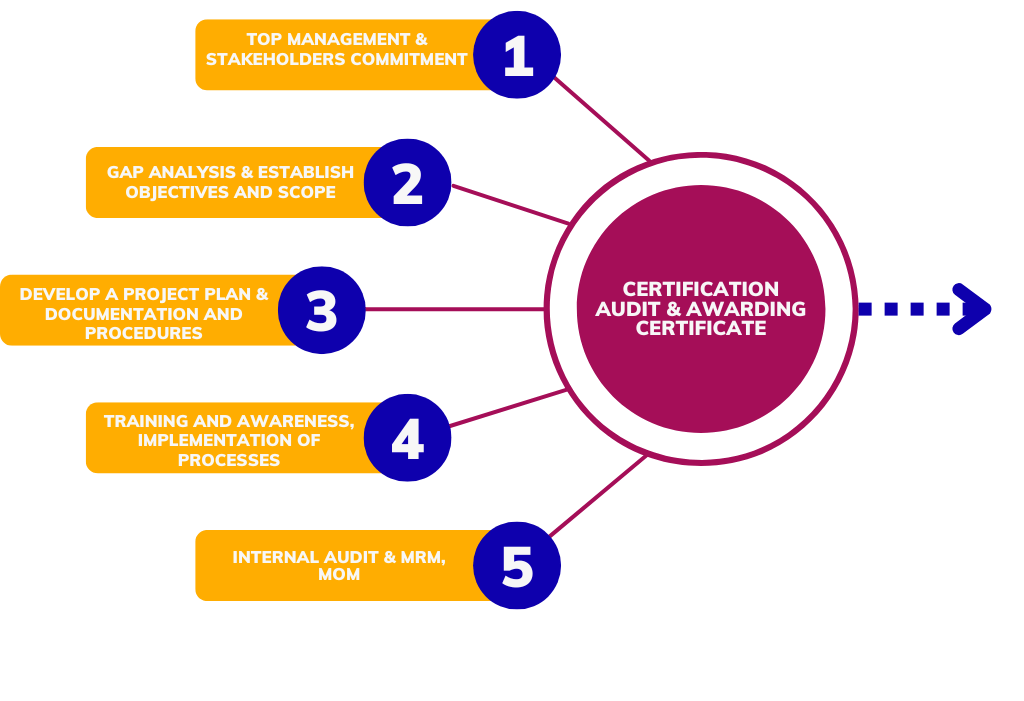
Implementing an ISO standards involves a structured methodology to ensure that the organization effectively meets the requirements of the chosen standard and achieves certification. Sometimes defined methodology may vary depending on factors such as the size of the organization, its industry, and the complexity of the ISO standard being implemented, the following steps provide a basic framework

OUR
Process
1, Determine the ISO Standard
2. Understand the Requirements
3. Training and Awareness
4. Implement the System
5. Internal Audit
6. Certification

Benefits of having ISO Certification
Enhanced Credibility and Reputation
Legal and Regulatory Compliance
Enhanced Customer Satisfaction
Access to Global Markets
Environmental Sustainability
Information Security
Our Achievements and Success
Our Clients





OUR
SERVICES
Halal, GMP and Organic Readiness in Riffa With Each Claim Kept Technically Distinct
Riffa organisations considering Halal, GMP & Organic Certification need a route that fits their actual scope, evidence and customer expectations.
Keep three different claim systems separate from the beginning
Halal, GMP and organic claims may appear together on the same product, but they are supported by very different evidence and approval routes. In practical terms, the work should separate three different compliance routes—religious permissibility, controlled manufacturing practice and organic production claims—so each is supported by the right suppliers, processes, records and approval pathway.
Halal, GMP and organic requirements arise from different schemes and authorities. One approval does not automatically satisfy the others, and scope must be confirmed with the relevant certification or regulatory body. Halal, GMP and Organic implementation should account for outsourced services and suppliers because important obligations often sit outside the organisation's direct payroll.
Riffa distributors, food businesses and product brands may source from several countries, which makes certificate scope, ingredient status and manufacturing evidence especially important. In Halal, GMP and Organic work involving food processing or cosmetics and personal care, the strongest approach connects requirements to actual responsibilities, records and decision points instead of creating a separate compliance layer.
Qualitcert can support Riffa organisations by reviewing the current state, clarifying the Halal, GMP and Organic scope, strengthening ingredient integrity and manufacturing hygiene, and checking whether evidence is ready for the relevant audit, appraisal, assessment or customer review. Clear Halal, GMP and Organic interfaces reduce gaps where each party assumes the other is responsible.
Managing Multiple Product Claims Without Mixing Their Requirements
The local operating context affects how ingredient integrity, manufacturing hygiene and third-party responsibilities should be implemented.
Customer tenders, group requirements and cross-border contracts can change the level of Halal, GMP and Organic evidence expected from a Riffa organisation. A defensible Halal, GMP and Organic programme therefore explains both what is in scope and why important exclusions, dependencies or third parties are treated the way they are.
A practical Halal, GMP and Organic implementation in Riffa should reflect the way nutraceutical operations and warehousing and distribution operate, including hand-offs to suppliers, contractors and customers. The Halal, GMP and Organic boundary should follow those interfaces rather than stop at an organisation chart.
East Riffa and West Riffa combine commercial, community and service activity, while the wider Southern Area includes healthcare, education and industrial operations relevant to many Halal, GMP and Organic scopes. That variety means Halal, GMP and Organic controls should be scaled to the organisation's real risk profile rather than copied from a larger or unrelated business.
Benefits of Separating Halal, GMP and Organic Control Routes
Well-designed controls should create visible operational value while making Halal, GMP and Organic evidence easier to explain and maintain.
Clearer claim ownership
Teams understand which ingredients, process controls and records support each Halal, GMP or organic claim.
Better supplier screening
Certificates, specifications and origin information can be checked before materials are approved for use.
Reduced cross-contamination risk
Storage, utensils, production lines and cleaning controls can be designed around claim-specific segregation needs.
More reliable label review
Marketing and packaging claims can be checked against approved scope instead of relying on assumptions.
Where Halal, GMP and Organic Controls Need Different Evidence
The examples below show how the requirements can translate into different Riffa operating environments without forcing every sector into the same model.
Food processing
Ingredient status, processing aids, cleaning and line segregation can influence Halal and organic claim integrity.
Cosmetics and personal care
Raw materials, manufacturing hygiene and claim evidence require careful review across multiple schemes.
Nutraceutical operations
Formula control, supplier documents and GMP discipline support consistent manufacturing and traceability.
Warehousing and distribution
Segregation, identification and chain-of-custody records help protect certified product status.
Private-label brands
Brand owners need traceable links to approved manufacturers, formulations and certification scope.
Restaurants and catering
Halal sourcing, storage and preparation controls may need to be demonstrated to customers or scheme owners.
A Separate Readiness Path for Each Product Claim
The sequence below moves from scope and current-state understanding to implemented controls, evidence and independent review readiness.
Separate the requested schemes
Confirm which Halal, GMP and organic requirements actually apply to the products and markets in scope.
Review materials and suppliers
Collect ingredient, origin, certificate and specification evidence before approving inputs.
Map manufacturing controls
Assess receiving, storage, processing, cleaning, line changeover and packing against scheme expectations.
Control claims and labels
Ensure package statements and logos are only used within the approved certification scope.
Build traceability
Link incoming materials, production batches, finished goods and supplier evidence.
Prepare for external review
Close scheme-specific gaps and organise records for the relevant certifier or regulatory assessment.
Evidence Sets Commonly Needed Across Halal, GMP and Organic Routes
Records should be current, attributable and relevant to the defined Halal, GMP and Organic scope; volume is less important than traceability and use.
Evidence Owners Should Maintain: Halal, GMP and Organic
- Approved supplier list
- Ingredient specifications
- Halal certificates
- Organic certificates
- GMP procedures
- Cleaning and sanitation records
- Segregation controls
- Batch manufacturing records
- Traceability records
- Label and claim approvals
Readiness Issues That Create Rework: Halal, GMP and Organic
These weaknesses can undermine Halal, GMP and Organic readiness even when the organisation has written procedures and good intentions.
- Treating Halal, GMP and organic as one combined certification requirement.
- Accepting supplier logos without verifying current certificate scope.
- Using organic or Halal claims on labels before the product is included in approved scope.
- Allowing uncontrolled line sharing that undermines segregation requirements.
- Assuming a GMP system alone proves ingredient origin or religious compliance.
Related Certification Support for Riffa Food and Supply Businesses
Where Halal, GMP and Organic and this requirement share business processes, consider HACCP support for Riffa organisations so common controls can be coordinated without blurring the two scopes.
A connected requirement for Halal, GMP and Organic may be ISO 22000 services in Riffa; review it separately and reuse evidence only where the underlying control genuinely serves both scopes.
For a broader Halal, GMP and Organic assurance programme, Riffa SA8000 readiness support can complement this work while retaining its own audit, assessment or review criteria.
Halal, GMP and Organic Questions From Riffa Product Businesses
These answers clarify common scope, evidence and implementation questions for organisations considering Halal, GMP and Organic in Riffa.
Are Halal, GMP and organic the same type of certification?
No. They address different issues and may be governed by different standards, schemes, certifiers and authorities.
Can one audit cover all three areas?
Sometimes assessments can be coordinated, but the applicable criteria and certification decisions remain separate unless a specific scheme formally combines them.
What should be checked for Halal readiness?
Ingredient origin, processing aids, supplier certificates, contamination risks, storage, production controls and label use are common review areas.
What does GMP focus on?
GMP focuses on controlled manufacturing conditions such as hygiene, facilities, personnel practices, documentation, equipment, process control and traceability.
What supports an organic claim?
Organic claims require evidence that ingredients, handling and chain-of-custody comply with the applicable organic standard and certification route.
Can private-label products be certified?
Potentially, but the brand owner and manufacturer need clear responsibility, approved formulations, traceability and scheme-specific scope.
How should certificates from suppliers be managed?
Track validity dates, issuing bodies, product scope and any conditions instead of keeping certificates as unreviewed attachments.
Why is line segregation important?
Shared equipment can create contamination or integrity risks, so cleaning, scheduling, identification and verification may be needed.
Can Qualitcert select the certifier for us?
Qualitcert can help clarify requirements and readiness, while the organisation should confirm an appropriately recognised certification body for the target market.
What is a practical first step in Riffa?
List the products and claims you want to make, then map every ingredient and manufacturing site to the evidence currently available.
Separate Your Halal, GMP and Organic Readiness Requirements
Bring the procedures, evidence and customer requirements currently driving your Halal, GMP and Organic work. Qualitcert can review what is usable, what needs strengthening and how your team can prepare for the relevant Halal, GMP and Organic independent review.