
ISO Certifications
tehran
Consulting &
ISO Certifications

-ISO Certification-
QUALIT
CERT
CONSULTING AND ISO CERTIFICATIONS
Qualitcert’s HACCP Certification Services in Tehran provide businesses with all-encompassing assistance in meeting international food safety regulations. A methodical strategy to detecting, assessing, and managing food safety risks, HACCP (Hazard Analysis and Critical Control Point) makes sure that goods are fit for human consumption. Qualitcert specializes in helping firms in the food industry with all aspects of the certification process, such as hazard assessment, the creation of crucial control measures, and the deployment of efficient monitoring systems. Their knowledge spans a number of industries, such as food production, processing, and distribution, guaranteeing customized solutions to satisfy demands unique to each area. Businesses in Tehran may exceed regulatory requirements, increase consumer trust, and obtain a competitive advantage in both domestic and foreign markets by collaborating with Qualitcert.
Get In Touch


Approach and Methodology used to implement Management System Standard
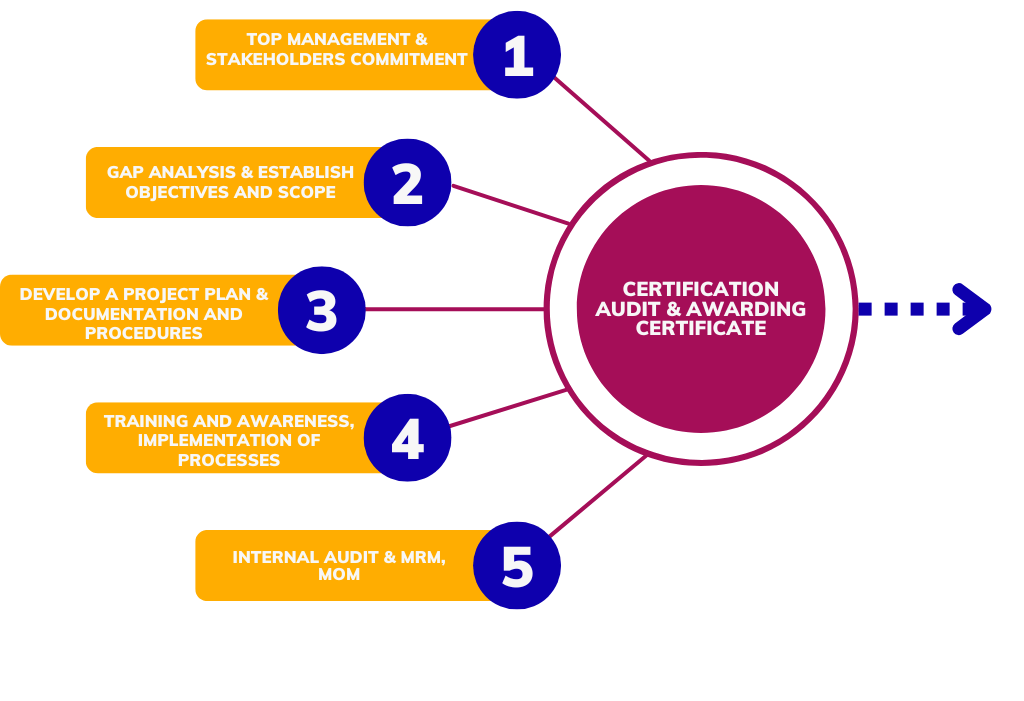
Implementing an ISO standards involves a structured methodology to ensure that the organization effectively meets the requirements of the chosen standard and achieves certification. Sometimes defined methodology may vary depending on factors such as the size of the organization, its industry, and the complexity of the ISO standard being implemented, the following steps provide a basic framework

OUR
Process
1, Determine the ISO Standard
2. Understand the Requirements
3. Training and Awareness
4. Implement the System
5. Internal Audit
6. Certification

Benefits of having ISO Certification
Enhanced Credibility and Reputation
Legal and Regulatory Compliance
Enhanced Customer Satisfaction
Access to Global Markets
Environmental Sustainability
Information Security
Our Achievements and Success
Our Clients





OUR
SERVICES
HACCP Certification Services in Tehran for Seven-Principle Food Hazard Control
Tehran food handlers, processors, caterers and storage operators need a hazard-control plan that identifies significant food safety risks and controls them at the right points.
Seven HACCP principles applied to the real process flow
HACCP certification services in Tehran focus on identifying, evaluating and controlling food safety hazards through the Seven HACCP Principles. The approach is practical, product-specific and process-specific.
HACCP begins with product description, intended use, process flow confirmation and hazard analysis. It then determines critical control points, critical limits, monitoring procedures, corrective actions, verification activities and recordkeeping.
This makes HACCP different from general hygiene documentation. It asks where a significant biological, chemical, physical or allergen hazard can be prevented, eliminated or reduced to an acceptable level.
Qualitcert supports Tehran food businesses with HACCP plan development, flow verification, hazard analysis workshops, CCP documentation, monitoring forms and audit readiness.
Why HACCP Is Important in Tehran Food Activities
Food production, catering, bakery, meat handling, dairy, cold storage, restaurant and retail food activities in Tehran depend on consistent control of hazards.
HACCP is valuable where products move through multiple handling steps and the business must prove that key hazards are managed before food reaches customers.
A strong HACCP plan supports staff training because it explains which steps are critical, what must be monitored and what action is required when limits are not met.
For suppliers serving institutional buyers, hotels or retailers, HACCP certification can provide clear evidence of hazard-control discipline.
HACCP Benefits for Tehran Food Businesses
The main value is targeted control of significant food safety hazards.
Focused hazard prevention
Controls are placed where hazards can actually be prevented or reduced.
Clear monitoring duties
Staff know what to check, how often to check and how to record results.
Faster corrective action
Defined actions reduce confusion when critical limits are exceeded.
Stronger buyer assurance
A documented HACCP plan supports customer audits and supplier approval.
HACCP Applications in Tehran
HACCP works best when the plan is written for the specific product and process.
Catering kitchens
Control cooking, cooling, reheating, holding and cross-contamination hazards.
Bakeries and confectionery
Manage allergen control, foreign matter, baking parameters and packaging hygiene.
Meat and poultry handling
Monitor temperature, sanitation, separation and receiving controls.
Dairy and chilled foods
Control time-temperature exposure, cleaning and product release criteria.
Cold chain logistics
Verify storage temperatures, dispatch checks and corrective action for deviations.
Food retail counters
Manage display temperatures, hygiene, expiry control and handling practices.
How HACCP Certification Readiness Is Developed
The route follows the HACCP principles from hazard analysis to verification records.
Describe product and flow
Confirm ingredients, process steps, intended use and onsite flow diagram.
Conduct hazard analysis
Identify biological, chemical, physical and allergen hazards at each step.
Determine CCPs
Decide where critical control points are needed for significant hazards.
Set critical limits
Define measurable limits such as time, temperature, pH or visual criteria.
Prepare monitoring and actions
Assign monitoring frequency, responsible staff and corrective action steps.
Verify and maintain records
Review monitoring logs, calibrations, validation, verification and plan updates.
Documents and Records for HACCP
HACCP records should show that significant hazards are controlled day by day.
Typical Records
- Product description
- Process flow diagram
- Hazard analysis table
- CCP decision record
- Critical limit sheet
- Monitoring log
- Corrective action form
- Verification checklist
- Calibration record
- HACCP review minutes
HACCP Mistakes to Avoid
HACCP plans lose value when they are copied from another process or not monitored.
- Using a generic flow diagram that does not match the actual kitchen or production line.
- Creating too many CCPs where prerequisite controls would be more suitable.
- Not defining measurable critical limits.
- Keeping monitoring logs without corrective action for deviations.
- Failing to review the plan after ingredient, supplier or process changes.
Related Food Safety Services in Tehran
HACCP can stand alone or support ISO 22000 implementation when a full food safety management system is needed.
For a connected requirement, review ISO 22000 certification services in Tehran to align a full Food Safety Management System with the same teams, records or controls.
For a connected requirement, review ISO 9001 certification services in Tehran to align supplier and process consistency with the same teams, records or controls.
For a connected requirement, review ISO 14001 certification services in Tehran to align waste and chemical control in food facilities with the same teams, records or controls.
HACCP Questions from Tehran Businesses
These answers focus on certification, implementation, documentation, audit readiness and practical business use.
What is HACCP certification in Tehran?
It is certification of a hazard-control system based on the Seven HACCP Principles for food safety.
What are the Seven HACCP Principles?
They are hazard analysis, CCP determination, critical limits, monitoring, corrective action, verification and recordkeeping.
How is HACCP different from ISO 22000?
HACCP focuses on hazard control principles, while ISO 22000 includes HACCP within a broader food safety management system.
Which businesses need HACCP?
Caterers, restaurants, processors, cold stores, bakeries, meat handlers, dairies and food retailers can benefit from HACCP.
What is a CCP?
A Critical Control Point is a step where control is essential to prevent, eliminate or reduce a significant food safety hazard.
What records are required?
Common records include flow diagrams, hazard analysis, CCP monitoring logs, corrective actions, verification and calibration records.
Does HACCP include allergen control?
Yes. Allergen hazards should be considered where ingredients, handling or cross-contact could affect food safety.
Can HACCP support customer audits?
Yes. Buyers often review HACCP plans and monitoring records during supplier evaluation.
When should a HACCP plan be reviewed?
It should be reviewed after product, process, equipment, supplier, ingredient or layout changes, and periodically as part of verification.
How does Qualitcert support HACCP readiness?
Qualitcert helps prepare HACCP plans, monitoring forms, corrective action records, verification methods and audit readiness.
Develop a HACCP Plan for Tehran Food Operations
Share your product flow, ingredients and current monitoring records. Qualitcert can help build a HACCP plan based on the Seven Principles.