

ISO Certifications
Riy
adh
Consulting &
ISO Certifications

-ISO Certification-
HACCP Certification Services in Riyadh
QUALIT
CERT
CONSULTING AND ISO CERTIFICATIONS
In order to assist businesses in the food and beverage sector in establishing strong food safety systems to recognize, evaluate, and manage any risks, QualitCert offers HACCP (Hazard Analysis and Critical Control Points) Certification services in Riyadh. Businesses looking to improve food safety, adhere to legal regulations, and guarantee consumer protection must get HACCP certification. From carrying out in-depth hazard studies and identifying crucial control points to putting monitoring protocols and remedial measures in place, our knowledgeable staff at QualitCert assists customers every step of the certification process. Organizations in Riyadh may show their dedication to food safety, increase consumer confidence, and expand their market reach by obtaining HACCP certification with QualitCert. This will help them establish themselves as reliable suppliers of safe, superior food items in a cutthroat market.
ISO Certification Process – Step by Step Guide
The ISO certification process helps organizations implement international standards to improve quality, safety, efficiency, and compliance. Below is a structured step-by-step ISO certification process followed by professional ISO consultants and certification bodies.
ISO Application
The organization submits an application for ISO certification and defines the scope of certification including departments, processes, and operations.
Gap Analysis
ISO consultants analyze the current management system and identify gaps between existing processes and ISO standard requirements.
ISO Documentation
Preparation of ISO manuals, procedures, policies, risk assessments, and records required to comply with ISO standards.
System Implementation
ISO processes are implemented across departments with employee training, process control, and compliance monitoring.
Internal Audit
Internal auditors review the management system to verify compliance and identify corrective actions before the certification audit.
Management Review
Top management evaluates the effectiveness of the ISO management system and ensures readiness for certification.
Certification Audit
An accredited certification body conducts an external audit to verify compliance with ISO standards.
ISO Certification
After successful audit completion, the organization receives the official ISO certificate demonstrating compliance with international standards.
Surveillance Audits
Annual surveillance audits ensure continuous compliance and improvement of the ISO management system.
Get In Touch


Approach and Methodology used to implement Management System Standard
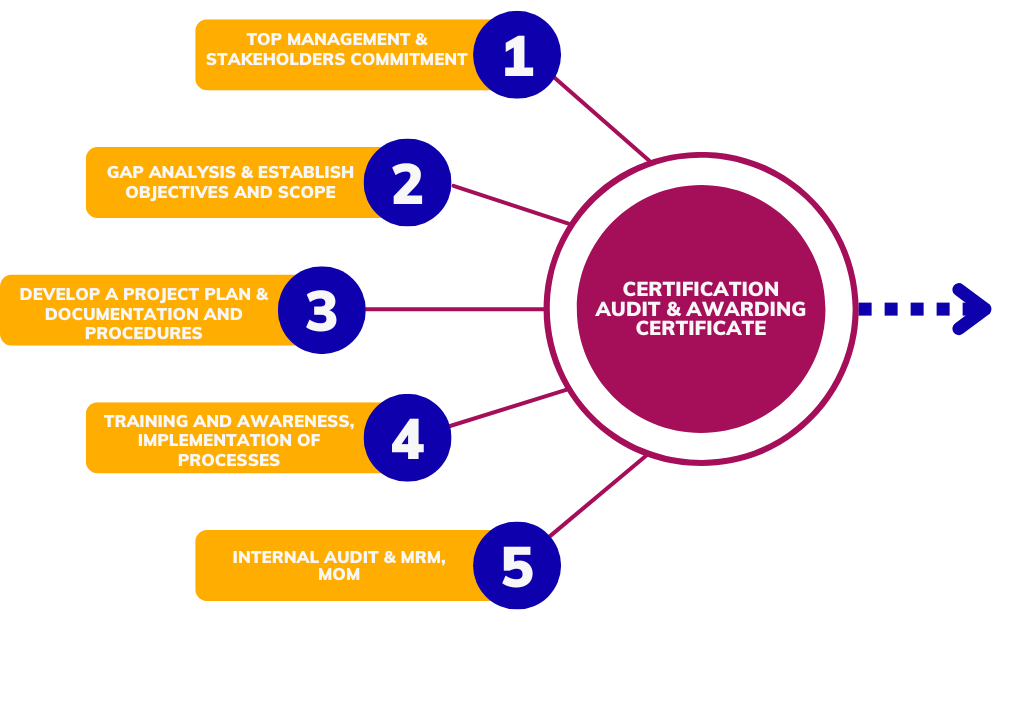
Implementing an ISO standards involves a structured methodology to ensure that the organization effectively meets the requirements of the chosen standard and achieves certification. Sometimes defined methodology may vary depending on factors such as the size of the organization, its industry, and the complexity of the ISO standard being implemented, the following steps provide a basic framework

OUR
Process
1, Determine the ISO Standard
2. Understand the Requirements
3. Training and Awareness
4. Implement the System
5. Internal Audit
6. Certification

Benefits of having ISO Certification
Enhanced Credibility and Reputation
Legal and Regulatory Compliance
Enhanced Customer Satisfaction
Access to Global Markets
Environmental Sustainability
Information Security
Our Achievements and Success
Our Clients





OUR
SERVICES
HACCP Consulting and Readiness Services in Riyadh
Build a practical HACCP plan that helps Riyadh organisations apply the Seven HACCP Principles to significant food safety hazards and critical control points with clear ownership, current evidence and assessment readiness.
Turn Process Knowledge into a Defensible Seven-Principle HACCP Plan
Meat, dairy, bakery, catering and chilled-food operations in Riyadh require process-specific application of all Seven HACCP Principles. Seafood, meat, dairy, bakery, catering and chilled-food operations in Riyadh require process-specific application of all Seven HACCP Principles. Meat, dairy, bakery, catering and chilled-food operations in Riyadh require process-specific application of all Seven HACCP Principles. Seafood, meat, dairy, catering and chilled-food operations in Riyadh require process-specific application of all Seven HACCP Principles. Meat, dairy, bakery, catering and chilled-food operations in Riyadh require process-specific application of all Seven HACCP Principles. Seafood, meat, dairy, catering and chilled distribution in Riyadh require process-specific application of all Seven HACCP Principles. High-volume catering, imported ingredients, chilled distribution and ready-to-eat operations in Riyadh require process-specific application of all Seven HACCP Principles. High-volume catering, imported foods, chilled distribution and ready-to-eat operations in Riyadh require process-specific application of all Seven HACCP Principles. HACCP gives Riyadh organisations a structured way to apply the Seven HACCP Principles to significant food safety hazards and critical control points. The work starts by defining the real operating scope, interested parties and decisions the HACCP plan must support.
Qualitcert maps current practices against requirements and examines how hazard analysis, critical control points and critical limits are handled across teams, suppliers and systems.
Implementation then connects monitoring, corrective action and verification and records with assigned ownership, current records and evidence that controls operate in practice.
The resulting programme is designed for sustained use in settings such as Meat and Poultry Processing, Bakeries and Confectionery and Central Kitchens, not only for the HACCP certification or customer assessment.
Hazard Control for Riyadh's High-Volume Food Operations
Riyadh organisations use HACCP to improve assurance where hazard analysis, critical control points and critical limits cross teams, suppliers or technical systems.
Meat, dairy, bakery, chilled meals and catering operations in Riyadh each require a distinct hazard-analysis and CCP rationale.
Rapid growth, distributed teams and specialist vendors can make critical limits and monitoring inconsistent unless ownership and evidence are designed into normal workflows.
Qualitcert uses the Riyadh operating context to prioritise corrective action and verification and records where they create the clearest business, assurance or compliance value.
Operational Benefits of HACCP in Riyadh
The value comes from making hazard analysis, critical control points and critical limits easier to manage, measure and explain.
Clearer Hazard Analysis
Defines ownership, criteria and evidence for hazard analysis across the agreed scope.
Stronger Critical Control Points
Connects critical control points to practical controls rather than isolated policy statements.
More Reliable Critical Limits
Makes critical limits easier to monitor, test and improve with current records.
Better Monitoring
Supports consistent decisions about monitoring during normal work and change.
Where HACCP Applies in Riyadh
The examples below show how the HACCP plan changes with the operating model, risk profile and evidence needs of each sector.
Catering, Central Kitchens and Chilled Foods
Apply the Seven Principles to receiving, preparation, cooking, chilling, holding and dispatch.
Bakeries and Confectionery
Address allergens, foreign matter, ingredient control and post-bake handling.
Central Kitchens
Define controls for high-volume preparation, cooking, holding, transport and service.
Chilled and Ready-to-Eat Foods
Manage post-process contamination, cooling, storage and shelf-life risks.
Dairy Products
Analyse pasteurisation, cooling, sanitation, storage and distribution hazards.
Food Exporters
Demonstrate process-specific hazard analysis, limits, monitoring and traceable records.
How HACCP Readiness Is Built
The sequence moves from scope and current-state review to operating evidence and preparation for the HACCP certification or customer assessment.
Define Hazard Analysis
Confirm boundaries, responsibilities and criteria for hazard analysis.
Assess Critical Control Points
Review current practices, risks and evidence relating to critical control points.
Design Critical Limits
Create proportionate controls and records for critical limits.
Implement Monitoring
Assign owners, train relevant personnel and operate monitoring.
Verify Corrective Action
Test the effectiveness and consistency of corrective action.
Improve Verification And Records
Close gaps and strengthen verification and records before the HACCP certification or customer assessment.
Evidence Commonly Prepared for HACCP
The final evidence set depends on scope, risk, customer obligations and the selected HACCP certification or customer assessment route.
Typical HACCP Records
- Scope, applicability and responsibility statement
- Hazard Analysis register or criteria
- Critical Control Points assessment records
- Critical Limits procedure or control matrix
- Monitoring operating evidence
- Corrective Action monitoring or test results
- Verification And Records review records
- Competence, awareness and communication evidence
- Internal review, findings and corrective-action log
- Management approval and HACCP certification or customer assessment readiness record
Weak Points to Correct Early
These issues commonly weaken HACCP readiness or create avoidable questions during the HACCP certification or customer assessment.
- Defining hazard analysis without linking it to the real operating scope.
- Assigning no accountable owner for critical control points.
- Documenting critical limits without current operating evidence.
- Leaving changes that affect monitoring outside formal review.
- Approaching the HACCP certification or customer assessment before corrective action and verification and records have been tested.
Verified Saudi Arabia Resources for HACCP Planning
Review ISO certification and sustainable growth across Saudi Arabia for verified national business and sector context relevant to Riyadh organisations.
Review Qualitcert services to review the broader consulting and compliance support portfolio.
Review a direct discussion about HACCP implementation in Riyadh to confirm scope, evidence needs and the appropriate assessment route.
HACCP Questions from Riyadh Organisations
These answers focus on scope, implementation evidence and preparation for the HACCP certification or customer assessment.
What business problem does HACCP address for Riyadh organisations?
It provides a structured way to apply the Seven HACCP Principles to significant food safety hazards and critical control points while creating clear ownership and reviewable evidence.
Which Riyadh operations usually consider HACCP?
It is commonly relevant to Meat and Poultry Processing, Bakeries and Confectionery, Central Kitchens and other organisations with comparable assurance needs.
How should the scope for HACCP be determined?
Scope should reflect the actual sites, services, products, systems, people and third parties needed for the HACCP plan to achieve its intended outcome.
Why is hazard analysis important in HACCP readiness?
Hazard analysis establishes the boundaries and decision criteria needed to make later controls and evidence coherent.
What evidence supports critical control points under HACCP?
Evidence normally includes approved criteria, assigned responsibilities, operating records, monitoring results and actions taken when requirements are not met.
How is critical limits checked before the HACCP certification or customer assessment?
Qualitcert reviews design, implementation and sampled evidence to confirm that critical limits is applied consistently across the agreed scope.
Can HACCP be coordinated with ISO 22000?
Yes. Shared governance, risk, competence, document control, audit and improvement activities can often be aligned without losing service-specific requirements.
What common gap delays HACCP readiness?
A frequent gap is having policies without current evidence that owners understand and operate the controls related to monitoring.
What should management review before the HACCP certification or customer assessment for HACCP?
Management should review scope, performance, open risks, findings, resources, changes and whether corrective action and verification and records are effective.
How does Qualitcert support HACCP implementation in Riyadh?
Qualitcert provides gap review, implementation planning, document and control development, training, internal review and readiness support without acting as the independent assessor.
Build a Practical HACCP Programme in Riyadh
Share your scope, current controls and target HACCP certification or customer assessment. Qualitcert can review gaps and define a proportionate implementation plan.