

ISO Certifications
mozambique
Consulting &
ISO Certifications
-ISO Certification-
HACCP Certification Services in Mozambique
QUALIT
CERT
CONSULTING AND ISO CERTIFICATIONS
Qualitcert’s HACCP Certification Services in Mozambique provide businesses with all-encompassing assistance in meeting international food safety regulations. A methodical strategy to detecting, assessing, and managing food safety risks, HACCP (Hazard Analysis and Critical Control Point) makes sure that goods are fit for human consumption. Qualitcert specializes in helping firms in the food industry with all aspects of the certification process, such as hazard assessment, the creation of crucial control measures, and the deployment of efficient monitoring systems. Their knowledge spans a number of industries, such as food production, processing, and distribution, guaranteeing customized solutions to satisfy demands unique to each area. Businesses in Mozambique may exceed regulatory requirements, increase consumer trust, and obtain a competitive advantage in both domestic and foreign markets by collaborating with Qualitcert.
Get In Touch


Approach and Methodology used to implement Management System Standard
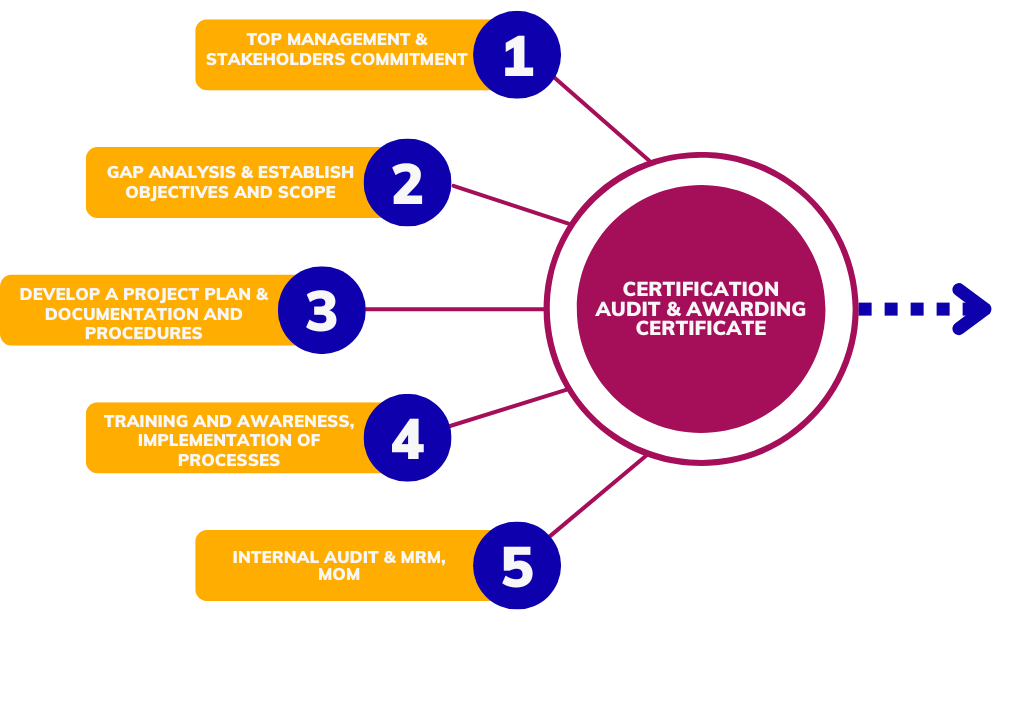
Implementing an ISO standards involves a structured methodology to ensure that the organization effectively meets the requirements of the chosen standard and achieves certification. Sometimes defined methodology may vary depending on factors such as the size of the organization, its industry, and the complexity of the ISO standard being implemented, the following steps provide a basic framework

OUR
Process
1, Determine the ISO Standard
2. Understand the Requirements
3. Training and Awareness
4. Implement the System
5. Internal Audit
6. Certification

Benefits of having ISO Certification
Enhanced Credibility and Reputation
Legal and Regulatory Compliance
Enhanced Customer Satisfaction
Access to Global Markets
Environmental Sustainability
Information Security
Our Achievements and Success
Our Clients





OUR
SERVICES
HACCP Certification Services in Mozambique for Verified Food Hazard Control
HACCP helps Mozambican food businesses identify biological, chemical and physical hazards and control them through the seven HACCP principles.
Base the HACCP plan on the actual product, process and site
HACCP is a preventive method built around seven principles: hazard analysis, critical control point determination, critical limits, monitoring, corrective action, verification and record keeping.
A credible study begins with product description, intended use, process-flow mapping and on-site confirmation. The team then evaluates hazards at each step using scientific and operational evidence.
Critical control points should be limited to steps where control is essential. Monitoring must detect loss of control in time for action, while corrective procedures address both the deviation and affected product.
Qualitcert supports HACCP team development, process studies, hazard evaluation, CCP validation, monitoring forms, verification schedules and implementation readiness.
Why HACCP plans in Mozambique must reflect operating conditions
Seasonal inputs, water quality, equipment condition, temperature exposure and staff practices can make copied hazard plans unreliable.
A critical limit must be measurable and justified. Phrases such as 'cook thoroughly' or 'keep cold' are insufficient without validated time, temperature or concentration criteria.
Monitoring records should prompt action, recording the product, result, time, responsible person and response when a limit is not met.
Verification through record review, calibration, observation, testing and reassessment after change keeps the HACCP plan current.
What a well-designed HACCP plan delivers
HACCP creates value by concentrating resources on the steps where food safety control matters most.
Earlier hazard prevention
Control takes place during processing rather than relying only on final inspection or testing.
Clear operator decisions
Defined limits and actions tell staff exactly when a process is acceptable and what to do when it is not.
Stronger customer evidence
Retailers, hotels, institutions and export buyers can review a documented, verified hazard-control approach.
More focused verification
Calibration, record review, testing and observations are directed at the controls that protect food safety.
Practical hazard-control applications in Mozambique
The HACCP study should be product-specific and sensitive to ingredients, consumers, processing and storage.
Seafood handling
Control time, temperature, ice, water, contamination and cold-chain records.
Cashew and nut processing
Manage foreign matter, roasting, handling, allergens, packing and storage.
Meat and poultry operations
Control contamination, cooking or chilling, sanitation and disposition.
Grain and flour mills
Address incoming grain, mycotoxins, foreign matter, milling and storage.
Beverage production
Manage water treatment, ingredients, filtration, filling and container integrity.
Hotels and catering
Control receiving, thawing, preparation, cooking, holding and service.
Apply the seven principles through a verified process study
The work progresses from accurate product knowledge to monitored CCPs and verified records.
Assemble the HACCP team
Bring together process, food safety, engineering, operations and product knowledge appropriate to the study.
Describe product and use
Document ingredients, processing, packaging, shelf life, storage, distribution and intended consumers.
Map and verify the flow
Create the process diagram and confirm every step on site, including rework, delays and transfers.
Analyse hazards and CCPs
Identify biological, chemical and physical hazards, evaluate significance and determine critical control points.
Set limits and monitoring
Define validated critical limits, monitoring responsibility, frequency, method and immediate correction.
Verify and maintain the plan
Review records, calibrate devices, validate changes, audit implementation and update the study when necessary.
Documents needed to show the seven principles are operating
The plan should allow an auditor to trace each significant hazard to a control decision, monitoring record and verification activity.
Core HACCP documentation
- HACCP team competence
- Product description
- Intended-use statement
- Verified process flow diagram
- Hazard analysis worksheet
- CCP decision records
- Critical-limit justification
- CCP monitoring forms
- Corrective-action records
- Verification and review records
HACCP weaknesses to prevent
Most ineffective plans fail because the preliminary information or control logic does not match actual production.
- Copying hazards and CCPs from another product without a fresh analysis.
- Treating sanitation and basic hygiene failures as CCPs instead of strengthening PRPs.
- Using limits that are convenient but not scientifically validated.
- Recording a deviation without identifying and controlling affected product.
- Calling record review verification while ignoring observation, calibration and plan reassessment.
Related HACCP Services for Mozambican Organisations
For a connected requirement, review ISO 22000 certification services in Mozambique to coordinate shared governance, documentation and management responsibilities.
For a connected requirement, review ISO 14001 certification services in Mozambique where common risks, suppliers or operational controls should be aligned.
For a connected requirement, review ISO/IEC 17025 certification services in Mozambique to reduce duplicated work and build a coherent assurance programme.
HACCP questions from Mozambican food businesses
These answers focus on the seven principles, critical control points, limits, monitoring and verification.
What are the seven HACCP principles?
They are hazard analysis, CCP determination, critical limits, monitoring, corrective actions, verification and documentation or record keeping.
What preliminary steps are completed before the seven principles?
The team is assembled, the product and intended use are described, a flow diagram is prepared and the flow is verified on site.
What is a critical control point?
A CCP is a step where control can be applied and is essential to prevent, eliminate or reduce a significant food safety hazard to an acceptable level.
How is a critical limit different from a target?
A critical limit separates acceptable from unacceptable control. A target may be set more conservatively to help operators act before the critical limit is breached.
Can cleaning be a CCP?
Usually cleaning is managed through prerequisite programmes, although the hazard analysis determines the correct classification for the specific process.
What should happen after a CCP deviation?
The organisation should regain control, identify affected product, decide disposition, investigate the cause and prevent recurrence.
How is a HACCP plan verified?
Verification can include record review, observation, calibration, sampling, internal audit and periodic reassessment of the plan.
When must a HACCP plan be reviewed?
It should be reviewed after changes, incidents, new hazard information or recurring deviations, as well as at planned intervals.
Is HACCP the same as ISO 22000?
No. HACCP is the seven-principle hazard-control method, while ISO 22000 places HACCP-based control inside a wider management system.
How can Qualitcert help with HACCP in Mozambique?
Qualitcert can facilitate the study, review PRPs and flows, develop monitoring and corrective-action records, train teams and support certification readiness.
Develop a HACCP Plan for Your Mozambique Food Process
Share your products, flow diagrams, monitoring records and hazard study. Qualitcert can help apply all seven principles through a site-specific plan.