










Global ISO Certification Consultant Services – Qualitcert

QualitCert Get a Quote
ISO Certifications

tripoli

Consulting &
ISO Certifications
-ISO Certification-

HACCP Certification Consulting Services in Tripoli

QUALIT

CERT

CONSULTING AND ISO CERTIFICATIONS

Qualitcert provides professional HACCP (Hazard Analysis and Critical Control Points) certification consulting services in Tripoli, helping food industry businesses implement effective food safety management systems in compliance with international standards. Their expert team guides organizations through every step, including hazard identification, risk assessment, gap analysis, and system implementation, ensuring full HACCP compliance. By working with Qualitcert, businesses can enhance food safety, improve product quality, and build customer trust while gaining access to local and international markets. Tailored to the specific needs of each company and aligned with Tripoli’s regulatory framework, Qualitcert’s consulting services make the HACCP certification process smooth, efficient, and cost-effective.

Get In Touch

Test
afd9a249 perf wp theme group 8796

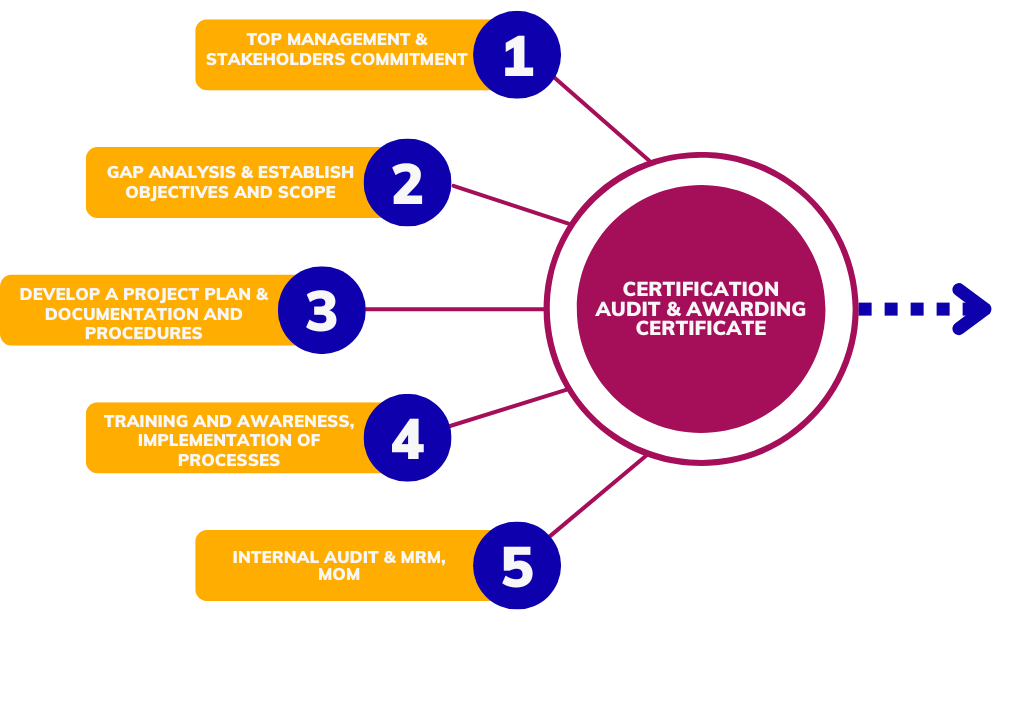
Approach and Methodology used to implement Management System Standard

Colorful Minimalist Linear Steps Circular Diagram 1 e1712599893569

Implementing an ISO standards involves a structured methodology to ensure that the organization effectively meets the requirements of the chosen standard and achieves certification. Sometimes defined methodology may vary depending on factors such as the size of the organization, its industry, and the complexity of the ISO standard being implemented, the following steps provide a basic framework

Ellipse 6 copy
OUR
Process

1, Determine the ISO Standard

2. Understand the Requirements

3. Training and Awareness

4. Implement the System

5. Internal Audit

6. Certification

partner_img
Benefits of having ISO Certification

Enhanced Credibility and Reputation

Legal and Regulatory Compliance

Enhanced Customer Satisfaction

Access to Global Markets

Environmental Sustainability

Information Security

Our Achievements and Success
Professional Experts
0 +
Years Experience
0 +
Projects
0 +
Satisfied Customers
0 %
Our Clients
WhatsApp Image 2023 05 12 at 8.24.31 PM e1684164170667
WhatsApp Image 2023 05 12 at 8.16.53 PM e1684163940587
WhatsApp Image 2023 05 12 at 8.22.55 PM
WhatsApp Image 2023 05 12 at 8.04.13 PM 3 e1684163886384
WhatsApp Image 2023-05-12 at 8.15.32 PM
OUR
SERVICES
ISO 9001 Certification
ISO 45001 Certification
ISO 14001 Certification
ISO 22000 Certification
ISO 13485 Certification
ISO 27001 Certification
ISO 20000-1 Certification
ISO 29001 Certification
Seven HACCP Principles for Food Operations

HACCP Certification Consulting Services in Tripoli for Hazard Control

Tripoli food handlers can use HACCP to identify significant hazards, set critical controls and prove that unsafe food is prevented before it reaches customers.

Hazard control at the process steps that matter

HACCP certification consulting services in Tripoli focus on the Seven HACCP Principles: hazard analysis, critical control point identification, critical limits, monitoring, corrective actions, verification and record keeping.

Unlike a general food hygiene checklist, HACCP is process-specific. A bakery, catering kitchen, cold store and seafood distributor each need a different hazard analysis because the risks, process flow and control points are different.

Qualitcert helps food teams develop process flow diagrams, identify biological, chemical, physical and allergen hazards, determine CCPs, create monitoring forms and prepare verification records.

The goal is simple: control food safety hazards through a practical plan that staff can follow during receiving, preparation, cooking, cooling, storage, delivery or service.

Tripoli Context

How HACCP supports Tripoli food safety

Food operations in Tripoli often manage imported ingredients, local preparation, cold storage, catering delivery and customer-facing service, each with specific hazards.

HACCP is especially valuable when a process includes high-risk steps such as cooking, chilling, reheating, seafood handling, dairy storage, allergen management or bulk meal delivery.

The method requires the food team to understand the actual process flow. If the flow diagram is wrong, the hazard analysis will also be weak. That is why implementation starts by walking through the process and confirming what staff really do.

A good HACCP system does not depend on long theory. It depends on accurate hazard decisions, practical monitoring, staff training and timely corrective action when limits are not met.

Business Value

HACCP benefits for food businesses in Tripoli

HACCP gives food businesses a focused method for preventing hazards rather than reacting after complaints.

Targeted hazard control

The plan focuses attention on the process steps where safety can be lost.

Stronger monitoring discipline

Critical limits and records help staff know what to check and when to act.

Better customer assurance

Buyers and institutions can review evidence that hazards are controlled.

Faster response to deviations

Corrective action rules help prevent unsafe products from continuing in the process.

Industry Applications

Where HACCP is used in Tripoli

HACCP works best when it is tailored to the exact product, process and hazard profile.

01

Catering and event kitchens

Cooking, hot holding, cooling and transport temperatures can be controlled.

02

Seafood and meat handling

Receiving, storage, preparation and chilling hazards can be assessed.

03

Bakeries

Allergen control, foreign material prevention and baking controls can be documented.

04

Juice and beverage preparation

Water quality, sanitation and storage risks can be addressed.

05

Cold chain distributors

Temperature limits, vehicle checks and product segregation can be monitored.

06

Restaurant groups

Branch-level HACCP plans can reduce variation in food safety practices.

Implementation Route

HACCP certification preparation steps

The route follows the Seven HACCP Principles and converts them into usable operational records.

01

Describe product

Define ingredients, intended use, consumers, packaging and storage conditions.

02

Confirm process flow

Prepare and verify the process flow diagram on site.

03

Analyze hazards

Identify biological, chemical, physical and allergen hazards at each step.

04

Set CCP controls

Determine CCPs, critical limits, monitoring methods and corrective actions.

05

Verify the plan

Review monitoring records, calibrations, tests and staff practices.

06

Maintain records

Keep HACCP logs, deviation records, reviews and updates after process changes.

Documentation and Audit Evidence

HACCP records and forms usually needed

HACCP evidence should directly support the control decisions in the plan.

Typical Records

  • Product description
  • Process flow diagram
  • Hazard analysis worksheet
  • CCP decision record
  • Critical limit sheet
  • Monitoring log
  • Corrective action record
  • Verification checklist
  • Calibration record
  • HACCP review minutes
Records should be controlled, current and easy for process owners to maintain during daily work.

Common Mistakes to Avoid

These issues often create delays during implementation, internal audit, certification readiness or customer review.

  • Using one HACCP plan for different products without review.
  • Setting critical limits that staff cannot measure.
  • Keeping monitoring forms but not reviewing deviations.
  • Ignoring allergens during hazard analysis.
  • Failing to update the plan after recipe or equipment changes.
Early correction reduces rework and makes the certification audit more predictable.
Related Tripoli Services

For related requirements, review ISO 22000 food safety management services in Tripoli so food safety hazards, monitoring records and improvement actions stay aligned.

For related requirements, review ISO 9001 quality management consulting services in Tripoli so shared document control, audits and corrective actions can support the wider management system.

For another Tripoli service, see ISO 27001 ISMS consulting services in Tripoli to coordinate documentation, audit readiness and management review evidence.

FAQs

HACCP Questions from Tripoli Businesses

These answers explain HACCP principles, monitoring and hazard-control readiness.

What is HACCP certification?

HACCP certification confirms that a food business has implemented a hazard analysis and critical control point system.

What are the Seven HACCP Principles?

They are hazard analysis, CCP identification, critical limits, monitoring, corrective action, verification and record keeping.

Is HACCP the same as ISO 22000?

No. HACCP focuses on hazard control principles, while ISO 22000 is a broader food safety management system.

What is a critical control point?

A CCP is a step where control is essential to prevent, eliminate or reduce a significant food safety hazard.

What documents are needed for HACCP?

Common documents include product descriptions, flow diagrams, hazard analysis, CCP records, monitoring logs and verification records.

Can restaurants use HACCP?

Yes. Restaurants can use HACCP for cooking, cooling, reheating, storage, allergens and hygiene controls.

How often should a HACCP plan be reviewed?

It should be reviewed after process, ingredient, equipment or supplier changes and at planned intervals.

What happens when a critical limit is exceeded?

The business should follow corrective action rules, control affected product and record the deviation.

Does HACCP require staff training?

Yes. Staff responsible for monitoring and corrective action must understand the plan and records.

How does Qualitcert support HACCP in Tripoli?

Qualitcert supports flow diagrams, hazard analysis, CCP planning, monitoring forms, training and audit readiness.

Speak with Qualitcert

Develop HACCP readiness in Tripoli

Share your food process, menu or product categories. Qualitcert can help build a HACCP plan based on the Seven Principles and real hazard control.

Request a Consultation →
Scroll to Top