








Global ISO Certification Consultant Services – Qualitcert

QualitCert Get a Quote
ISO Certifications

Salalah

Consulting &
ISO Certifications
-ISO Certification-

HACCP Certification Services in Salalah

QUALIT

CERT

CONSULTING AND ISO CERTIFICATIONS

In Salalah, Qualitcert provides expert HACCP (Hazard Analysis and Critical Control Points) certification services to businesses in the food sector, assisting them in putting in place efficient food safety management systems. To ensure compliance with worldwide HACCP standards, our knowledgeable consultants help firms identify and evaluate food safety concerns, develop essential control points, and put preventive measures in place. From the first gap analysis and system design to training and audit preparation, we offer complete support throughout the certification process, making sure your operations are secure, hygienic, and able to produce food items of the highest caliber. Companies in Salalah may show their dedication to food safety, boost consumer confidence, and comply with regulations by obtaining HACCP certification. This will give them a competitive advantage in both domestic and international markets. Qualitcert’s customized methodology guarantees a

Please Reach Us Today

Test
Consultants Consultants
afd9a249 perf wp theme group 8796 Consultants Consultants

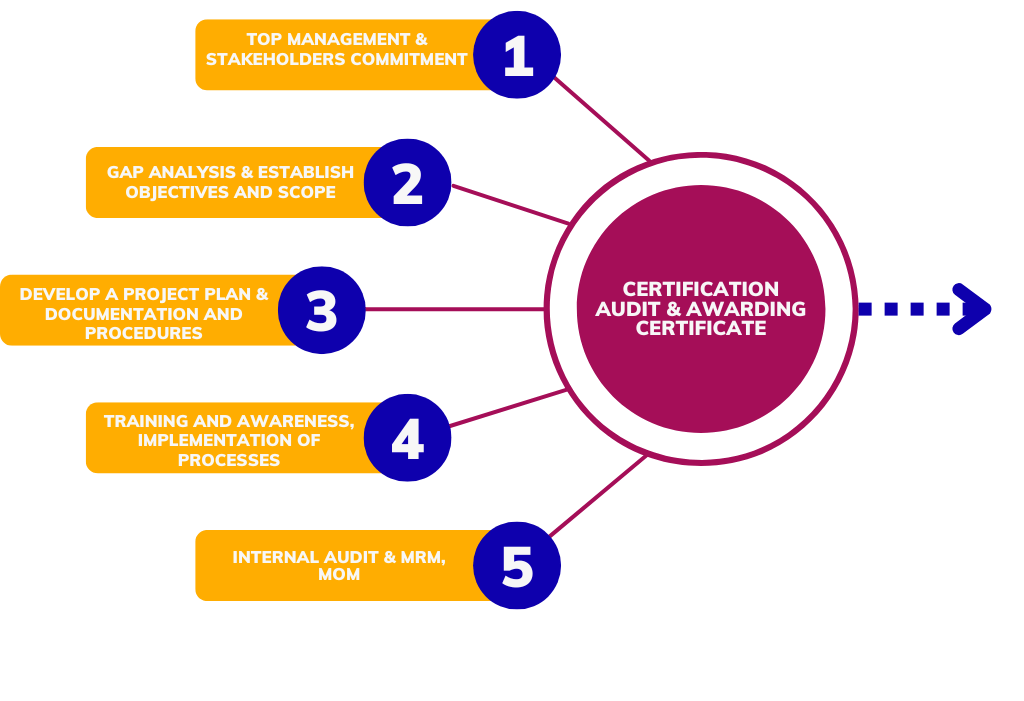
Approach and Methodology used to implement Management System Standard

Colorful Minimalist Linear Steps Circular Diagram 1 e1712599893569 Consultants Consultants

Implementing an ISO standards involves a structured methodology to ensure that the organization effectively meets the requirements of the chosen standard and achieves certification. Sometimes defined methodology may vary depending on factors such as the size of the organization, its industry, and the complexity of the ISO standard being implemented, the following steps provide a basic framework

Ellipse 6 copy Consultants Consultants
OUR
Process

1, Determine the ISO Standard

2. Understand the Requirements

3. Training and Awareness

4. Implement the System

5. Internal Audit

6. Certification

partner_img Consultants Consultants
Benefits of having ISO Certification

Enhanced Credibility and Reputation

Legal and Regulatory Compliance

Enhanced Customer Satisfaction

Access to Global Markets

Environmental Sustainability

Information Security

Our Achievements and Success
Professional Experts
0 +
Years Experience
0 +
Projects
0 +
Satisfied Customers
0 %
Our Clients
WhatsApp Image 2023 05 12 at 8.24.31 PM e1684164170667
WhatsApp Image 2023 05 12 at 8.16.53 PM e1684163940587
WhatsApp Image 2023 05 12 at 8.22.55 PM
WhatsApp Image 2023 05 12 at 8.04.13 PM 3 e1684163886384
WhatsApp Image 2023-05-12 at 8.15.32 PM
OUR
SERVICES
ISO 9001 Certification
ISO 45001 Certification
ISO 14001 Certification
ISO 22000 Certification
ISO 13485 Certification
ISO 27001 Certification
ISO 20000-1 Certification
ISO 29001 Certification
Scope, Evidence and Accountability

HACCP Readiness in Salalah for Operationally Stronger Hazard control plan

Haccp development, implementation and audit-readiness support for Salalah, Oman should connect requirements with actual operating evidence, responsible owners and a scope that reflects the organization’s products, services and risks.

Use current operations as the baseline for HACCP

Salalah's food service, seafood, cold-chain, retail preparation and processing activities can face temperature, hygiene, allergen and cross-contamination risks. A workable HACCP plan has to reflect the actual process flow and equipment at the site.

A credible HACCP programme is built by connecting requirements with business decisions. Its practical purpose is to identify significant food-safety hazards, establish effective control measures and maintain monitoring, corrective action and verification across the food process.

That HACCP connection requires controlled scope, competent people, measurable criteria and records that show the control was performed at the time it mattered. Retrospective HACCP file-building usually creates inconsistency and weakens confidence.

HACCP certification requirements vary by customer, scheme, regulator and certification provider. The plan should be based on recognized HACCP principles and the actual food operation. For the Salalah operation, the readiness work should leave a hazard control plan that can be sustained after assessment rather than a temporary file prepared for one audit.

Salalah Scope Decisions

Operational Context for HACCP Across Salalah

In Salalah, HACCP can intersect with hotel kitchens and catering, seafood handling and bakeries and central kitchens. For HACCP, the implementation emphasis should follow the risks and obligations of the specific Salalah operation.

City-specific readiness for HACCP starts by understanding the site, customers, workforce, suppliers and systems that the Salalah operation relies on.

The most important early decisions usually involve accurate process flow and hazard analysis and critical limits and monitoring methods. These determine where evidence should come from and which roles need to participate in the HACCP programme.

The remaining priorities—corrective action for loss of control and verification and record reliability—should then be embedded into routine reviews so the hazard control plan keeps working after the initial readiness phase.

Control Benefits

Where HACCP Can Strengthen Control and Decision-Making

The strongest value appears when HACCP improves decisions and records that teams already rely on, rather than creating a parallel compliance routine.

Focused food-safety decisions

Teams can distinguish significant hazards from routine operational issues and apply controls where they matter.

Clearer shift responsibilities

Monitoring tasks, limits and escalation rules can be assigned to named roles.

Faster incident response

Defined corrective actions can reduce uncertainty when a limit is missed.

Better audit traceability

Monitoring, verification and review records can show how the plan operates over time.

Salalah Applications

How Different Salalah Sectors Use HACCP

The examples below show how HACCP changes emphasis according to the work being performed; the final scope should always follow the organization’s actual activities.

01

Hotel kitchens and catering

Cooking, cooling, holding, allergen and cross-contamination controls can be built around menu processes.

02

Seafood handling

Receiving temperature, icing, processing hygiene and storage risks can be assessed step by step.

03

Bakeries and central kitchens

Ingredient control, baking, cooling, filling and storage can be covered in one process-specific plan.

04

Cold stores

Temperature, product integrity and dispatch controls can be monitored against defined limits.

05

Retail food preparation

High-risk preparation areas can use practical monitoring and sanitation records.

06

Food manufacturers

Hazard analysis can connect raw-material risks with process controls and finished-product release.

From Gap to Evidence

Building HACCP Step by Step

This sequence keeps the hazard control plan tied to scope, implementation evidence and management ownership instead of treating preparation as a last-minute document exercise.

01

Describe products and consumers

Capture ingredients, intended use, vulnerable consumers, storage and distribution conditions.

02

Verify the process flow

Walk the site and confirm that the flow diagram matches actual handling and rework steps.

03

Analyze hazards

Assess biological, chemical, physical and allergen hazards at each relevant stage.

04

Set critical controls

Define CCPs or other control measures, limits, monitoring, responsibility and corrective action.

05

Validate and verify

Confirm controls are capable of managing the hazard and periodically check they remain effective.

06

Review after change

Reassess the HACCP plan when products, equipment, suppliers or process steps change.

What to Prepare

Documents That Show HACCP Is Operating

Strong hazard-control evidence is current, attributable to the right process and detailed enough for another person to understand what happened.

Records That Support Readiness

  • Product descriptions
  • Process flow diagrams
  • Hazard analysis worksheet
  • CCP decision records
  • Critical limit justification
  • Monitoring forms
  • Corrective action records
  • Validation evidence
  • Verification schedule and results
  • HACCP review history
Use controlled records that match the Salalah scope; obsolete, copied or out-of-scope files can weaken the clarity of the HACCP evidence trail.

Where Evidence Often Breaks Down

These issues can make a HACCP programme look documented while leaving important operational questions unanswered.

  • Using a generic flow diagram that omits rework, storage or delay steps.
  • Choosing CCPs without a defensible hazard analysis.
  • Setting limits that staff cannot measure reliably during production.
  • Recording monitoring results without acting on deviations.
  • Failing to review the plan after a recipe, supplier or equipment change.
Finding these weaknesses during implementation gives owners time to correct the process and generate reliable hazard-control evidence before formal assessment activity.
Where Controls Overlap

Where controls overlap with ISO 22000 services in Salalah, a Salalah HACCP programme can share owners or records without treating the two requirements as interchangeable.

For HACCP, a connected requirement may be FSSC 22000 services in Salalah. Coordinate FSSC 22000 with HACCP where shared risks, suppliers or management routines make that useful.

Organizations extending beyond HACCP can also review ISO 9001 services in Salalah; integration at process level can reduce duplicate work while preserving the distinct purpose of HACCP.

Decision Support

HACCP Readiness Questions and Clear Answers

These answers clarify scope, evidence and practical preparation for organizations considering HACCP in Salalah.

What should a Salalah organization define first for HACCP?

For HACCP, start with the business objective, scope, sites, services or products involved, responsible owners and evidence already available. Early attention should also go to accurate process flow and hazard analysis.

What is the main purpose of HACCP?

The practical HACCP purpose is to identify significant food-safety hazards, establish effective control measures and maintain monitoring, corrective action and verification across the food process.

Which HACCP evidence deserves early review?

Review HACCP records connected to critical limits and monitoring methods and corrective action for loss of control, then test whether they are current, approved and consistently used.

Can Qualitcert issue the final HACCP approval?

Qualitcert can support HACCP implementation and readiness; the formal external assessment or certification decision is made by the relevant independent assurance body.

How do we know a HACCP scope is too broad?

A HACCP scope needs refinement when teams cannot clearly identify included activities, owners, systems, sites and interfaces before documentation expands.

What makes an internal HACCP review useful?

An internal HACCP review should sample real work, follow evidence across process steps and verify that identified gaps trigger correction and root-cause action.

Can existing procedures be reused for HACCP?

Existing procedures can support HACCP when they match the required outcome and actual practice; effective controls do not need to be replaced merely to make the system look new.

How should third parties be handled within HACCP?

For HACCP, include suppliers, contractors or service providers when they affect scope, then apply proportionate evaluation, contractual and monitoring controls.

What should management review before a HACCP external assessment?

Before a HACCP external assessment, management should review performance, open risks, objectives, incidents or nonconformities, resources, audit results and major changes.

How can a Salalah team keep HACCP active after assessment?

Keep HACCP ownership inside normal Salalah operations, review relevant indicators on a planned cadence and update controls whenever services, products, technology, people or obligations change.

Review the Scope

Make the Next HACCP Step Clear and Evidence-Based

Start with the actual food process, product range and existing monitoring records to build a HACCP plan that staff can operate in Salalah.

Review Your Current Scope →
Scroll to Top